
Can a metal detector detect gold? Yes, with real limits. This guide covers how detectors actually sense gold, what your target ID number means, which settings and frequencies help, and how deep you can realistically expect to find it. If you are shopping for a machine built for this, our best metal detector for gold guide covers specific picks.
DetectorBrief is a participant in the Amazon Services LLC Associates Program, an affiliate advertising program designed to provide a means for sites to earn advertising fees by advertising and linking to Amazon.com.
Quick answer: Yes. Most conventional metal detectors can detect gold jewelry and sufficiently large gold nuggets under suitable conditions. Tiny nuggets, fine chains and flakes are much harder to detect. Your detector, its settings, the target’s shape, and the ground all determine what you can actually find.
Rings & chains
Found almost anywhere people spend time outdoors: beaches, parks, sports fields, old swimming holes.
Difficulty: easy to moderate (thin chains are harder)
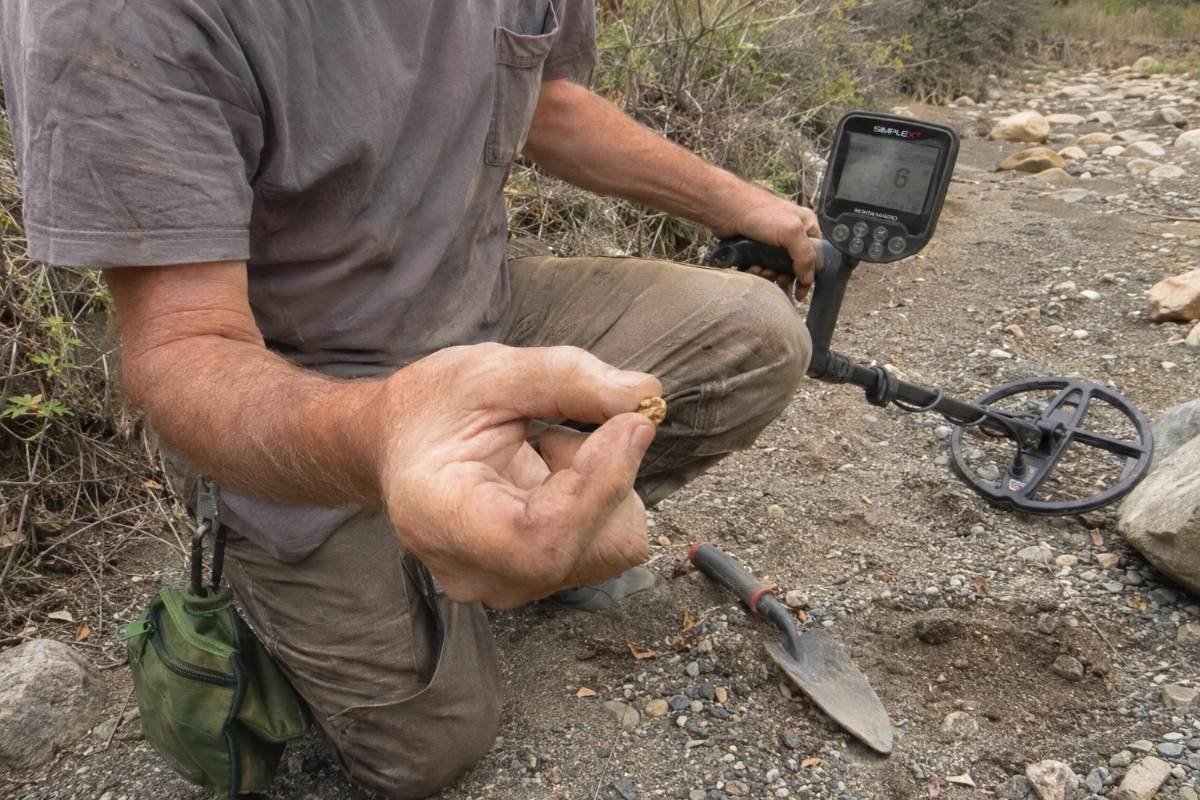
Natural nuggets
Found in old mining areas, dry creek beds and mineralized ground, usually small and irregular.
Difficulty: moderate to difficult, size-dependent
Fine gold & flakes
Tiny flakes are usually found by panning rather than detecting, even with specialized gear.
Difficulty: very difficult to extremely difficult
Table of Contents
Can a regular metal detector find gold?
Most conventional, general-purpose metal detectors can detect gold jewelry and sufficiently large gold nuggets under suitable conditions. Pure gold is a good electrical conductor, close to copper and silver, and a detector responds to a target’s electrical and magnetic behavior, not to what metal it happens to be.
Tiny nuggets, fine chains, and small flakes are a different story. They are much harder to detect with a standard machine, which is why dedicated gold detectors and different techniques exist for serious prospecting.
Why gold can be difficult to detect
Reliable gold detection depends on more than the type of metal. It responds to the electrical and magnetic behavior of the entire target: its mass, shape, orientation under the coil, and the mineral content of the ground around it. Small mass, thin or irregular shapes, and mineralized ground are the main reasons gold is difficult to detect, not impurities in the gold itself.
A small gold nugget may produce a weak electromagnetic response even though gold is a good conductor. A thin ring or chain presents a small cross-section to the coil depending on its orientation, which can make an otherwise detectable piece of jewelry easy to miss. Heavily mineralized ground, common in many gold-bearing areas, adds background noise that can mask a weak, legitimate target signal. All three factors matter more than whether the gold is 24 karat or 10 karat.
Gold nuggets vs. rings, chains and flakes
Gold alloys vary in their electrical properties, but karat alone cannot predict a target’s ID number. A thin chain can be difficult to detect because each individual link is small and produces a weak response on its own, even though the clasp or a pendant on the same chain may be much easier to detect. Treat a "chain" as several small targets linked together, not one large one.
Natural nuggets usually turn up in old mining areas, dry creek beds, and mineralized ground in the western United States. They tend to be small, irregular, and low-mass, which is exactly the combination a detector struggles with most. Finding them reliably usually means a detector designed for gold prospecting and a lot of patience; our gold panning guide is still the more reliable starting point for very fine gold.
Gold jewelry turns up almost anywhere people spend time outdoors: beaches, parks, sports fields, and old swimming holes. A general-purpose detector set up correctly can detect many types of gold jewelry, and our beach metal detector guide covers wet salt-sand conditions specifically, since saltwater changes how a detector behaves.

What number is gold on a metal detector?
There is no universal gold number, and any guide that gives you one single figure is oversimplifying. Target ID scales differ by brand and model, and manufacturers’ manuals make it clear that gold can land almost anywhere on the scale, depending on its size and shape. Two verified, manufacturer-documented examples below show just how differently this plays out model to model.
| Detector | Documented gold example | Source |
|---|---|---|
| Garrett AT Gold | Small nuggets typically indicate 40 to 60 on its Digital Target ID scale. Very tiny nuggets may give no numeric reading at all. | AT Gold owner’s manual, p.14-15 |
| Minelab Gold Monster 2000 | Lists 00 to 15 for small gold nuggets, foil, lead shot and small iron fragments on its 00-99 scale. The manual itself notes gold "can potentially show at any Target ID number depending on size and shape." | Gold Monster 2000 manual, p.12 |
Never transfer a target ID reading from one model to another. A 45 on a Garrett and a 45 on a Minelab are not the same measurement, because each brand defines and calibrates its own scale.
Why your discrimination settings might be hiding gold
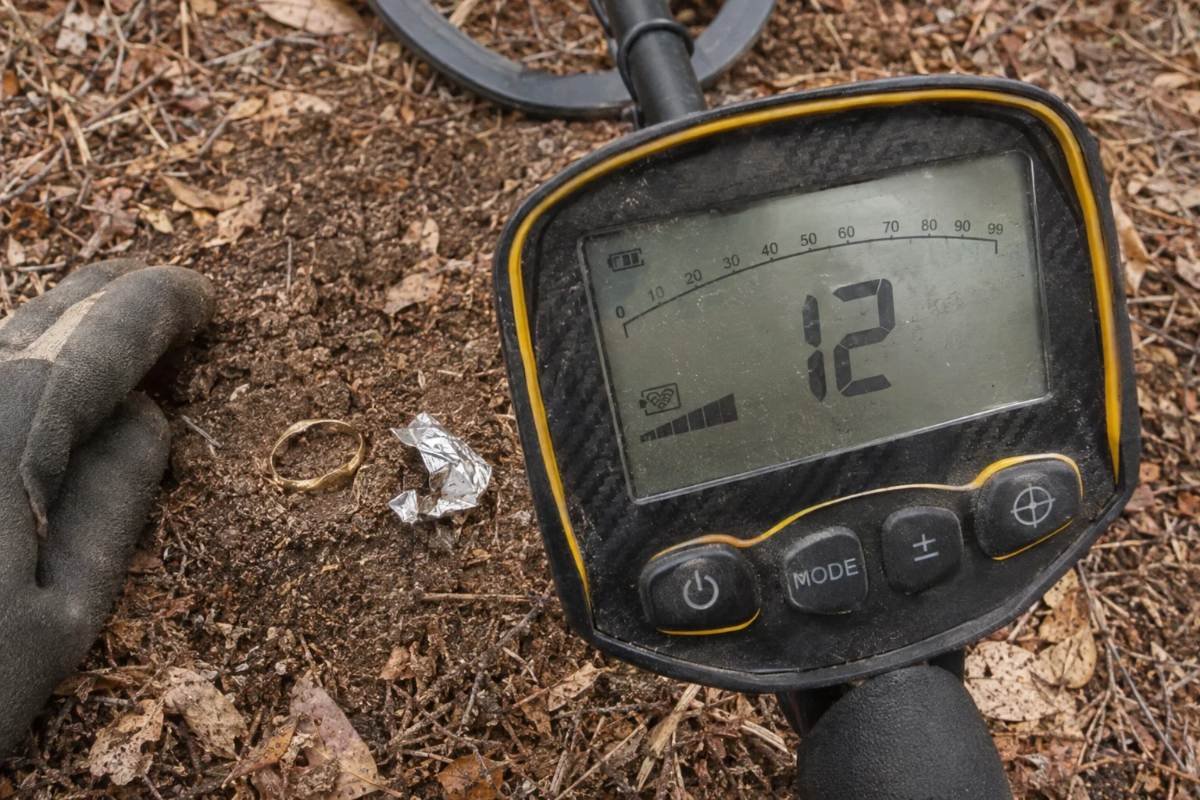
Incorrect discrimination settings are a common reason detectorists miss gold. The setting tells your detector to ignore certain nonferrous conductivity ranges, usually to cut down on signals from foil and pull tabs. Gold frequently overlaps with that same nonferrous trash range, so rejecting those signals can reject real gold too. This is separate from ferrous (iron) discrimination, which targets a different category of junk. Iron discrimination can also cause missed gold targets when weak signals are misclassified, particularly in mineralized ground. For dedicated nugget hunting, use minimal discrimination or an appropriate all-metal mode when ground conditions permit. Depending on the model, discrimination may reject ferrous or nonferrous target categories, or both, so check your own detector’s manual for how its specific discrimination controls are organized.
Garrett’s AT Gold manual advises against its DISC 2 setting for nugget hunting and recommends running the detector in All Metal mode in mineralized ground, especially for tiny nuggets. Most experienced gold hunters run little to no discrimination and dig every repeatable signal, then sort out the junk by hand. Not every gold target will repeat cleanly on a second pass, so do not assume a single solid hit is the only kind worth digging where that is appropriate on your ground.
Illustrative target difficulty (ordinal ranking, not a measurement)
This is a relative ordinal ranking (1 = easiest, 5 = hardest), not measured data or a percentage scale. Actual difficulty changes with your specific detector, soil and target orientation.
VLF vs. multi-frequency vs. pulse induction
Most detectors sold today are single-frequency VLF (very low frequency) machines, and they can detect gold jewelry well in ordinary soil. Multi-frequency and pulse induction (PI) are technologies, not just alternate frequency bands, and each handles mineralized ground differently.
A multi-frequency detector like the Minelab Equinox 900 transmits several frequencies at once through its Multi-IQ technology, so you get the benefits of more than one frequency without switching. It also offers individually selectable single frequencies and a dedicated Gold search mode built for low-conductivity targets in mineralized ground.
Pulse induction detectors, such as the Minelab GPX 6000, read targets in a fundamentally different way. Pulse induction detectors generally handle heavily mineralized ground better than conventional VLF detectors; however, ground conditions can still affect their stability and detection performance. That is why PI machines dominate serious nugget hunting in highly mineralized western ground, even though most PI detectors give little or no numeric target ID and discriminate less precisely than a VLF or multi-frequency machine. Our pulse induction guide covers the trade-offs in more depth.


Conceptual signal illustrations, not measured waveforms. Specifications are based on manufacturer-published documentation; see the sources section below.
Comparing more than these three?
Our full buying guide to the best metal detectors for gold ranks six models side by side, including a budget VLF pick below the AT Gold and other advanced options.
Beyond the detector itself, a few inexpensive accessories make gold-specific hunting meaningfully easier. None are required to get started, but each solves a real problem: pinpointing inside the hole without re-swinging the whole coil, sifting dirt without feeding the detector a false signal, and actually panning out what you find.


Best frequency for detecting gold
There is no single frequency where gold detection "starts." Garrett’s own frequency guide gives an overall range of roughly 18 kHz to 71 kHz and above, but its band-by-band breakdown starts usefully lower, around 15 kHz, and leaves the 20-40 kHz stretch uncharacterized—a genuine gap in that source, not a claim we are making ourselves. Treat every band below as a broad tendency, not a guaranteed threshold: ground conditions and target size matter more than the number on the frequency dial. See Garrett’s own frequency guide for the source data behind this table.
| Frequency / technology | General tendency |
|---|---|
| 5-15 kHz | Not recommended for gold by Garrett’s own guide; tuned for coins and larger, higher-conductivity targets. |
| 15-20 kHz | Entry-level gold prospecting; moderately sized nuggets and gold jewelry (Garrett). |
| 20-40 kHz | Not specifically characterized in Garrett’s published guide — a real gap in the source data. Treat any specific claim about this exact range with caution. |
| 40-70+ kHz | Best for fine gold: tiny nuggets, chains, earrings and flakes (Garrett). |
| Simultaneous multi-frequency | Transmits several frequencies at once (e.g. Minelab Multi-IQ); versatile across varying targets and ground types rather than tuned to one band. |
| Pulse induction | No fixed kHz rating; built to handle heavily mineralized ground rather than tuned to a frequency tier. Not directly comparable to the VLF bands above. |
Higher frequencies improve sensitivity to small, low-conductivity gold, but that sensitivity comes at a real stability cost: Garrett’s own guide notes higher-frequency detectors are more sensitive to ground mineralization and lose some depth penetration compared to lower frequencies, and that careful ground balance becomes more critical as frequency rises. In heavily mineralized ground, a lower-frequency VLF or a pulse induction detector can outperform an ultra-high-frequency model even though the high-frequency machine is nominally more "sensitive." Multi-frequency and pulse induction detectors are technologies for managing that trade-off, not simply higher-numbered frequency bands.
How deep can a metal detector detect gold?
There is no universal gold detection depth. Size, shape, orientation, coil size, the detector itself, its settings, and the soil all factor in. A tiny nugget may only be detectable in the top few inches, while a larger nugget or a substantial ring can be found much deeper under favorable, low-mineralization conditions. Do not trust any claim of a specific depth that is not tied to documented test conditions, since depth claims without stated targets and soil are difficult to evaluate without documented test conditions.
Metal detector settings for gold
| Setting | Jewelry | Nuggets |
|---|---|---|
| Mode | Jewelry or a suitable general mode | Gold or All Metal |
| Discrimination | Low | Minimal or off |
| Sensitivity | Highest stable setting | Highest stable setting |
| Ground balance | As supported by your model | Adjusted or tracked |
| Coil | General-purpose or small | Small, for tiny targets |
| Sweep | Slow, overlapping | Slow, overlapping |
Highest stable sensitivity means the highest setting your detector can hold without constant false signals from ground noise, rather than automatically selecting maximum sensitivity. Use a beach or saltwater mode on wet salt sand where your model supports one. Gold Prospecting mode is tuned for mineralized ground, and is not automatically the best choice for beach jewelry in sand that is not heavily mineralized.
How to Test Your Metal Detector for Gold
You can evaluate your detector’s response to different gold targets using a simple controlled test. Comparing gold jewelry with common aluminum trash helps you understand how your detector responds before you begin searching outdoors. We have not published our own test results yet, and we will not invent them; below is the exact protocol, including the fields to record, plus a blank table if you want to run this yourself.
- Gather a 10K or 14K gold ring, a thin gold chain, a piece of foil, an aluminum pull tab, a US nickel and a US quarter.
- Record the detector model, mode, sensitivity, coil size, and ground balance setting (if your model supports it) used for each pass.
- Test each target in air first, then in controlled soil, and keep the two results separate.
- Record target dimensions, orientation, burial depth, and distance from the coil.
- Note the target ID range shown and whether the signal repeats on a second, slower pass.
- Record misses as well as hits. A protocol that only reports successes is not a real test.
- Photograph the setup and the readout for each test.
Running this yourself? Use this blank table to record your own results — print the page or copy the table into a notes app before you head out.
| Target | Medium (air/soil) | Depth | Target ID shown | Repeats on 2nd pass? | Hit / Miss |
|---|---|---|---|---|---|
Where to look and how to obtain permission
Permission, land ownership, mineral claims and local rules all matter, and they vary by state, county and land manager. Always verify the applicable rules directly with the land manager before you dig, since a universal legal assurance is not something anyone can honestly give you. Our guide to where you can legally metal detect covers how to check this for a specific location. Fill in any holes you dig where that is permitted, and stay off protected archaeological sites.
Getting better results with the detector you already own
- Lower discrimination or dig more nonferrous signals in areas known for gold, since discrimination rejects gold along with junk.
- Ground balance your detector properly before you start; mineralized soil can interfere with target readings.
- Use a smaller coil for better sensitivity to small, low-mass targets like nuggets and thin chain links.
- Try a higher-frequency setting or a Gold mode if your detector offers one.
- Sweep slowly and overlap each pass, since a weak gold signal is easy to walk past at normal detecting speed.
Once you dig something that might be gold, do not guess. Our guide to telling if gold is real walks through simple tests you can do at home before deciding whether to keep or discard the find.
Frequently asked questions
Can a regular or cheap metal detector find gold?
Yes, a general-purpose detector can find gold jewelry and larger nuggets under suitable conditions. It will struggle more than a dedicated gold detector with tiny nuggets, fine chains and flakes, and with heavily mineralized ground.
Will a metal detector find gold rings?
Yes, rings are usually among the easier gold targets to detect because of their size and shape. A thin band can still be harder to detect than a thick one, and a ring with stones or a mixed-metal setting can read differently than a solid gold band.
Can a metal detector find a gold chain?
It depends on the chain. Thick chains and chains with a solid clasp or pendant can be found, but fine, delicate chains made of many small links are among the hardest gold items to detect because each link produces a weak signal on its own.
Does a metal detector detect gold nuggets?
Small, irregular gold nuggets can be more difficult to detect than many gold rings, particularly in mineralized soil. Detection difficulty depends on target size, shape, orientation, detector sensitivity and ground conditions. Larger nuggets detect more easily and at greater depth than small ones.
Can a metal detector find gold flakes?
Very fine flakes are extremely difficult for any metal detector, including dedicated gold detectors, because of their tiny mass. Most prospectors recover fine flakes by panning rather than detecting.
What target ID number is gold on a metal detector?
There is no single universal number. On a Garrett AT Gold, small nuggets typically read 40 to 60. On a Minelab Gold Monster 2000, small gold reads 00 to 15 on its 00-99 scale. Numbers are not comparable between brands, and gold can read outside these examples depending on its size and shape.
Why does my detector not find gold even with discrimination on?
Discrimination settings usually reject a range of nonferrous conductivity to filter out foil and pull tabs. Small nuggets and some gold jewelry fall into that same range, so discrimination can filter out real gold along with the trash.
How deep can a metal detector find gold?
There is no fixed depth. It depends on the size and shape of the target, your coil, your detector and settings, and the ground. A tiny nugget may only be found in the top few inches, while a larger nugget or ring can be found much deeper in favorable soil.
Sources and technical references
The target ID, frequency and specification claims in this guide are drawn from the following manufacturer manuals and published specification pages, verified directly rather than copied from secondary sources:
- Garrett AT Gold instruction manual (PDF) – digital target ID ranges, frequency-shift adjustment, ground balance and discrimination guidance.
- Minelab Gold Monster 2000 instruction manual (PDF) – 00-99 target ID scale and operating frequency range.
- Garrett’s frequency guide for gold detection – source for the frequency-range table above.
- Minelab Equinox 900 product page – Multi-IQ simultaneous multi-frequency specifications and Gold mode.
- Minelab GPX 6000 tech specs – GeoSense-PI technology and weight.
- Garrett Axiom user manual – confirms Ultra-Pulse technology, 1,500 Hz adjustable pulse rate, automatic EMI cancellation, no numeric target ID, and 4.2-4.7 lb weight range by coil.
Target ID numbers and frequency figures vary by brand, model and firmware version; always check your own detector’s manual rather than assuming another model’s numbers apply.
So, can a metal detector detect gold? Yes, but successful detection depends on several factors. Run the right settings for the target you are chasing, understand what your detector’s target ID actually means for that specific model, and choose detector technology suited to your ground conditions. For a machine built around these trade-offs from the start, see our best metal detector for gold guide.