
To tell if gold is real, start with the stamp. A karat mark like 14K or 585 is a good sign, while GF, GP, or RGP means the piece is only gold-filled or plated. Next, try a magnet, since gold is not magnetic. For a nugget, check that it is soft enough to dent and leaves a yellow streak, not a black one. For a firm answer, test the density, use an acid test kit, or take it to a jeweler for an electronic or X-ray test.
This guide on how to tell if gold is real walks through each test, from the quickest to the most accurate, from free at-home checks to lab tests, and explains what each one can and cannot prove. It also has a density calculator for rings and nuggets. Facts come from the Federal Trade Commission (FTC), the U.S. Geological Survey (USGS), and the Gemological Institute of America (GIA). We have not tested the products below ourselves.
DetectorBrief is a participant in the Amazon Services LLC Associates Program, an affiliate advertising program designed to provide a means for sites to earn advertising fees by advertising and linking to Amazon.com.

Quick Links
Check the Stamp First
Look on the inside of a ring band or near the clasp of a chain with a 10x loupe. Karat is a measure of purity out of 24 parts. The FTC explains that 14K gold is 14 parts gold mixed with 10 parts other metal. Many pieces use a three digit number instead, which shows the gold content in parts per thousand.
| Karat stamp | Gold content | Number stamp |
|---|---|---|
| 10K | 10/24, about 41.7% | 417 |
| 14K | 14/24, about 58.3% | 583 or 585 |
| 18K | 18/24, 75% | 750 |
| 22K | 22/24, about 91.7% | 916 or 917 |
| 24K | Pure gold | 999 |
Plated and filled pieces carry their own marks. Under the FTC Jewelry Guides, these are not solid gold:
- Gold filled (GF): a layer of gold that makes up at least 1/20 of the total weight.
- Rolled gold plate (RGP): a thinner layer, at least 1/40 of the weight.
- Gold electroplate (GEP): a very thin coat, at least 0.175 microns thick. GP (gold plated) is a general mark for plating.
- Heavy gold electroplate (HGE): a thicker plated coat, at least 2.5 microns.
- Vermeil: sterling silver coated with at least 2.5 microns of 10K or better gold.
In the U.S., the FTC treats 10 karat as the lowest purity that can be called gold. A stamp is a good start, not proof. Fake pieces can carry fake stamps, and real gold can have a worn or missing mark, so keep testing if the piece matters.
The Magnet Test
Gold is not magnetic. Hold a strong magnet, like a neodymium magnet, against the piece. If the whole piece jumps to the magnet, it is not solid gold. Check the clasp separately, since gold dealers point out that clasp springs are often steel and will pull even on a real chain.
A piece that does not stick has only passed the first round. Brass, copper, and tungsten fakes are not magnetic either, so a magnet can rule a piece out but never prove it is gold.
Gold Nugget or Fool's Gold?
If you dug up a shiny yellow lump or found flakes in your pan, the most common look-alike is pyrite, also called fool's gold. Geology.com lists a few quick ways to tell them apart:
- Shape: pyrite often forms sharp crystals with flat faces, like cubes.
- Color: pyrite has a brassy color. Gold nuggets are usually bright and untarnished, since gold does not rust or tarnish.
- Softness: gold bends or dents when you press a pin into it. Pyrite is brittle and breaks instead.
- Streak: gold leaves a yellow streak. Pyrite leaves a greenish-black one (see the next section).
Chalcopyrite, another brassy mineral, and flakes of mica can also fool beginners in a gold pan. If you are hunting for nuggets, our guide to the best metal detector for gold covers the machines built for it.
The Streak Test
Rub the piece firmly across the back of an unglazed ceramic tile. Real gold leaves a yellow streak. Pyrite leaves a greenish-black to brownish-black streak.
This test rubs off a little metal, so geology.com calls it destructive. It works well on a nugget, but think twice before scraping a ring.
The Density Test
Gold is very heavy for its size. The USGS gives the density of pure gold as 19.3 grams per cubic centimeter, while natural gold usually runs 16 to 18 because it is not pure. Pyrite is only about 5. Jewelry alloys fall in between: gold dealers list about 12.9 for 14K and about 15.6 for 18K.
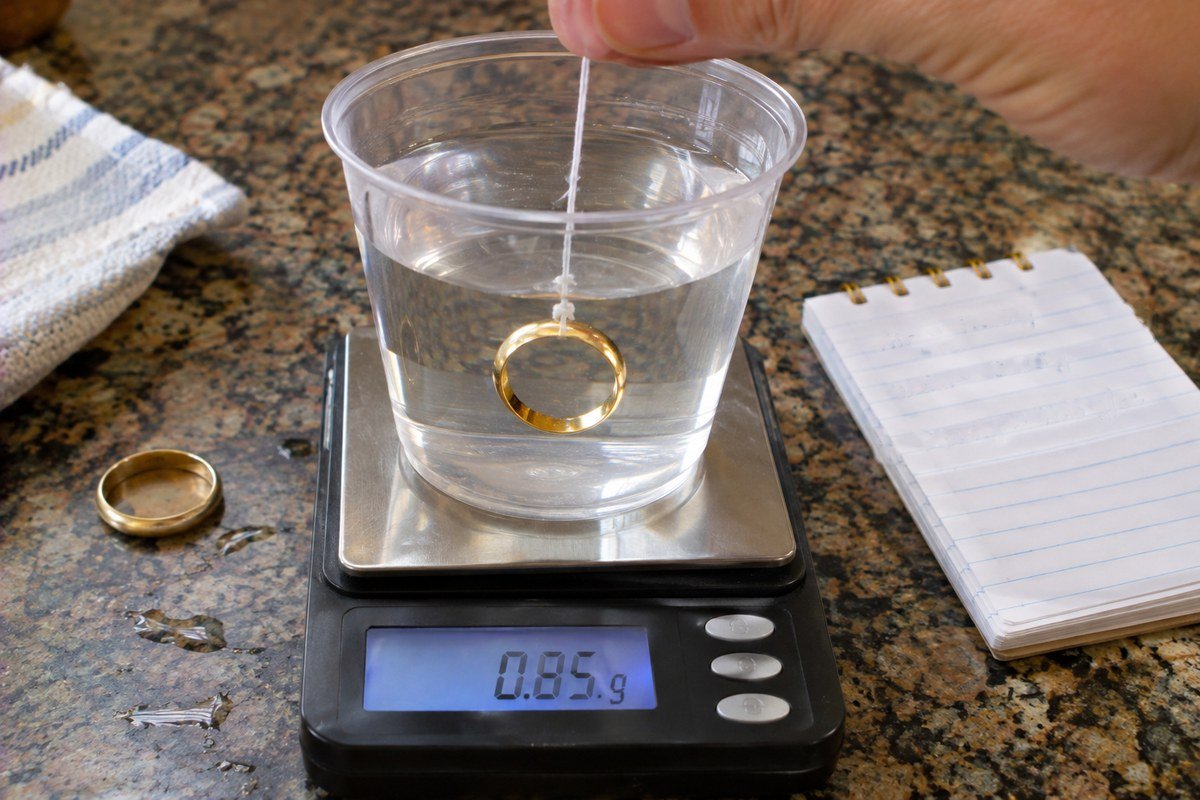
You can measure density at home with a jewelry scale that reads to 0.01 grams:
- Weigh the piece dry and write down the grams.
- Set a small cup of water on the scale and press tare so it reads zero.
- Hang the piece from a thin thread so it sits fully under the water without touching the cup's sides or bottom. Tap off any air bubbles clinging to it.
- Read the scale. The new number in grams equals the piece's volume in cubic centimeters, since 1 gram of water takes up 1 cubic centimeter.
- Divide the dry weight by that number. The result is the density.
Small rings give small readings, so the result is rough. A ring with stones, a hollow chain, or a nugget with quartz stuck to it will read low. One more limit: tungsten is almost exactly as dense as gold, at about 19.25, so a plated tungsten fake can pass this test.
Gold Density Calculator
Enter your two scale readings to get the density and the closest match.
Gold Density Calculator
Weigh the piece dry, then hang it in a tared cup of water and enter both readings in grams.
Density calculator by DetectorBrief. Reference values from the USGS and gold dealers. A rough guide only, not proof of gold.
The Acid Test
An acid test kit is the classic way to check karat at home. Rub the piece on a black touchstone to leave a thin streak, then put a drop of test acid on it. According to a GIA bench tip, nitric acid tests 14K and lower, and stronger acids test higher karats. If the streak stays, the gold is at least that karat. If it dissolves, it is lower. GIA notes that a strong green fizz points to base metal.
To check under plating, GIA suggests using an engraving tool to cut a small notch in a hidden spot to expose fresh metal first. Test acids are corrosive, so GIA recommends gloves, safety goggles, and a well-ventilated area.
Electronic Testers and X-Ray Testing
Electronic gold testers use a probe that takes an electrical reading to estimate karat, with no acid and no streak. They are fast, but GIA notes that plating can only be detected by testing a spot where the plating has been removed.
Jewelers and gold buyers often use X-ray fluorescence (XRF), a machine that reads metal content without harming the piece. It is quick and accurate on solid metal. GIA cautions that XRF reads only the first few microns of the surface, so a thick plating can still fool it, and curved or textured surfaces can throw off the reading.
Tests That Don't Work
Gold dealers warn against these popular home tricks:
- The bite test. Biting gold can chip a tooth and dent the piece, and it tells you little about purity.
- The vinegar test. Many fakes look fine after a vinegar soak, so it can be misleading.
- The float test. Gold sinks, but so do brass and tungsten. It only catches very light fakes.
- The skin test. Solid gold rarely marks your skin, but a clean result does not rule out plating.
When to See a Jeweler
If home tests disagree, or the piece looks old or valuable, have a jeweler or gold buyer test it with an XRF machine. For a written value, see a qualified appraiser. GIA advises choosing an appraiser with both gemological and appraisal training, and asking up front what the appraisal will cost and how long it will take. GIA also notes that it does not certify its graduates, so be wary of anyone who claims to be "GIA certified."
Before you take in a dirty find, rinse off the mud. Our guide on how to clean old coins covers gentle ways to clean old metal finds.
Gear for this guide4 items

Loupe
GemOro 10x Jewelers Loupe
A 10x triplet loupe for reading tiny karat stamps and spotting worn plating. Sold by GemOro
Check Price on Amazon
Scale
GemOro Platinum XP500 Pocket Jewelry Scale
Reads to 0.01 gram, which is what the density test needs. Sold by GemOro
Check Price on Amazon
Acid kit
The Sharpest Point Gold, Silver, Platinum and Palladium Testing Kit
A touchstone, test acids from 9K to 24K, and an acid neutralizer. Sold by the maker. Wear gloves and goggles
Check Price on Amazon
Electronic tester
GemOro Auracle Analyzer Gold Tester
An electronic tester that the listing says reads gold from 6K to 24K and also tests platinum. Sold by GemOro
Check Price on Amazon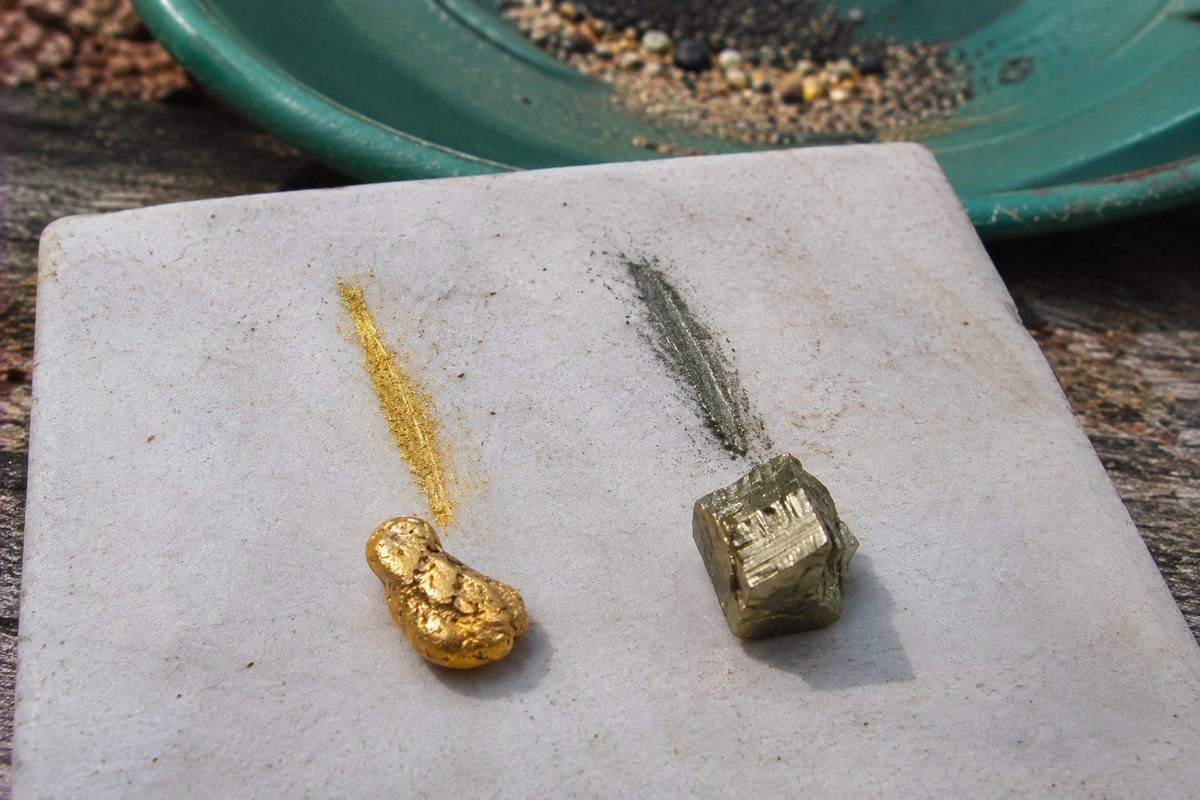
Gold Testing FAQ
How can you tell if gold is real at home?
Check the stamp with a loupe, then try a magnet, since gold is not magnetic. For nuggets, gold dents and leaves a yellow streak, while pyrite is brittle and leaves a greenish-black streak. For a firmer answer, measure density with a 0.01 gram scale or use an acid test kit.
What does 585 mean on gold?
585 is the common number stamp for 14K gold. It means about 58.5 percent gold, or 585 parts per thousand. Other common stamps are 417 for 10K, 750 for 18K, and 999 for pure gold.
Does real gold stick to a magnet?
No. Gold is not magnetic, so a piece that pulls hard to a magnet is not solid gold. Clasp springs are often steel, and many fakes aren't magnetic either, so a magnet can only rule a piece out.
What does GF or GP mean on jewelry?
GF means gold-filled, and GP or GEP means gold-plated.
Both have only a layer of gold over another metal. Under the FTC Jewelry Guides, gold-filled has a layer of at least 1/20 of the total weight, while electroplating can be as thin as 0.175 microns.
How do you tell a gold nugget from fool's gold?
Fool's gold, or pyrite, is brassy, often forms sharp, cube-shaped crystals, breaks when you press a pin into it, and leaves a greenish-black streak. Gold is soft enough to dent, does not tarnish, and leaves a yellow streak.
How to Tell if Gold Is Real: Bottom Line
Here is how to tell if gold is real in short: start with the stamp and a magnet, since those are free and catch a lot of fakes. For nuggets, add the dent and streak tests to rule out pyrite. When it matters, measure the density, then confirm with an acid kit or an XRF test at a jeweler. No single home test proves gold on its own, but two or three that agree give you a good answer.