Knowing how to clean old coins starts with knowing when to stop. A dug coin comes out of the ground covered in soil, and the urge is to scrub it until it shines. That is the fastest way to ruin it. Scrubbing, polishing, and acid strip away the original surface, and collectors and grading services can spot a cleaned coin. A coin worth keeping should only ever get the gentlest wash.
DetectorBrief is a participant in the Amazon Services LLC Associates Program, an affiliate advertising program designed to provide a means for sites to earn advertising fees by advertising and linking to Amazon.com.
This guide shows you which coins to clean and which to leave alone, the safe way to wash a dug coin, what to do for each metal, what never to use, and how to store coins once they are dry. The advice comes from museum conservators at the Canadian Conservation Institute (CCI), Britain's Portable Antiquities Scheme, and the coin grading services NGC and PCGS. All of them are listed at the end.
Table of Contents
Quick Answer
- Do not clean a coin that might be valuable or historic. Brush off loose dirt and get an opinion first.
- The safe wash: lukewarm distilled water with a little mild soap, then a distilled water rinse and an air-dry on a paper towel. Do not scrub the surface.
- Leave patina and toning alone. A smooth, even brown, green, or toned surface is stable, and collectors value it.
- Never use wire brushes, metal polish, coin dips, vinegar, lemon juice, or a rock tumbler on a coin you want to keep.
- Light green powder in spots on copper can be active corrosion. Dry the coin and store it with silica gel instead of scrubbing it.

Should I Clean This Coin?
Pick the metal, how valuable the coin might be, and what is on the surface. The tool gives you a plain answer based on the conservation advice in this guide.
Should I Clean This Coin?
Answer three questions about your find. The tool tells you whether to clean it, how far to go, and what to avoid.
Coin cleaning checker by DetectorBrief.com. Based on advice from the Canadian Conservation Institute and the Portable Antiquities Scheme. When in doubt, leave it as found.
Why Cleaning Can Ruin a Coin
A coin's surface adds to its value. Many coins have a fine, frosty texture from the minting dies that reflects light in many directions. NGC explains that harsh chemicals or abrasives smooth out that texture, leaving a flat, lifeless look. The damage is permanent. A cleaned coin cannot be "uncleaned."
Grading services notice. NGC says unskilled and improper cleaning is one of the most common reasons a coin gets a Details grade instead of a number. NGC's labels for this include brushed, burnished, polished, and whizzed. PCGS also gives cleaned coins a Details grade. NGC notes that light, non-destructive cleaning on older coins may still allow a regular grade, but harsh cleaning that hurts the coin's look means a Details grade only.
Old surfaces matter even when a coin is not rare. The Canadian Conservation Institute says many collectors value patina and toning and prefer uncleaned coins, and that conservators should handle corrosion removal.
Sort Your Finds Before You Clean
Before you wash anything, split your finds into three piles. It takes a minute and keeps you from damaging the one coin that mattered.
| Pile | What goes in it | What to do |
|---|---|---|
| Spend | Modern dimes, quarters, nickels and cents from pocket change | Wash them however you like. There is no collector value to lose. |
| Keep | Older coins you want for your collection, common dates | Gentle wash only, then store dry. Leave patina and toning alone. |
| Ask first | Anything old, rare, unfamiliar or possibly valuable | Brush off loose dry dirt or leave it as found. Get an opinion from a coin dealer, coin club, or conservator. |
If you are not sure what a coin is, look it up before you clean it. Our guide to the best metal detector for coins covers which old coins detectorists find most often.
What You Need
A safe cleaning kit is simple and cheap. Everything here is gentle on purpose.
- Distilled water. Tap water contains minerals and chlorine. The CCI method uses distilled water to wash and rinse.
- Mild dish soap. A drop or two in the water. Do not use powdered dishwasher detergent. The CCI warns against it.
- A soft toothbrush. Extra-soft bristles, used on dirt only.
- Wooden sticks. Orange wood sticks or toothpicks for lifting dirt out of lettering. Wood is softer than the coin, unlike a metal pick.
- Paper towels. For air drying.
- Pure acetone (optional). The CCI method uses it to remove grease and fingerprints after washing.
- Cotton gloves. The CCI recommends handling coins by the edges with clean gloves, and using cotton gloves rather than latex for silver.
How to Clean Old Coins Safely, Step by Step
This method follows the washing steps the Canadian Conservation Institute gives for coins, with our brush and wooden stick tips added. It removes dirt and grime without taking metal off the coin. Do one coin at a time.
- Knock off loose, dry soil. Brush gently with a soft, dry brush over a towel. Stop if anything other than dirt starts to come off.
- Wash in soapy distilled water. Fill a small bowl you keep for coins, not one used for food, with lukewarm distilled water and add a drop of mild soap. Set the coin in and let the dirt soften for a few minutes.
- Loosen the dirt, not the coin. Use a soft toothbrush with light strokes, or a wooden stick, to clean the lettering. Do not scrub the surface. If the dirt will not come off, stop. Some crust is fused to the metal, and forcing it pulls the surface away.
- Rinse in clean distilled water. Use a second bowl. Change the water when it turns cloudy.
- Degrease with acetone (optional). Briefly soak the coin in pure acetone in a glass dish to remove oils. Acetone can soften some plastics. Work in a ventilated room away from flames, and keep it away from children. Skip this step on any coin with a coating, such as a lacquered medal.
- Air dry on a paper towel. Do not rub it dry. Let it dry fully at room temperature before you put it away, and keep it away from heaters and ovens.
The Portable Antiquities Scheme adds one warning for old finds: do not leave them soaking for long, and wash each one separately.

How to Clean Coins by Metal
Each metal reacts differently in the ground and in the bowl. Use this section after the gentle wash above.
Copper and Bronze Coins
Old copper cents and tokens often come out of the ground brown, black or green. A smooth, even color that stays put is a stable patina, and the Portable Antiquities Scheme says patina on old copper alloy finds adds value. Leave it.
Watch for bronze disease. The CCI describes it as a light green powder that shows up in spots and can spread. It happens in damp air, at about 55 percent relative humidity and above. Do not scrub it off. Dry the coin and store it in a sealed box with silica gel. The Portable Antiquities Scheme says dry storage can stop it, and that only a conservator should treat it with chemicals. Our guide to coin holders and storage covers how to set up a dry box.
Silver Coins
Silver turns gray to black as it tarnishes. The CCI says collectors value toned silver coins, that removing corrosion from a coin is a job for a conservator, and that dips and metal cleaners, including polishing cloths, should not be used on coins. If you still want to brighten a common silver coin you will never sell, the CCI note on silver describes these methods for silver in general. Each one removes some silver.
- A silver polishing cloth. The CCI silver note says cloths suit light tarnish. Each polish still takes off a little silver.
- The foil and soda method. The silver sits against aluminum in a warm washing soda solution, and the tarnish turns back into silver. The CCI says silver cleaned this way may tarnish faster afterward and leave a dull finish.
- Commercial silver dips. They work fast but can pit the metal. The CCI says to expose silver to dips as little as possible.
The Portable Antiquities Scheme warns that silver from the ground can be brittle and crack easily, so handle old silver gently.
Gold Coins
Gold hardly corrodes, according to the Portable Antiquities Scheme. A gold coin usually needs only a gentle wash and careful drying.
Modern Clad Coins
Dimes and quarters made since 1965 are copper with a copper-nickel layer on each side. Pocket change you plan to spend has no collector value to protect, so soap, water, and a brush are fine. Keep the gentle method for any clad coin you think might be an error or a rare date.
Lead, Pewter and Iron Finds
Lead and pewter tokens and buttons need care for your health as well as the find. The Portable Antiquities Scheme says lead can be absorbed through your skin, so wear gloves and don't brush off the white powder that forms on lead, because it is harmful. Wash your hands afterward, and do not wash lead finds in a kitchen sink or a bowl you use for food. The CCI says that white powder is caused by acid vapors from things like oak, old cardboard, cheap paper, and vinegar.
Iron corrodes quickly, according to the Portable Antiquities Scheme. It says iron needs very dry storage, below 15 percent relative humidity. Orange powder or wet-looking droplets mean it is still corroding.
What Never to Use on an Old Coin
These are the methods you will see most often in videos and forums. Each one removes metal along with the dirt.
| Method | Why to skip it |
|---|---|
| Wire brushes and steel wool | The Portable Antiquities Scheme lists wire brushes among the harsh methods that only cause damage. |
| Metal polish and toothpaste | The CCI says most metal cleaners contain abrasives that scratch a coin's surface. |
| Vinegar, lemon juice and cola | These are acids. The Portable Antiquities Scheme lists vinegar and lemon juice as damaging. |
| Coin dips | The CCI says dips contain acids that can damage the coin if any is left on the surface. |
| Rock tumblers | Tumbling, which the Portable Antiquities Scheme calls barrelling, is another harsh method it says causes damage. |
| Powdered dishwasher detergent | The CCI says never to use it on coins. |
| Rotary tools and wheels | Polishing a coin with a power tool is called whizzing. NGC lists it as a reason for a Details grade. |
Some detectorists soak coins in olive oil for weeks. We could not find any conservation source that recommends it, so we leave it out.
How to Tell If a Coin Has Been Cleaned
This is useful when you buy or trade coins, not just when you clean them. Look at the coin under a magnifier and tilt it in good light. Our guide to the best coin microscope explains how much magnification a coin needs.
- Flat, dull shine. NGC says an uncleaned coin's luster rolls around the coin as you tilt it, while a cleaned coin reflects light in one flat direction.
- Fine parallel scratches. Brushing and wiping leave thin lines, often running the same way across the coin.
- Unnatural color. A very old coin that looks bright pink or white usually has had its patina or toning stripped.
- Dirt left only around the letters. Grime packed around the letters next to a bright, clean field can indicate cleaning.
How to Dry and Store Coins After Cleaning
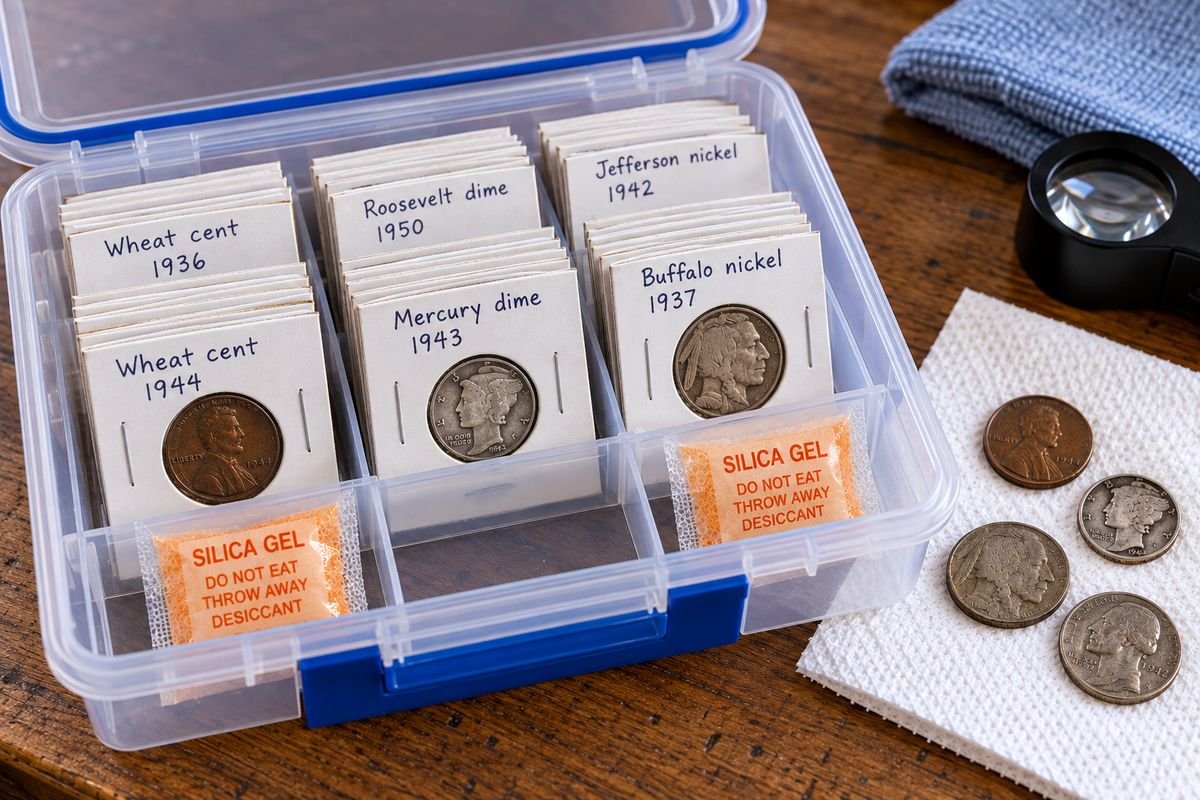
Cleaning does nothing if the coin goes back into damp air. The CCI says humidity should be kept as low as possible, ideally below 30 percent, and recommends silica gel if corrosion starts. The Portable Antiquities Scheme suggests an airtight box with silica gel and an indicator strip, and warns against leaving the box open, or the gel will soak up moisture from the room.
- Make sure each coin is fully dry before placing it in a holder.
- Use holders made of PVC-free plastic. The CCI says PVC flips cause green corrosion on copper coins.
- Keep coins out of oak boxes and cheap cardboard, which can release acidic vapors.
- Write the find date and place on the holder or a card with the coin.
Our guide to coin holders and storage compares safe holders, boxes, and silica gel for dug coins.
When to Get Professional Help
Take a coin to a professional before you touch it if it is old, rare, unusual, or worth more than you would want to lose. A local coin dealer or coin club can identify it. A conservator can deal with active corrosion. NGC runs a conservation service called NCS, and NGC says conservation removes contaminants and stabilizes the surface without adding anything to the coin. It cannot undo damage from a past cleaning, which is why it pays to ask first.
What to Buy
You likely have distilled water, mild soap, and paper towels at home. These are the other pieces of a safe coin cleaning kit.
Best brush: Oral-B Complete Sensitive Toothbrush, Extra Soft, 4 Pack
An extra-soft toothbrush is the right stiffness to loosen dirt without scratching metal. A four-pack lets you keep one just for coins, so no toothpaste residue ends up on a find.

Oral-B Complete Sensitive Toothbrush, Extra Soft, 4 Pack
- Bristles
- Extra soft
- Count
- 4 brushes
- Use
- Loosening dirt
Good for: brushing soil out of the field and lettering during the wash.
Pros
- Extra soft bristles
- Angled head reaches tight spots, per the listing
- Four brushes in a pack
Cons
- Too soft for hard crust, which you should leave alone anyway
Best for lettering: Orange Wood Sticks, 100 Pack
Orange wood sticks are softer than coin metal, so they lift dirt out of dates and letters without leaving marks the way a pin or needle would. The listing gives the size as 3.5 mm thick and 110 mm long, with two shaped ends.

Orange Wood Sticks, 100 Pack
- Material
- Orange wood
- Count
- 100 sticks
- Size
- 3.5 x 110 mm
Good for: picking dirt out of dates, mint marks and lettering.
Skip if: the dirt is already gone. Do not use the stick on the coin's surface itself.
Pros
- Softer than the coin
- Two shaped ends
- Cheap enough to throw away when dirty
Cons
- Can splinter if you press too hard
Best degreaser: ALDON ACS Grade Acetone, 12 oz
The CCI washing method finishes with a quick acetone dip to remove oils and fingerprints. This one is sold as 100 percent ACS grade acetone, which means it meets a lab purity standard.

ALDON ACS Grade Acetone, 12 oz
- Purity
- ACS grade, 100% acetone
- Size
- 12 oz
- Use
- Degreasing after washing
Good for: removing grease and fingerprints after the wash.
Skip if: the coin has a lacquer or resin coating. Acetone can dissolve it.
Pros
- Sold as pure ACS grade acetone
- Evaporates quickly and leaves no film
Cons
- Flammable. Use it in a ventilated room away from flames
- Not needed for coins you plan to spend
Best gloves: White Cotton Gloves, 10 Pairs
The CCI recommends handling coins by the edges with clean gloves, and cotton gloves rather than latex for silver, because sulfur in latex causes tarnish. This pack is sold for coin, art and jewelry handling.

White Cotton Gloves, 10 Pairs
- Material
- Cotton
- Count
- 10 pairs
- Size
- Large
Good for: handling silver and any coin you want to keep after it is clean and dry.
Skip if: you only clean pocket change you plan to spend.
Pros
- Cotton, as the CCI recommends for silver
- Ten pairs, so you always have a clean one
Cons
- Large size only on this listing
Best for dry storage: Dry & Dry Orange Indicating Silica Gel, 100 Packets
Both the CCI and the Portable Antiquities Scheme recommend silica gel in a closed box to keep coins dry after cleaning. These 10 gram packets change color as they soak up moisture, so you can see when to dry them out. The listing says each packet covers about 1,200 cubic inches.

Dry & Dry Orange Indicating Silica Gel, 100 Packets
- Packets
- 100 x 10 gram
- Indicator
- Orange when dry
- Reusable
- Yes, after drying
Good for: keeping a sealed coin box dry, especially for copper with any sign of bronze disease.
Skip if: your coins sit in an open tray. Silica gel only works in a closed box.
Pros
- Color change shows when the gel is used up
- Can be dried out and reused, per the listing
- Small packets fit in coin boxes
Cons
- Needs drying out regularly in a humid house
Pair the silica gel with PVC-free holders from our coin holders guide.
How to Clean Old Coins: FAQ
What is the best way to clean old coins?
Wash them in lukewarm distilled water with a little mild soap, loosen dirt gently with a soft toothbrush or wooden stick, rinse in distilled water, and air-dry on a paper towel. Do not scrub the surface, and do not clean a coin that might be valuable.
Does cleaning old coins lower their value?
Usually, yes. Harsh cleaning removes the original surface, and grading services like NGC and PCGS give cleaned coins a Details grade instead of a numeric grade. Light, gentle washing does much less harm than polish, acid, or brushing.
Can you clean old coins with vinegar?
It is not a good idea for any coin you want to keep. Vinegar is an acid that eats into the metal, and the Portable Antiquities Scheme lists it among the things that damage finds. It is fine to skip it entirely.
How do you clean old silver coins without damaging them?
Start with a gentle soap-and-distilled-water wash. Toning on silver is often valued, so leave it on any coin that might be collectible. The Canadian Conservation Institute advises against dips and polishing cloths on coins, because each one removes some silver.
What is the green stuff on old copper coins?
A smooth, even green or brown layer is usually stable patina and should be left alone. Light green powder in spots can be bronze disease, an active corrosion. Dry the coin and store it with silica gel instead of scrubbing it.
Should I clean coins I dug with my metal detector?
Wash modern pocket change however you like. Give older coins only a gentle wash, and leave anything old, rare, or unfamiliar as found until you know what it is.
Sources
- Canadian Conservation Institute: Basic Care of Coins, Medals and Medallic Art (CCI Notes 9/4)
- Canadian Conservation Institute: Recognizing Active Corrosion (CCI Notes 9/1)
- Canadian Conservation Institute: Silver, Care and Tarnish Removal (CCI Notes 9/7)
- Portable Antiquities Scheme: Conservation Advice Notes
- NGC: Details Grading
- NGC: Why Cleaned Coins Can't Be Uncleaned
- PCGS: The Details Grade