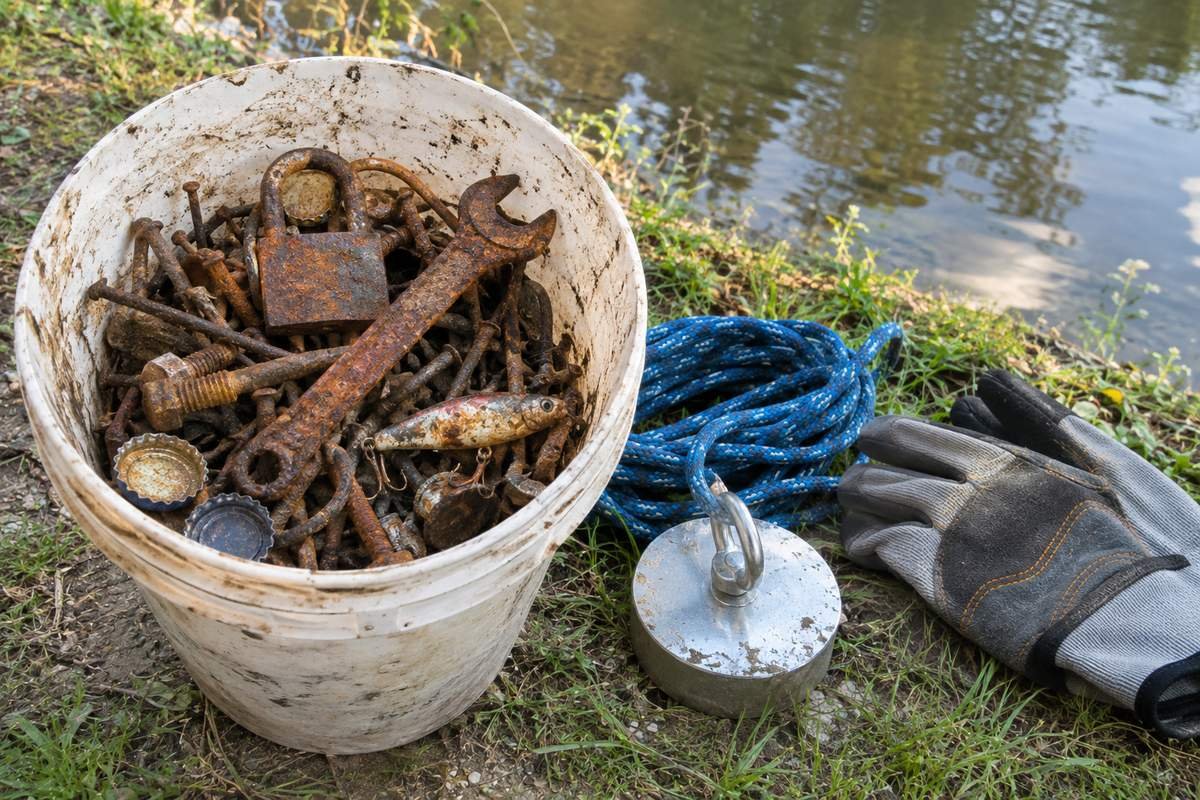
Magnet fishing is pulling metal out of rivers, lakes, and canals with a strong magnet on a rope. To start, you need a neodymium fishing magnet, a long braided rope, a good knot, gloves, and a spot like a bridge, dock, or pier where you have permission to fish. Throw the magnet out, let it sink, and drag it slowly back along the bottom. Most of what you pull up is scrap, but old tools, hardware, fishing lures, and even a bike are all part of the fun.
This guide covers how to choose a magnet, how to tie it on, how to throw and drag, where to go, and what to do with your finds. It also covers safety, because a magnet can bring up live ammunition or a weapon, and you need to know what to do before that happens.
DetectorBrief is a participant in the Amazon Services LLC Associates Program, an affiliate advertising program designed to provide a means for sites to earn advertising fees by advertising and linking to Amazon.com.

Quick Links
What Is Magnet Fishing?
Historic Environment Scotland, a government body, describes magnet fishing as "the retrieval of metallic objects from water using a strong magnet." The magnets are neodymium, a rare earth magnet that is far stronger than a fridge magnet for its size. Most iron and steel will stick, though many stainless steels will not. Aluminum, brass, copper, gold, and silver will not.
That last point matters. Magnet fishing and metal detecting find different things. A metal detector can find gold rings and silver coins. A magnet only pulls up iron and steel, plus anything stuck to them. If you are just starting with a detector, our guide on how to use a metal detector covers that side of the hobby.
Choosing a Magnet
Fishing magnets are sold by pull force, a number in pounds. Makers measure it in a lab, not in a river. Magnetar, for example, rates its magnets by the force needed to pull the magnet straight off a 1/8-inch-thick steel plate. Another magnet maker, K and J Magnetics, tests on a large, flat, dry steel plate.
In the water, a magnet holds much less than its rating. K and J Magnetics lists the main reasons:
- Gap. Mud, paint, or a curved surface between the magnet and the metal lowers the hold a lot.
- Angle. Pulling from the side gives the object leverage to peel off.
- Contact. A full, flat contact holds better than a corner or an edge.
- Thin metal. In the company's own test, thin sheet steel held under a fifth of what a heavy wrench held on the same magnet.
Magnets also come in two main shapes. A single-sided magnet has its pulling face on the bottom and an eyebolt on top. K and J Magnetics says these are ideal for vertical lifts and for targeting one object. That makes them a good fit for dropping straight down off a bridge and lifting back up. A double-sided magnet has a face on each side. Brute Magnetics says double-sided magnets are designed mainly for dragging along the bottom. Makers rate double-sided magnets in different ways, so check whether the number is per side or for both faces together. Our guide to the best fishing magnet compares single, double-sided, and 360-degree magnets.
For complete starter sets with magnet, rope, and gloves, see our guide to the best magnet fishing kit.
Rope, Knots, and Threadlocker
- Use strong, braided rope. Magnetar sells double braided rope in 6, 8, and 10 mm and calls 8 mm its best all-around choice.
- Lock the eyebolt. Apply threadlocker to the eyebolt threads so it cannot twist loose. Brute Magnetics says to use the threadlocker that came with the magnet and let it cure for 24 hours before you fish.
- Tie a strong knot. Brute Magnetics recommends the Palomar knot as strong, reliable, and easy to tie.
- Tie off the other end. Tie the free end of the rope to a railing or another fixed object. Brute Magnetics says plainly: never tie the rope to yourself.
Makers disagree on carabiners. Brute Magnetics rates a locking carabiner as a better practice than a knot alone, while Magnetar prefers using the rope's built-in loop on the magnet and the carabiner only to anchor the far end of the rope. Either way, check every knot and the eyebolt before each throw.
How to Magnet Fish Step by Step
- Check the spot. Make sure you are allowed to fish there, nobody is behind you, and nobody is near the rope.
- Put on gloves. Magnetar suggests cut-resistant gloves for sharp edges and rope burn.
- Throw or drop. From a bank or dock, use an overhead toss or a sidearm cast. From a bridge, lower the magnet straight down, lift it, move a little, and drop it again.
- Drag slowly. Let the magnet reach the bottom, then pull it back slowly. Magnetar suggests sweeping it side to side as you pull.
- Lift gently. When you feel weight, pull steadily. A find feels heavier once it leaves the water, because the water no longer helps hold it up. Brute Magnetics suggests a grappling hook for this.
- Clean up. Put rusty finds in a bucket or bag, and take them all home.
If the magnet gets stuck, Brute Magnetics suggests pulling steadily from different angles, or giving the rope plenty of slack and letting the current work it loose. Magnetar warns never to use a vehicle to pull a stuck object, and never to go into the water after a magnet. Sometimes you will lose one. That is part of the hobby.

Magnet Fishing Safety
Most finds are harmless scrap. But magnet fishers do pull up old ammunition, grenades, and firearms, so learn the rule before you ever need it.
If you find ammunition, a shell, or anything that might explode, follow the U.S. Army's 3Rs of explosives safety: Recognize, Retreat, Report. Stop pulling and do not handle it any further. Carefully leave the area, then call 911 and tell the police what you saw and where. Historic Environment Scotland adds that you should not use a mobile phone near any recovered munitions, so walk well away before you call.
If you find a gun, do not touch or move it. West Midlands Police in the UK warns it could be loaded, and Magnetar says to treat every recovered firearm as loaded, unstable, or linked to a crime. Call 911 or your local police.
- Tetanus. Rusty, sharp metal can cut you. The CDC recommends a tetanus booster every 10 years for adults. Ask your doctor if you are not sure when you last had one.
- Pinched fingers. Keep your fingers out of the space between the magnet and any metal. Strong magnets snap together hard.
- Pacemakers and electronics. Magnetar warns that strong magnets can interfere with some pacemakers. Ask your doctor about a safe distance, and store magnets away from phones and electronics.
- Water. Stay on solid footing and never go into the water to free a magnet. In the UK, the Broads Authority advises wearing a life jacket while magnet fishing.
What Did I Find? Quick Checker
Pick what came up on your magnet to see what to do next.
What Did I Find?
Pick the closest match. When in doubt, treat it as dangerous.
Find checker by DetectorBrief. Based on U.S. Army explosives safety guidance and police advice. In an emergency, call 911.
Where to Go Magnet Fishing
Magnetar lists bridges, docks, piers, and riverbanks as popular spots, especially in towns and cities. Brute Magnetics adds the water under overpasses and railways.
Rules vary a lot by place. Some parks, canals, and private docks ban magnet fishing or require permission from the owner. Before you go, read our guide on whether magnet fishing is legal and check the local rules for your spot.
What to Do With Your Finds
- Weapons and ammunition: leave them and call the police, as above.
- Knives: wear gloves, keep them away from other people, and call your local police non-emergency line, since a knife in the water may be linked to a crime.
- Items that might be stolen, such as bikes, safes, or phones: call your local police non-emergency line and let them decide.
- Old relics: rinse them and set them aside. Some places require you to report old objects. In Scotland, for example, Historic Environment Scotland says failing to report a found portable antiquity is an offense, so check your local rules.
- Scrap and trash: take it all home. The Broads Authority tells magnet fishers to take home and safely dispose of everything they pull out, and Historic Environment Scotland says finds left on towpaths count as fly-tipping, the UK term for illegal dumping. Scrap metal can go to a local recycler.
Gear for this guide4 items

Starter kit
Magnetar Easy 600 lb Magnet Fishing Kit
A magnet the listing says is magnetic on all four sides, with a protective case, gloves, and rope
Check Price on Amazon
Double-sided kit
1320 lb Complete Magnet Fishing Kit
A double-sided magnet for dragging, with a carry case. Check the listing for how the pull force is rated
Check Price on Amazon
Grappling hook
MHDMAG 3-claw stainless steel grappling hook
For lifting heavy finds and snags
Check Price on Amazon
Magnet Fishing FAQ
Is magnet fishing legal?
It depends on where you fish. Some parks, canals, and private docks ban it or need the owner's permission. See our full guide on whether magnet fishing is legal, and check local rules before you go.
What is the best magnet for magnet fishing?
A neodymium fishing magnet with an eyebolt. Single-sided magnets are best for straight drops and lifts from bridges, and double-sided magnets are made for dragging along the bottom. Remember that real pull in the water is much lower than the lab rating.
What knot is best for magnet fishing?
Brute Magnetics recommends the Palomar knot as strong and easy to tie. Put threadlocker on the eyebolt and anchor the far end of the rope to a fixed object, never to yourself.
What should I do if I find a grenade or ammunition while magnet fishing?
Stop pulling and do not handle it. Follow the U.S. Army 3Rs: recognize the danger, retreat carefully, and report it by calling 911 once you are clear of the area.
Can you find gold with a magnet?
No. Gold, silver, brass, copper, and aluminum are not magnetic. A magnet picks up iron and most steel, so use a metal detector if you want to find gold or silver.
Bottom Line
Magnet fishing is cheap to start and easy to learn. Get a strong neodymium magnet, good rope, threadlocker, gloves, and a grappling hook. Tie a Palomar knot, anchor the rope, and drag slowly from a bridge, dock, or pier where you have permission. Take your trash home, and if anything looks like a weapon or ammunition, stop, step back, and call the police.