

A beach metal detector has to survive three different environments in the same afternoon: bone-dry sand above the tide line, wet packed sand near the water, and the wash zone where waves roll in over your coil. Most detectors handle dry sand well. Wet salt sand and the surf are where they start to separate. If you are just starting out, our guide to the best metal detector for beginners covers lighter, cheaper options. Each pick here suits a specific kind of beach hunter, from a scuba diver to a weekend hunter working dry sand before the crowds arrive.
How we built this guide: we compared manufacturer manuals, brochures, and spec sheets for all five detectors, and rechecked that each one was listed and in stock on Amazon on 11 November 2026. We have not field tested these machines side by side. Specs come from the manufacturers, rankings and verdicts are our editorial judgment, and nothing below is presented as a test result. Four of the five are fully submersible, so you can wade or work the shallows. The fifth, the Garrett ACE 400, is a dry-sand machine with a waterproof coil only.
DetectorBrief is a participant in the Amazon Services LLC Associates Program, an affiliate advertising program designed to provide a means for sites to earn advertising fees by advertising and linking to Amazon.com.
- Saltwater guidanceHow wet salt sand affects each detector
- Waterproofing explainedCoil-only, 10 ft, 16 ft, and 250 ft ratings
- 4 head-to-headsSide-by-side trade-offs, not test scores
- Pick by beach zoneDry sand, wet sand, surf, or diving
Beach hunting zones at a glance
- Dry sand: almost any detector works here, including budget models with a waterproof coil only.
- Wet salt sand: pick a detector with good ground balance and a beach or saltwater setting. Multi-frequency models are usually more stable here.
- Surf and shallows: the whole detector must be submersible, rated deeper than you plan to go, with headphones that work in water.
Our top beach metal detector pick
Minelab Equinox 700
Our pick for most beach hunters: multi-frequency for wet salt sand and full submersion to 16 feet, for well under the price of a dive detector.

Manufacturer specs
- Frequency
- Multi-IQ or 4 single
- Waterproof
- To 5 m (16 ft)
- Weight
- 2.8 lb
- Coil
- 11 in Double-D
Good for: wet salt sand, wading, and mixed beach and land hunting with one machine.
Not ideal for: scuba diving (16 ft limit), or dry sand only on a tight budget.
Quick decision guide
Find the type of beach you hunt most often.
| Where you hunt | Look at |
|---|---|
| Dry ocean sand only | Garrett ACE 400 or any pick below |
| Freshwater beach | Garrett AT Max |
| Wet saltwater sand | Minelab Equinox 700 |
| Wading, saltwater, small budget | Nokta Simplex Ultra |
| Surf and shallow water | Equinox 700 or Simplex Ultra (16 ft) |
| Scuba diving | Fisher CZ-21 (250 ft) |
Table of Contents
All 5 beach metal detectors at a glance
Swipe the table sideways to see every column.
| # | Detector | Best for | Water rating | Frequency | Weight | Our take (editorial) |
|---|---|---|---|---|---|---|
| 1 | Minelab Equinox 700 (details) | Best overall | Submersible to 16 ft (5 m) | Multi-IQ, or 4 single frequencies | 2.8 lb | Most stable all-round choice for wet salt sand and wading |
| 2 | Fisher CZ-21 Quicksilver (details) | Scuba and deep surf | Submersible to 250 ft (equipment rating) | Dual: 5 and 15 kHz at once | 6 lb 1 oz (10.5 in coil) | Dive-rated specialist. Heavy and expensive for casual beach use |
| 3 | Garrett AT Max (details) | Freshwater beaches and inland | Submersible to 10 ft | Single, 13.6 kHz | 3.03 lb | Rugged and proven. Needs careful setup in wet salt sand |
| 4 | Garrett ACE 400 (details) | Dry-sand budget pick | Coil only, control box not submersible | Single, 10 kHz | About 2.9 lb | Simple and affordable for sand above the tide line |
| 5 | Nokta Simplex Ultra (details) | Budget waterproof | Submersible to 16 ft (5 m) | Single, 15 kHz | 2.6 lb | Fully waterproof for the money, with limits in wet salt sand |
Specs from each manufacturer's manual or spec sheet. Weights are with the stock coil. The order is our editorial ranking for beach use, not a lab score.
How to choose the right detector for the beach
A beach is a harder environment than a park or a field, and the wrong machine will either false constantly on wet salt sand or give up the moment a wave rolls over the coil. Here is what matters most before you buy.
Match the detector to the beach you hunt
- Dry ocean sand. Dry sand is far less conductive than wet salt sand, so most detectors run smoothly here. A coil-only waterproof model like the ACE 400 is enough.
- Wet salt sand. Salt water in the sand is conductive and can produce signals that sound like foil or thin jewelry. This is where a multi-frequency detector or a well-designed beach mode earns its price.
- Freshwater beaches. Lakes and rivers lack the salt problem. A single-frequency detector like the AT Max or Simplex Ultra is usually stable here, and waterproofing matters more than frequency.
- Shallow surf and wading. The control box will get wet, so the whole detector must be submersible. You also need wired waterproof headphones once the control box goes under, because wireless audio does not pass through water.
- Scuba diving. Only a dive-rated detector belongs here. Of our five picks, only the Fisher CZ-21 (250 ft) is rated for diving depths. A 10 ft or 16 ft rating is for wading and snorkeling.
Waterproof rating: coil, shaft, or full submersion
Check whether the whole detector is rated waterproof or just the search coil. With a coil-only rating, the coil can get wet but the control housing must stay dry. That is fine for dry sand and damp sand, as long as you keep the control box clear of splashes, spray, and any chance of a dunking, which rules out most work in the wash zone. If you plan to hunt in knee-deep water or snorkel the shallows, look for a detector rated to at least 10 feet of full submersion. Treat the rating as a maximum, not a target. Garrett, for example, says going past the AT Max's 10 foot limit can cause leaks and void the warranty.
Waterproof hardware is not the same thing as stable saltwater detection. A detector can survive being dunked and still chatter on wet salt sand. Water rating tells you where the detector can go. Frequency and ground balance tell you how quietly it will run when it gets there.
VLF vs multi-frequency in saltwater
Salt water is conductive, and wet salt sand can confuse a detector and cause constant false signals. Black sand adds a second problem, since it is full of iron minerals. A single-frequency VLF machine can still work on a salt beach if you ground balance carefully, lower the sensitivity, and keep the coil flat. A simultaneous multi-frequency detector generally handles the move between dry sand, wet sand, and surf with less chatter, because it reads the ground at several frequencies at once.
On this list, the Minelab Equinox 700 runs true multi-frequency (Multi-IQ), and the Fisher CZ-21 transmits two frequencies at the same time. The Garrett AT Max, Garrett ACE 400, and Nokta Simplex Ultra are single-frequency machines. They work at the beach, but expect more setup and more noise on wet salt sand. If saltwater beaches are your main hunting ground, lean toward multi-frequency.
Coil size and weight for long beach sessions
A larger coil covers more sand per swing, which matters on an open beach where you are covering a lot of ground. The tradeoff is fatigue. Wading in waves while swinging a heavy detector for hours wears on your shoulder fast. Most of our picks weigh about 2.6 to 3 pounds. The Fisher CZ-21 is the exception at about 6 pounds, which is fine underwater but noticeable on a long walk across dry sand.
Ground balance and beach mineralization
Wet salt sand and black sand pockets can both throw off a detector's ground balance (tuning the detector to ignore minerals in the soil). Automatic or tracking ground balance adjusts as you move between dry sand, wet sand, and water, and it is worth having if you hunt the same beach across a full tide cycle. Manual ground balance still works but needs rechecking every time the sand changes underfoot.
The manuals agree on a few habits. Ground balance again whenever you move from dry sand to wet sand. Keep the coil at a steady height and avoid bumping it on wet sand. Expect a false signal as the coil goes in or out of the water, and keep it fully in or fully out when you can. Garrett's AT Max manual adds that swinging parallel to the water's edge and lowering sensitivity help when the detector gets noisy. Fisher's CZ-21 manual suggests rechecking ground balance every 5 to 10 minutes underwater.
Wet sand, dry sand, and the surf line
These are effectively three different hunting grounds layered on top of each other. Dry sand above the high tide line is the easiest to detect, and on some beaches it gets less attention because many hunters head straight for the water. Wet packed sand near the waterline can hold recently dropped items on busy swimming beaches. The surf line, where waves move sand, can expose older targets when sand is stripped away, but it demands a fully waterproof detector and steady footing. Where finds collect on any given day depends on beach traffic, tides, storms, sand movement, and local access rules.
Safe use of depth ratings in salt water
- Check seals and battery doors before every water trip. Fisher warns that a badly seated gasket on the CZ-21 means a leak.
- Use wired waterproof headphones once the control box goes under. Garrett and Nokta both say their wireless headphones are not for submersion.
- Rinse the control box, shaft, and coil with fresh tap water after salt water, and make sure no salt is left in the connectors.
- Never use a power bank with the detector in the water. Nokta's manual says this directly for the Simplex.
Our 5 picks for beach detecting
Spec pills on each card come from the manufacturer's current manual, brochure, or product page. "Good for", "Not ideal for", pros, and cons are our editorial judgment based on those specs, not field-test results. Where sources disagree, we say so.
1. Minelab Equinox 700: best overall for most beach hunters
The Minelab Equinox 700 uses Minelab's Multi-IQ technology to run multiple frequencies at once, which handles the jump between dry sand, wet sand, and saltwater without manual retuning. Its Beach mode is built for salty, conductive ground, and you can also pick one of 4 single frequencies when you want to fine-tune for a specific target. It ships with an 11-inch waterproof Double-D coil, and Minelab lists ML 85 wireless headphones in the box. The collapsible shaft makes it easy to travel with. Three detection modes (Park, Field, and Beach) give you room to set it up for coins, relics, or general hunting. For coin-focused picks, see our guide to the best metal detector for coins.
The Equinox 700 sits between the budget picks and the dedicated dive machine below, and for most beach hunters who also detect parks and fields, it is the better long-term investment than a single-purpose surf detector. Two limits to know: the 16 foot rating covers wading and snorkeling, not scuba, and for deep wading you will need a separate wired waterproof headset (see the depth-rating tips above).
Manufacturer specs
- Frequency
- Multi-IQ or 4 single
- Waterproof
- To 5 m (16 ft), IP68
- Weight
- 2.8 lb (1.27 kg)
- Coil
- EQX 11 in Double-D
- Modes
- Park, Field, Beach
Good for: wet salt sand, wading, and one detector for beach and land.
Not ideal for: diving below 16 ft, or dry-sand-only hunting.
Pros
- Simultaneous multi-frequency for salt beaches
- Fully submersible coil and control box
- Light at 2.8 lb, packs down for travel
Cons
- Needs wired waterproof headphones for deep wading
- More than twice the Simplex Ultra (Amazon, 11 Nov 2026)
- More settings to learn than a basic detector
2. Fisher CZ-21 Quicksilver: best for scuba and deep surf
The Fisher CZ-21 Quicksilver is purpose-built for underwater and surf hunting. It transmits two VLF frequencies, 5 kHz and 15 kHz, at the same time, and Fisher's manual says salt water should not cause false signals under most conditions, with an occasional faint signal at high sensitivity in the surf. The control housing is rated waterproof to 250 feet, so it is the only pick here built for scuba use. That is an equipment rating, not a suggested dive depth: diving for targets needs proper scuba training and dive planning, and you should stay within your certification limits. First Texas (Fisher's maker) lists permanently attached waterproof headphones. The version on Amazon comes with the 10.5-inch coil, which Fisher lists at 6 lb 1 oz complete.
This is the most expensive detector on this list, and it is a specialist tool rather than an all-rounder. The design is older than the other picks, ground balance is manual or push-button rather than automatic tracking, and it is heavy for a long walk on dry sand. Fisher also warns never to hip-mount the control housing while diving, since the cable can tangle. If diving and deep surf hunting are your main focus, the CZ-21 is worth the premium. If you mostly wade and work wet sand, the Equinox 700 does that job for much less. Stock is limited: on 11 November 2026 Amazon showed only 1 in stock.

Manufacturer specs
- Frequency
- 5 and 15 kHz at once
- Waterproof
- To 250 ft
- Weight
- 6 lb 1 oz (10.5 in coil)
- Battery
- 4 x 9V, 35 to 55 hr alkaline
- Ground balance
- Manual or push-button
Good for: scuba, deep wading, and serious saltwater surf hunting.
Not ideal for: hunters who stay on dry or wet sand.
Pros
- Only pick rated for diving depths
- Two frequencies at once for salt water
- Long battery life on four 9V cells
- Waterproof headphones attached
Cons
- Heaviest and most expensive pick
- No automatic ground tracking
- Coil is fixed, not swappable
3. Garrett AT Max: best for freshwater beaches and all-terrain use
The Garrett AT Max is fully waterproof to 10 feet, which covers wading and shallow surf work without needing a dedicated surf machine. It runs a single 13.6 kHz frequency with iron audio. Its frequency adjust setting shifts that one frequency slightly to reduce interference from other detectors nearby, which helps on a crowded public beach. This is not multi-frequency detection. Included Z-Lynk wireless headphones and a backlit display make it a detector that works as well inland as it does at the coast. Garrett says those headphones should never be submerged, and wireless audio does not work once the detector is fully under water, so see our guide to metal detector headphones for submersible options.
The AT Max is a strong choice for lake and river beaches and for anyone who wants one rugged detector for beach, park, and field. On wet salt sand it needs more care than the Equinox 700. Garrett's own manual says salt water produces signals similar to foil and fine jewelry, and that proper ground balance is the most important step for stable saltwater use. Its battery life is a strength: Garrett quotes 15 to 25 hours on AA batteries without wireless, and 10 to 20 hours with it.

Manufacturer specs
- Frequency
- 13.6 kHz single (shift for interference)
- Waterproof
- To 10 ft (3 m)
- Weight
- 3.03 lb
- Coil
- 8.5 x 11 in Double-D
- Battery
- 4 AA, 15 to 25 hr
Good for: freshwater beaches, wading to 10 ft, and inland hunting.
Not ideal for: mostly wet salt sand.
Pros
- Rugged, fully submersible to 10 ft
- Wireless headphones included
- Long runtime on AA batteries
Cons
- Single frequency, noisier on wet salt sand
- Included headphones are not waterproof
4. Garrett ACE 400: best budget dry-sand detector
The Garrett ACE 400 is built for dry sand, parks, and general-purpose hunting, not wading or surf work. Its search coil is waterproof, but the control box is not, so keep it above the waterline. For hunters who mostly work the dry sand above the tide line, or who want an affordable second detector to leave in the truck for weekend trips, the ACE 400 offers Garrett's Digital Target ID (a number or tone that hints at what kind of metal is buried) and iron discrimination at a price well below the waterproof picks above. It runs at 10 kHz, and the frequency can be shifted slightly to cut interference from other detectors.
It is one of the two lowest-priced detectors on this list, and the right choice if wading and surf hunting are not part of your plan. Note that the fully waterproof Nokta Simplex Ultra listed for slightly less on Amazon on 11 Nov 2026, so if price is the deciding factor, compare both before you buy. On wet salt sand, a basic single-frequency machine like this one will be noisier, so treat it as a dry-sand tool.

Manufacturer specs
- Frequency
- 10 kHz single (shift for interference)
- Waterproof
- Coil only
- Weight
- About 2.9 lb
- Coil
- 8.5 x 11 in Double-D
Good for: dry sand above the tide line, parks, and a low budget.
Not ideal for: wading, or frequent wet salt sand.
Pros
- One of the two lowest-priced picks
- Simple Digital Target ID and iron discrimination (a setting that ignores signals from metals you don't want, like iron)
Cons
- Control box is not submersible
- Single frequency, noisy on wet salt sand
5. Nokta Simplex Ultra: best budget waterproof detector
The Nokta Simplex Ultra offers a lot for its price, with a fully waterproof design rated to 16 feet (IP68), a carbon fiber shaft that keeps the weight to 2.6 pounds, and an 11-inch Double-D search coil. It has a dedicated Beach mode that Nokta designed for salty wet sand, plus a vibration alert that helps in loud surf or underwater. It is a capable wading and freshwater detector for well under half the price of the Equinox 700 at Amazon prices checked 11 Nov 2026, making it the easiest recommendation for someone buying their first fully waterproof beach detector.
Know its limits before you buy. It runs a single 15 kHz frequency, so it will be noisier than the Equinox 700 on wet salt sand. Nokta's manual quotes about 12 hours of battery life. The Amazon listing we link to does not include headphones. Nokta sells Bluetooth headphones separately, says they are not waterproof, and notes the connection drops once the control box goes under. The Simplex Ultra is the best value on this list for anyone who wants to wade without paying for multi-frequency.

Manufacturer specs
- Frequency
- 15 kHz
- Waterproof
- To 5 m (16 ft), IP68
- Weight
- 2.6 lb (1.2 kg)
- Coil
- 11 in Double-D
- Battery
- Built-in, about 12 hr
Good for: a first fully waterproof detector, freshwater beaches, and wading.
Not ideal for: mostly wet salt sand, if your budget allows multi-frequency.
Pros
- Fully submersible to 16 ft for a low price
- Beach mode and vibration alert
- Lightest pick at 2.6 lb
Cons
- Single frequency, less stable on wet salt sand
- No headphones with the linked listing
Head-to-head comparisons
These four pairings are the decisions beach hunters ask about most. Each one compares published specs and design, not our own field tests.
Minelab Equinox 700 vs Fisher CZ-21
| Spec | Equinox 700 | Fisher CZ-21 |
|---|---|---|
| Frequency | Multi-IQ, or 4 single | 5 and 15 kHz at once |
| Water rating | 16 ft (5 m) | 250 ft |
| Weight | 2.8 lb | 6 lb 1 oz (10.5 in coil) |
| Ground balance | Automatic options | Manual or push-button |
| Use on land | Park and Field modes | Possible, but heavy |
- you hunt from the beach and wade to chest depth or less
- you also want to detect parks and fields
- weight matters on long walks
- you scuba dive for targets (with proper dive training)
- you work deep water where 16 ft is not enough margin
- long battery life on 9V cells suits your trips
The choice changes if: you only snorkel. At snorkel depths the 16 ft rating is enough, and the Equinox 700 is the lighter, cheaper, more flexible choice.
Cost and limits: on Amazon on 11 Nov 2026 the CZ-21 cost well over the Equinox 700, with only 1 in stock. The Equinox needs a separate wired waterproof headset for deep wading.
Minelab Equinox 700 vs Garrett AT Max
| Spec | Equinox 700 | Garrett AT Max |
|---|---|---|
| Frequency | Multi-IQ, or 4 single | Single, 13.6 kHz |
| Water rating | 16 ft (5 m) | 10 ft (3 m) |
| Weight | 2.8 lb | 3.03 lb |
| Power | Built-in Li-ion | 4 AA, 15 to 25 hr |
| Wet salt sand | Beach mode, multi-frequency | Workable with careful ground balance |
- you hunt wet salt sand or ocean surf
- you want the most stable reading at the waterline
- you want the deeper water rating
- you mostly hunt freshwater beaches, parks, and fields
- you prefer swappable AA batteries
- you like Garrett's simpler, proven layout
The choice changes if: you never hunt salt water. On lakes and inland sites the AT Max's single frequency is not a handicap.
Cost and limits: at Amazon prices checked 11 Nov 2026 the two are close, so for a saltwater hunter the Equinox gives more for a small step up.
Nokta Simplex Ultra vs Garrett ACE 400
| Spec | Simplex Ultra | Garrett ACE 400 |
|---|---|---|
| Frequency | Single, 15 kHz | Single, 10 kHz |
| Water rating | Fully submersible, 16 ft | Coil only |
| Weight | 2.6 lb | About 2.9 lb |
| Beach setting | Beach mode for wet salt sand | No dedicated beach mode |
| Power | Built-in, about 12 hr | 4 AA |
- you want to wade or get the control box wet
- you want a beach mode on a budget
- you prefer a rechargeable battery
- you only hunt dry sand and parks
- you like AA batteries you can swap in the field
- you already know Garrett's ACE layout
The choice changes if: you will never go near the water line. Then waterproofing adds nothing and either detector will do.
Cost and limits: at Amazon prices checked 11 Nov 2026 the Simplex Ultra was listed slightly lower than the ACE 400, so for most beach buyers it is the better value. Both are single-frequency and will be noisier on wet salt sand than a multi-frequency detector.
Minelab Equinox 700 vs Nokta Simplex Ultra
| Spec | Equinox 700 | Simplex Ultra |
|---|---|---|
| Frequency | Multi-IQ, or 4 single | Single, 15 kHz |
| Water rating | 16 ft (5 m), IP68 | 16 ft (5 m), IP68 |
| Weight | 2.8 lb | 2.6 lb |
| Beach setting | Beach mode, multi-frequency | Beach mode, single frequency |
| Battery | Li-ion, about 12 hr | Built-in, about 12 hr |
- you hunt wet salt sand and the surf line every trip
- you want fewer false signals on conductive sand
- you plan to keep the detector for years
- you hunt freshwater beaches or dry ocean sand
- you want full waterproofing on the smallest budget
- you are testing whether beach hunting is for you
The choice changes if: most of your time is on wet salt sand. That is where the premium for multi-frequency pays off. Away from salt, the gap narrows a lot.
Cost and limits: on Amazon on 11 Nov 2026 the Equinox cost more than twice as much. Both share the same 16 ft rating, so you are paying for saltwater stability, not more depth.
Gear to bring on a beach detecting trip
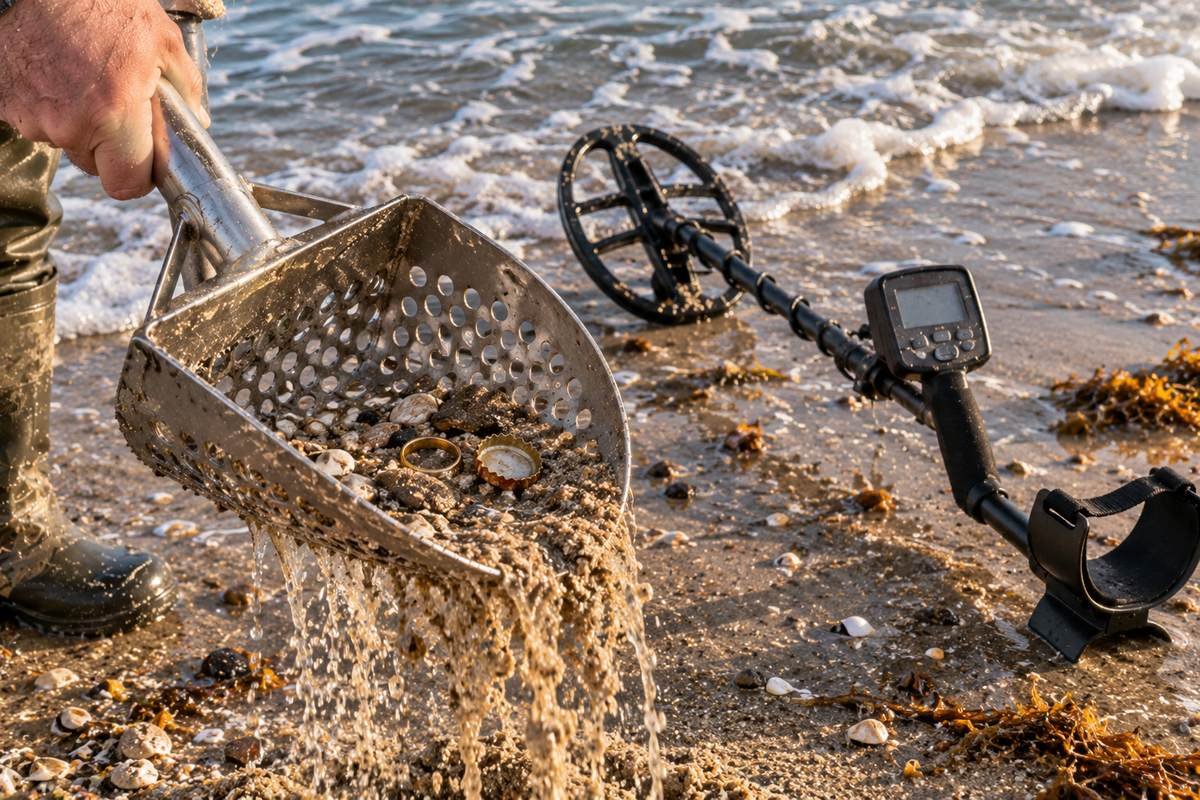
- A sand scoop, ideally a long-handled one so you are not bending over for every target on wet sand
- A mesh finds bag or pouch that drains water and sand as you walk
- A waterproof pinpointer for narrowing down a target inside a scoop full of wet sand
- Headphones, wired or wireless depending on your detector, since wind and waves drown out the built-in speaker fast.
- A bottle of fresh water or access to a tap, to rinse salt off the detector before you pack it away
- Sun protection, since a full day on open sand offers no shade
Best time to hunt a beach
Low tide is often the most useful window, since it exposes the most sand and lets you reach wet sand and wash-zone areas that are underwater at high tide. The hours around low tide after a storm can be worth checking, since storm surf reshapes the sand and can uncover older targets. Results vary with the beach, the season, and how much sand has moved. Check your local tide tables and plan to arrive as the tide is going out rather than coming in, so you get the maximum window of exposed sand before the water returns.
Before you dig, check your state or local regulations on beach metal detecting, since rules vary by beach and some protected areas restrict or prohibit it. The National Park Service's metal detecting policy is a useful starting point if you plan to hunt anywhere near federally managed land.
How to search a beach

Technique matters as much as the machine on a beach. Work in slow, overlapping sweeps rather than wide arcs, keeping the coil low and flat to the sand the whole way through each pass. Dry sand above the high-tide line rewards a methodical grid pattern since nothing moves it around between visits. Wet sand in the wash zone gets reshuffled by every wave, so it is worth re-hunting the same stretch of wet sand more than once in a session.
The wrack line (the band of shells, seaweed, and debris the tide leaves behind) marks where the last high tide reached, which makes it a useful line to start a grid from and worth a slower pass. After a storm or a strong tide pulls sand off the beach, that freshly exposed layer can turn up older targets a normal week of foot traffic would not reach.
How to recover a target with a sand scoop
- Pinpoint the signal with the center of the coil, then mark the spot with your foot or the scoop tip.
- Set the scoop a few inches behind the target, so the target sits in the middle of the scoop's path.
- Push straight down, lever the handle back, and lift out a full scoop. In wet sand, a firm push works better than a slow dig.
- Shake the scoop until only the target and shells are left, then check the hole again with the coil in case the target fell back in.
- In the surf, scoop as a wave pulls back, keep your feet planted, and never turn your back on incoming waves.
- Fill the hole before you move on.
Beach etiquette and conservation
Fill every hole you dig, every time, even a small one. An uneven hole left in dry sand is a twisted-ankle hazard for the next person walking through, and on more crowded beaches it is the single biggest reason towns restrict metal detecting hours or areas. Carry out the trash you find (bottle caps, pull tabs, broken glass) rather than leaving it in the hole or on the sand.
Keep a respectful distance from sunbathers and swimmers rather than sweeping right next to a blanket, and stay off roped-off dune or nesting areas, which are often protected habitat even when there is no visible sign. This also protects the hobby: beaches that stay clean and free of holes are the ones that keep allowing detecting.
Frequently asked questions
What is the best detector for saltwater beaches?
For most hunters, the Minelab Equinox 700. Its simultaneous multi-frequency and Beach mode handle wet salt sand and shallow surf with less noise than single-frequency detectors, and it is fully submersible to 16 feet. If you scuba dive, the Fisher CZ-21 is the only pick here rated to 250 feet.
Do I need a waterproof detector for dry sand beaches?
No. If you only plan to hunt dry sand above the tide line, a detector with just a waterproof coil, like the Garrett ACE 400, is enough. Full waterproofing only matters once you start wading or working the wash zone.
What frequency is best for beach detecting?
Multi-frequency detectors generally perform best on salt beaches because they handle the move between dry sand, wet sand, and saltwater with less retuning. A single-frequency VLF detector can still work if you ground balance carefully, lower the sensitivity, and use its beach mode if it has one. On freshwater beaches, frequency matters much less.
How deep can a beach detector find targets?
There is no honest single number. Depth depends on the target's size and metal, the coil, your settings, and how salty or mineralized the sand is. Wet salt sand usually costs some depth compared with dry sand, and a larger coin reads deeper than a small ring. Be wary of any guaranteed depth claim.
How long does a battery last during a full beach hunting session?
It varies by model. Nokta quotes about 12 hours for the Simplex Ultra, and Minelab dealers list about 12 hours for the Equinox 700. Garrett quotes 15 to 25 hours for the AT Max on AA batteries without wireless headphones, and Fisher quotes 35 to 55 hours for the CZ-21 on alkaline 9V batteries. Wireless headphones, a backlight, and cold weather all shorten runtime, so carry spares or a charged power bank, and never connect a power bank while the detector is in the water.
Is target ID accurate in wet sand?
Wet, salty sand is harder on target ID than dry sand, which is why multi-frequency and dedicated saltwater detectors usually read more steadily in the wash zone than a basic single-frequency VLF machine. Ground balance set correctly for the spot you are hunting makes the biggest difference.
Do wireless headphones work underwater?
No. Radio signals do not pass through water, so wireless audio cuts out once the control box is submerged. Garrett and Nokta both say their wireless headphones must not be submerged. For wading deep or diving, use wired waterproof headphones.
Is the Garrett AT Max good for saltwater beaches?
It works, but it takes care. Garrett's manual says salt water produces signals similar to foil and fine jewelry, and that careful ground balance, lower sensitivity, and a steady coil height are key. If wet salt sand is where you hunt most, a multi-frequency detector like the Equinox 700 is the easier choice.
Summary
Choosing the right beach metal detector comes down to where on the beach you hunt and how much time you spend in salt water. For most beach hunters, the Minelab Equinox 700 is the strongest all-around choice, with multi-frequency for wet salt sand and full submersion to 16 feet. If you scuba dive or work deep surf, the Fisher CZ-21 Quicksilver is the specialist tool built for exactly that job. The Garrett AT Max suits freshwater beaches and hunters who want one rugged detector for beach, park, and field. If you'll mostly be working dry sand on a budget, the Garrett ACE 400 is a simple option. The Nokta Simplex Ultra is the best value pick if you want a fully waterproof detector to wade and work wet sand without paying for multi-frequency.
Sources: Minelab Equinox 700 tech specs, Fisher CZ-21 product page (First Texas), Fisher CZ-21 manual (dealer copy), Garrett AT Max product page, Garrett AT Max manual, Garrett ACE 400 spec sheet, Nokta Simplex Ultra product page, and the Nokta Simplex user manual. Prices and stock checked on Amazon on 11 November 2026 and may have changed.