
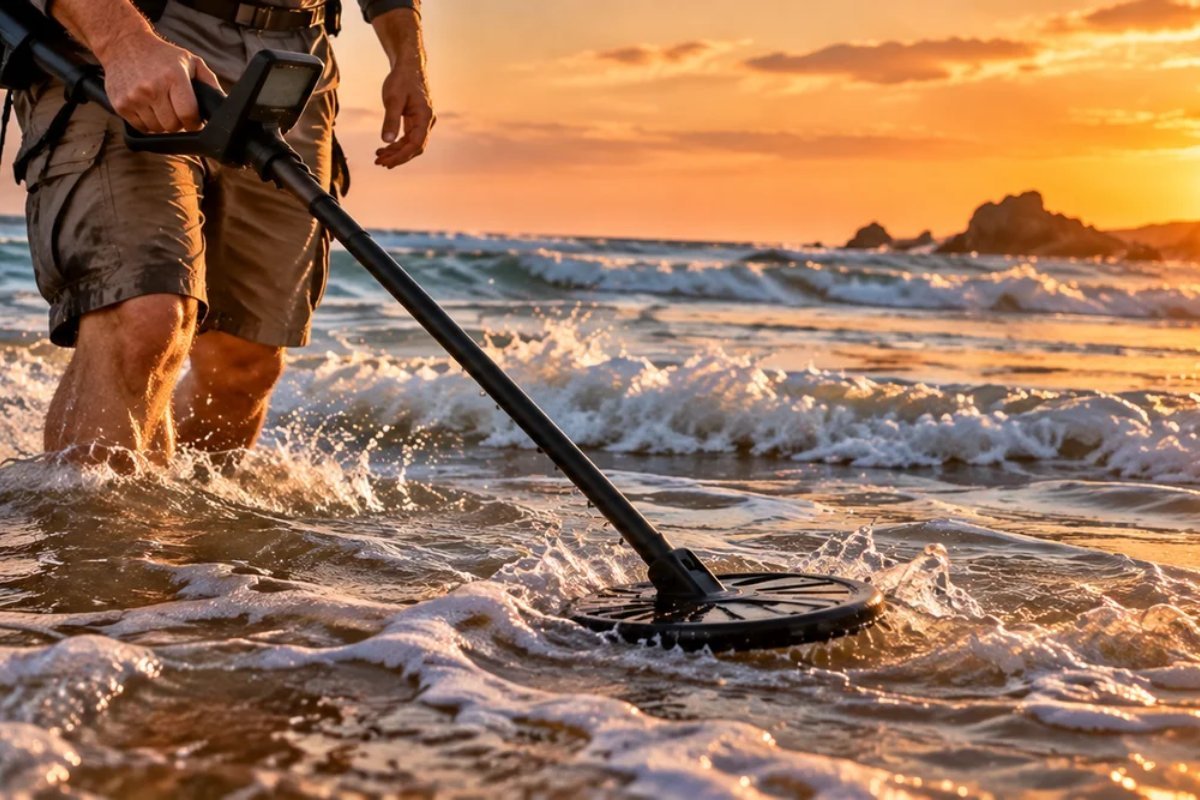
A regular metal detector is not built for water. Push most VLF (very low frequency) detectors past their coil into a puddle and water can get past the seals and short out the control box. An underwater metal detector, whether a basic waterproof model or a dedicated dive machine, is a different category of tool, sealed to a rated depth and tuned to keep working in wet sand, tide pools, and sometimes 100 feet down.
DetectorBrief is a participant in the Amazon Services LLC Associates Program, an affiliate advertising program designed to provide a means for sites to earn advertising fees by advertising and linking to Amazon.com.
Below are five detectors built for water, from a budget wading machine to a dedicated scuba detector rated to 200 feet. If you are just starting out and don't need full submersion, our guide to the best metal detector for beginners covers lighter, cheaper options. Every waterproof rating, frequency, and weight figure below comes from the maker's own listing. We haven't tested these five side by side, so treat this as a spec-based shortlist, and read how we research if you want the details.
Table of Contents
Quick picks: the best underwater metal detector
| Detector | Waterproof to | Frequency | Weight | Best for |
|---|---|---|---|---|
| Minelab Excalibur II 1000 (see details) | 200 ft (66 m) | BBS multi frequency, 1.5 to 25.5 kHz | 5.1 lbs | Scuba and full submersion |
| Garrett AT Max (see details) | 10 ft | 13.6 kHz | 3.03 lbs | All around waterproof detecting |
| Garrett AT Pro (see details) | 10 ft | 15 kHz | 3.02 lbs | Budget waterproof detecting |
| Minelab Equinox 900 (see details) | 16 ft | Multi-IQ, 5 kHz to 40 kHz | 2.96 lbs | Saltwater and multi purpose use |
| Nokta Legend Pro Package (see details) | 10 ft | Multi frequency plus 4, 10, 15, 20, 40 kHz | 3.0 lbs | Feature rich value pick |
How to choose an underwater metal detector
The depth rating is for the detector, not you
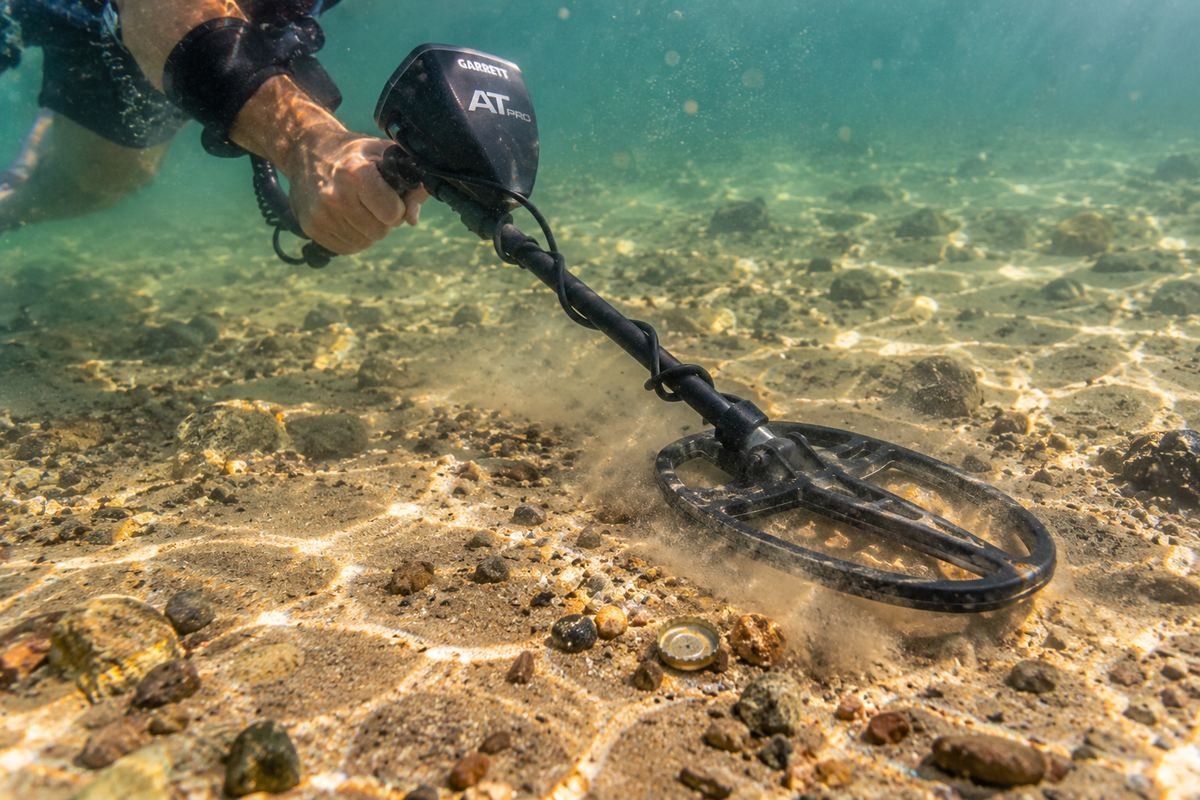
"Waterproof" on a detector listing means the control box, shaft, and coil can be submerged to a stated depth without leaking, not that the machine is rated for scuba diving at that depth. Knowing this keeps you from overpaying for a detector rated far deeper than you'll ever use. A detector rated to 10 feet is built for wading a creek or working a swimming beach where you occasionally dunk the coil and lower shaft. A machine like the Excalibur II, rated to 200 feet, is built around a diver taking it down there, with a fully sealed control housing meant to survive the pressure and handling of dive work.
Listings also mix up three different terms. Water-resistant means a machine can handle rain or splashes but not submersion. Waterproof, the rating that matters here, means the coil and often the full housing can go underwater to a stated depth. Submersible is sometimes used interchangeably with waterproof, but when a maker lists a specific depth and duration for it, treat that number as the real limit rather than assuming the machine can go deeper just because it is labeled submersible.
VLF vs. multi-frequency for saltwater
Saltwater conducts electricity, and a single-frequency VLF detector reads that conductivity as a wall of false signals, the same problem it has with heavily mineralized (full of natural minerals that can confuse a detector) ground. Multi-frequency detectors, like the Equinox 900's Multi-IQ or the Legend's simultaneous multi-mode, run several frequencies at once and can separate a real target's signal from the saltwater noise around it. If you plan to hunt a saltwater beach or wade the surf, multi-frequency is worth the extra cost. For freshwater lakes, rivers, and creeks, a single-frequency VLF like the AT Pro or AT Max works fine.
Coil size and weight for wading and diving
A detector you carry above the waterline swings differently once you're wading waist-deep or finning along a lake bottom. Water supports some of the machine's weight, which helps with the Excalibur II's 5.1 pounds on land, but a bulky coil still drags and catches current underwater. Smaller, rounder coils track easier in moving water and tight spots between rocks, while larger coils cover more ground faster on an open, calm bottom.
All metal mode and iron audio for wet trash
Swimming beaches and boat launches accumulate pull tabs, bottle caps, and rusted iron along with the coins and jewelry. A true all-metal mode, like the one on the AT Max, digs the deepest possible signal at the cost of discrimination (a setting that ignores signals from metals you don't want, like iron). That is useful when you want maximum depth and don't mind checking everything. Iron audio, on both the AT Pro and AT Max, lets you hear when a signal is ferrous before you dig, saving time in a swim area full of trash without losing depth on good targets.
Headphones: wired vs. wireless underwater
Wireless headphones are a convenience feature everywhere else and a liability underwater. Bluetooth and Z-Lynk signals don't transmit reliably through water, so most underwater work is still done with wired, waterproof headphones or a detector's built-in speaker. The AT Max ships with Z-Lynk wireless for land use, but plan on wired headphones for anything more than a shallow dunk.
The 5 best underwater metal detectors
1. Minelab Excalibur II 1000: best for scuba and full submersion
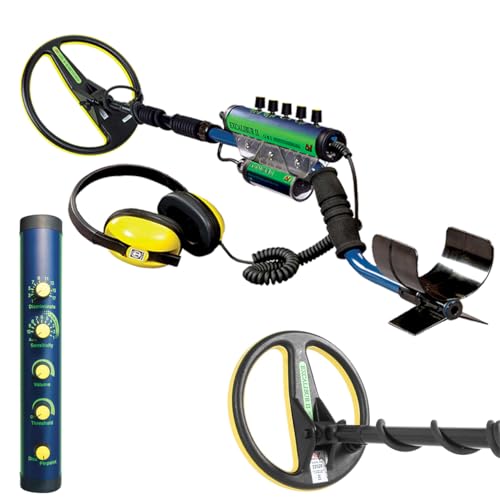
The Minelab Excalibur II 1000 is built as an amphibious machine first, rated to work from dry beach sand down to 200 feet underwater. Its Broadband Spectrum (BBS) technology runs multiple frequencies from 1.5 kHz to 25.5 kHz simultaneously, with ground canceling strong enough that Minelab says saltwater false signals aren't an issue once it's set up.
At 5.1 pounds, it's the heaviest detector on this list, but that weight matters less underwater, where the water supports part of the load. It runs on a rechargeable NiMH battery pack, and a side-mount shaft is available as an accessory for shallow wading and surf work. This is a serious, expensive tool built for divers and dedicated beach hunters, not a casual wading machine.
Minelab Excalibur II 1000
- Depth
- Down to 200 ft
- Frequency
- BBS, 1.5 to 25.5 kHz
- Weight
- 5.1 lb
Good for: divers and dedicated beach hunters.
Skip if: you only wade now and then. It is a serious, expensive tool built for divers.
Pros
- Works from dry sand down to 200 ft
- Minelab says saltwater false signals are not an issue once set up
- Rechargeable NiMH battery pack
Cons
- Heaviest detector on this list
- Expensive
2. Garrett AT Max: best all-around waterproof detector
The Garrett AT Max runs at 13.6 kHz and is waterproof to 10 feet, with a true all-metal mode (a mode that signals on every metal, with no filtering) for maximum depth. It also has Z-Lynk wireless technology that pairs near instantly with the included MS-3 headphones on land. Iron Audio lets you hear a ferrous signal before you dig, and a backlit display keeps it usable in low light or from inside a shadowed streambank.
At about 3 pounds, it handles land detecting and shallow water equally well, which is why detectorists moving up from a beginner machine often choose it. It costs more than the AT Pro for the wireless audio and all-metal mode, features worth having if you detect often enough to notice the difference.

Garrett AT Max
- Frequency
- 13.6 kHz
- Waterproof
- To 10 ft
- Weight
- About 3 lb
Good for: detectorists moving up from a beginner machine who hunt both land and shallow water.
Skip if: you do not need wireless audio or all-metal mode. The AT Pro costs less.
Pros
- True all-metal mode for maximum depth
- Z-Lynk wireless with MS-3 headphones included
- Iron Audio and a backlit display
Cons
- Costs more than the AT Pro
3. Garrett AT Pro: best budget waterproof detector
The Garrett AT Pro is fully submersible to 10 feet and has been a popular choice for wading detectorists for years. Proportional Audio and Tone Roll give a detailed target response for judging depth and conductivity (how easily a metal carries electric current) by ear, and 40 levels of iron discrimination let you filter out debris without losing real targets.
At 3.02 pounds, it weighs about the same as the AT Max, and it costs less while keeping the same fully submersible rating. The trade-off is no wireless audio and no true all-metal mode, but for a detectorist who wants a reliable waterproof machine without paying for extras, the AT Pro remains the value pick in the Garrett lineup.

Garrett AT Pro
- Waterproof
- To 10 ft
- Weight
- 3.02 lb
- Iron discrimination
- 40 levels
Good for: a reliable waterproof machine without paying for extras.
Skip if: you want wireless audio or a true all-metal mode. The AT Max has both.
Pros
- Fully submersible to 10 ft
- Proportional Audio and Tone Roll
- Costs less than the AT Max
Cons
- No wireless audio
- No true all-metal mode
4. Minelab Equinox 900: best for saltwater and multi-purpose use
The Minelab Equinox 900 is waterproof to 16 feet and runs Multi-IQ technology, simultaneous multi-frequency detection that handles saltwater beaches noticeably better than a single-frequency VLF. Dedicated Beach and Park modes switch the detector's behavior for the ground you're standing on, and wireless headphones are included for use above the waterline.
It isn't a dedicated dive machine like the Excalibur II, but for someone who wants one detector for wading the surf, sweeping the dry sand above the tideline, and hunting parks the rest of the year, the Equinox 900 covers more ground than a single-purpose waterproof detector.

Minelab Equinox 900
- Frequency
- Multi-IQ
- Waterproof
- To 16 ft
- Modes
- Beach and Park
Good for: one detector for wading the surf, sweeping the dry sand and hunting parks.
Skip if: you dive. The Excalibur II is the dedicated dive machine.
Pros
- Handles saltwater beaches better than a single-frequency detector
- Wireless headphones included for above the waterline
- Covers the beach and parks
Cons
- Not a dedicated dive machine
5. Nokta Legend Pro Package: best value multi-frequency pick
The Nokta Legend Pro Package is waterproof to 10 feet and offers a simultaneous multi-frequency mode alongside five selectable single frequencies from 4 kHz to 40 kHz. That gives you the flexibility to tune the detector to a specific ground condition instead of relying on one fixed setting. It ships with both a 6-inch and an 11-inch DD coil (a common coil design with two D-shaped windings), wireless headphones for land use, and a spare battery.
At 3 pounds for the detector itself, it swings comfortably all day, and four search modes (Park, Field, Beach, and Gold Field) cover most conditions a detectorist will hunt. Reviewers consistently point to it as the best detector for the money in this price range, with the trade-off being a steeper settings menu than something like the AT Pro.

Nokta Legend Pro Package
- Frequency
- Multi or 4 to 40 kHz
- Waterproof
- To 10 ft
- Coils
- 6 in and 11 in DD
Good for: getting multi-frequency and two coils at a lower price.
Skip if: you want simple menus. The settings are steeper than the AT Pro.
Pros
- Two coils and a spare battery in the box
- Wireless headphones for land use
- Park, Field, Beach and Gold Field modes
Cons
- Steeper settings menu than the AT Pro
What else you need for underwater detecting
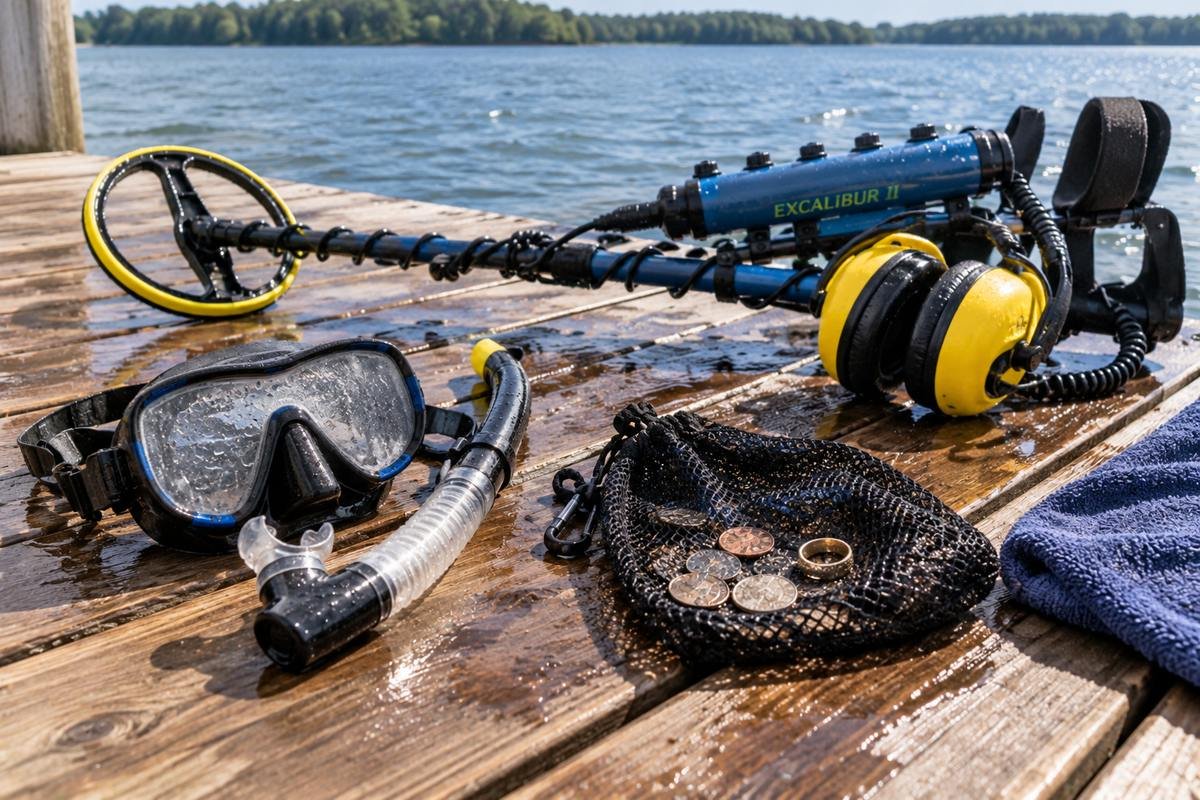
- Waterproof pinpointer: narrows a signal down to the exact spot in murky water or a scooped pile of sand instead of digging blind.
- Sand scoop: a long-handled, perforated scoop lets you sift wet sand in the surf without kneeling or losing the target in the wash.
- Wired waterproof headphones: wireless audio is unreliable underwater, so a wired pair is still the practical choice for wading and diving.
- Finds pouch or mesh bag: keeps recovered items secure while your hands stay free to keep swinging.
- Spare or backup search coil: a smaller coil swaps on for tighter work around rocks and wrecks, and carrying a spare means a cracked housing does not end a dive trip early.
Freshwater vs. saltwater detecting
Freshwater lakes, rivers, and creeks are the easier environment for any waterproof detector, since there's much less interference to fight and a single-frequency VLF like the AT Pro performs about as well wet as it does dry. Saltwater is a different problem. Dissolved salt makes the water and wet sand conductive. That produces false signals that overwhelm a single-frequency machine, which is why serious saltwater and surf hunters lean toward multi-frequency detectors like the Equinox 900 or Excalibur II.
Many public beaches allow detecting outside posted swimming hours and roped-off areas, but check local park and beach rules, since some public swimming areas restrict detecting during the day for safety reasons.
FAQ
How deep can a waterproof metal detector go?
Most waterproof detectors like the Garrett AT Pro and AT Max are rated to 10 feet, built for wading and shallow water rather than diving. Dedicated underwater machines like the Minelab Excalibur II are rated much deeper, up to 200 feet, and are built around actual scuba use.
Can I use a regular metal detector in water?
No. A standard detector's control box and connections aren't sealed for water, and submerging one can short the electronics or ruin the seals. Only a detector specifically rated as waterproof or submersible should go below its coil into standing water.
Do waterproof metal detectors work in saltwater?
A basic waterproof rating doesn't guarantee good saltwater performance. Single-frequency VLF detectors tend to false signal heavily in saltwater and wet salt sand, so multi-frequency detectors like the Equinox 900 or Excalibur II are the better choice for saltwater beaches and surf.
Do I need a fully submersible detector for beach detecting?
Not for dry sand detecting above the tideline, where any detector with a waterproof coil works fine. You only need full submersion if you plan to wade into the surf or work wet sand at the waterline, where the whole unit might get dunked.
Which One to Buy
For most wading and beach detectorists, the Garrett AT Pro is the practical starting point since it's fully submersible to 10 feet without the premium price of the AT Max. If you're hunting saltwater beaches or the surf regularly, the Minelab Equinox 900's multi-frequency detection is worth the upgrade. And if you dive to work wrecks or deep water, nothing on this list comes close to the Excalibur II's 200-foot rating.