
Where can you legally metal detect? The answer depends on who owns or manages the property, the applicable laws, and whether detecting and target recovery are permitted.
This guide covers state park regulations across all 50 states and Washington, D.C., along with public beaches, local parks, private property and four major federal land-management agencies.
Use the state selector below to find permit requirements, recovery restrictions, reporting obligations and relevant regulatory sources before planning your next metal detecting trip.
Our research draws on government regulations, published agency policies and identified legal repositories. Where a specific rule could not be confirmed, we explain the uncertainty and provide agency contact information.
Reviewed against official state and federal sources only. See our sourcing and review policy near the end of this guide. This is general information, not legal advice, and is not a blanket authorization to detect anywhere.
DetectorBrief is a participant in the Amazon Services LLC Associates Program, an affiliate advertising program designed to provide a means for sites to earn advertising fees by advertising and linking to Amazon.com.
Short answer
There is no single nationwide rule. Whether you can legally detect somewhere comes down to five checks: who manages the land, whether you have legal access or permission, what recovery-tool restrictions apply, who owns any finds and whether you must report them, and confirming all of that before you dig. Work through the five steps below, then jump to your state.
- Identify the property and who manages it
- Confirm you have legal access or permission
- Confirm which recovery tools and restrictions apply
- Check who owns any finds and whether you must report them
- Proceed only within the conditions you just confirmed
State-by-state legal guide
Every state is collapsed by default - tap or click a state to expand its rule, agency, permit requirement, and official source. Tap or click any state to jump straight to its rules.
Know Before You Detect
AlabamaSpecific rule located
- Agency
- Alabama State Parks
- General rule
- Current Alabama Administrative Code r. 220-5-.08(6) makes it unlawful to use a metal detector in a state park without the Park Manager's permission.
- Permit/registration
- Yes - permission from the individual park's Park Manager is required. No statewide permit form exists, each manager decides case by case.
- Key restriction
- Unauthorized use (without Park Manager permission) is unlawful statewide.
- Finds
- Not addressed in the reviewed rule text.
- Verification date
- 2026-11-25
- Regulation citation
- Ala. Admin. Code r. 220-5-.08(6)
- Agency contact
- Alabama State Parks Division, 1-800-ALA-PARK (252-7275). 64 North Union St., Room 538, Montgomery, AL. No general office email published. Individual staff emails only (e.g., Director Matthew Capps, matthew.capps@dcnr.alabama.gov).
AlaskaSpecific rule located
- Agency
- Alaska DNR, Division of Parks and Outdoor Recreation
- General rule
- Recreational metal detecting is allowed in Alaska State Parks, subject to park regulations, park-specific closures, and posted signs. Natural objects cannot be disturbed or removed, and cultural or historical material cannot be disturbed or removed unless specifically authorized by the Director under 11 AAC 18.010 (see also 11 AAC 12.170 and 12.175).
- Permit/registration
- Not required for ordinary recreational detecting that follows park regulations and involves no resource disturbance or removal.
- Key restriction
- No disturbance of natural or cultural/archaeological material. Leave and report possible historic finds.
- Finds
- Historically significant items must be left in place and reported to Alaska State Parks.
- Source
- Alaska DNR Parks FAQ
- Verification date
- 2026-11-25
- Regulation citation
- 11 AAC 12.170, 11 AAC 12.175, 11 AAC 18.010 (cited by the FAQ page. No detector-specific numbered regulation beyond the FAQ's general cultural/natural-resource rules)
- Agency contact
- DNR Public Information Center (907) 269-8400, dnr.pic@alaska.gov. Division of Parks and Outdoor Recreation Director's Office (907) 269-8700
ArizonaSpecific rule located
- Agency
- Arizona State Parks
- General rule
- Metal detecting is not permitted in Arizona state parks. Metal detecting, rock-hounding, and geocaching should avoid culturally and ecologically sensitive areas, and detectors cannot be used to search for relics or artifacts on public lands.
- Permit/registration
- Not applicable - prohibited outright.
- Key restriction
- Blanket prohibition in state parks.
- Finds
- Leave artifacts where found. Do not remove.
- Verification date
- 2026-11-25
- Regulation citation
- No codified regulation number found. Rule is stated as agency policy/guidance (not an Arizona Administrative Code section) on the Archaeological Site Etiquette page.
- Agency contact
- (877) 697-2757 (Arizona State Parks and Trails general information line, from the Arizona State Parks and Trails contact page)
ArkansasContact agency before detecting
- Agency
- Arkansas State Parks (Dept. of Parks, Heritage & Tourism)
- General rule
- No detector-specific rule could be located on any official Arkansas government source. The old arkansasstateparks.com domain now redirects to the tourism site arkansas.com/state-parks. The tourism site's own State Park Rules and Policies page confirms rules are issued as Park Directives (PD 3000 through PD 3250) under the Park Operations Manual, but does not reproduce their text. A search of the published Arkansas Administrative Code register for the Parks Division found no Park Directive titled or indexed under metal detecting, artifacts, or relic hunting among roughly 20 filed directives. A non-official hobbyist site reproduces text describing a 2004-2005 pilot program allowing detecting on public swim beaches at nine specific parks, but this is undated and unconfirmed on any government source.
- Permit/registration
- Unconfirmed on any primary source. The hobbyist-reported pilot program described registration at the park visitor center, but this cannot be verified as current policy.
- Key restriction
- Unconfirmed on any primary source. Contact Arkansas State Parks directly before detecting.
- Finds
- Unconfirmed on any primary source.
- Verification date
- 2026-11-25
- Regulation citation
- No detector-specific regulation found. Checked the Arkansas Administrative Rules database and the Arkansas Code R. Agency 013 Division 05 index. No Park Directive titled for metal detecting, artifacts, or relic hunting.
- Agency contact
- 888-287-2757 (TDD) / parks.info@arkansas.gov (per arkansas.com state park rules page). main Parks Division office 501-682-1191 (1 Capitol Mall, Little Rock, AR 72201)
CaliforniaSpecific rule located
- Agency
- California State Parks
- General rule
- No single statewide rule - individual park units each issue their own superintendent's order on metal detectors, so the rule varies park to park. The source example (Folsom Lake SRA, Order No. 690-006-2022) bans both use and possession of metal detectors/geophysical discovery devices anywhere in that unit, with only narrow exceptions (transport in a vehicle without use, or a permit under 43 CFR 423.50).
- Permit/registration
- Per-unit order/permit. Confirm with the specific park unit - some units (like Folsom Lake) effectively ban detectors outright rather than issuing permits.
- Key restriction
- Varies by unit - many restrict historic/archaeological areas. Folsom Lake SRA restricts the entire unit.
- Finds
- Per unit order.
- Verification date
- 2026-11-25
- Regulation citation
- CA State Parks Superintendent's Order No. 690-006-2022 (example, Folsom Lake SRA). cites California Public Resources Code Sections 5003 and 5008, several 14 CCR sections, and 43 CFR 423.29(f)/423.50. No single statewide detector regulation exists - each unit issues its own order.
- Agency contact
- California State Parks Contact Us form (mailing address 715 P Street, Sacramento, CA 95814). For cultural-resource-specific questions: Office of Historic Preservation, (916) 445-7000, info.calshpo@parks.ca.gov.
ColoradoGeneral rules only
- Agency
- Colorado Parks & Wildlife
- General rule
- Checked CPW's current state parks regulation, Chapter P-1 (2 CCR 405-1, formerly cited as Chapter W-9/Wildlife Properties), directly in full - no metal-detector-specific clause found. The chapter's general resource-protection provision, Regulation #100(b), prohibits removing, destroying, or defacing park objects of archaeological, geological, or historical value, with a narrow carve-out for recreational gold mining in the Arkansas Headwaters Recreation Area except where posted closed.
- Permit/registration
- Unclear - no detector-specific permit process found. CPW's own "Ask Colorado Parks and Wildlife" form is the suggested way to get a park-specific answer.
- Key restriction
- General resource-protection rule applies (no removing/disturbing archaeological, geological, or historical objects). no detector-specific text located in the current regulation.
- Finds
- Unclear - not addressed by name in the regulation.
- Verification date
- 2026-11-25
- Regulation citation
- No detector-specific regulation found (general resource-protection rule is 2 CCR 405-1, Ch. P-1, Reg. #100(b))
- Agency contact
- Colorado Parks and Wildlife headquarters: 303-297-1192 (Mon-Fri, 8am-5pm MST). online form at cpw.state.co.us/form/ask-colorado-parks-and-wildlife for park-specific questions.
ConnecticutGeneral rules only
- Agency
- CT DEEP, State Parks Division
- General rule
- Checked DEEP's own State Parks and Forests Policies page directly - no mention of metal detecting or object removal. The page covers alcohol, buses, hours, and pet rules only. No detector-specific statute, regulation, or published policy was located after a renewed search.
- Permit/registration
- Unclear - contact DEEP State Parks Division directly. A special-use permit may be required for activities not otherwise addressed.
- Key restriction
- Unclear. No detector-specific rule found. General park rules against disturbing/removing natural or historic/archaeological resources would likely apply by default.
- Finds
- Unclear.
- Verification date
- 2026-11-25
- Regulation citation
- No detector-specific regulation found. Connecticut General Statutes and DEEP regulations broadly prohibit removing natural or historic objects from state parks, but no provision naming metal detectors specifically was located.
- Agency contact
- CT DEEP State Parks Division: (860) 424-3200, deep.stateparks@ct.gov
DelawareSpecific rule located
- Agency
- Delaware Division of Parks and Recreation / DNREC
- General rule
- 7 Del. Admin. Code Section 9201-3.6: use of metal detectors on lands under the jurisdiction of the Division of Parks and Recreation is prohibited, except during normal park hours, and only on ocean beaches east of the dune line (Section 3.6.1).
- Permit/registration
- No permit described in the rule itself. Detecting is simply geographically and time-of-day restricted to ocean beaches east of the dune line during normal park hours.
- Key restriction
- Prohibited everywhere in the park system except on ocean beaches east of the dune line, and only during normal park operating hours.
- Finds
- Not addressed in Section 9201-3.6. general park rules on removal of state property/artifacts would apply elsewhere in the code.
- Verification date
- 2026-11-25
- Regulation citation
- 7 Del. Admin. Code Section 9201-3.6 and 3.6.1
- Agency contact
- 302-739-9220 (Delaware State Parks main number, from DNREC's contacts page)
FloridaSpecific rule located
- Agency
- Florida State Parks (FL Dept. of Environmental Protection, Division of Recreation and Parks)
- General rule
- Confirmed live: metal detecting is prohibited on all state park lands except coastal parks, where it is allowed only in beach areas designated by the park manager, between the toe of the dune and the high-water line. Submerged areas are off-limits. Objects over 50 years old are archaeological artifacts owned by the State of Florida and may not be kept.
- Permit/registration
- Not required on designated beach areas, but the FAQ recommends calling the specific park ahead to confirm where detecting is allowed. For a personal lost item, the owner contacts the park manager, who schedules a search with a staff member present.
- Key restriction
- Beach areas only, above the high-water line (toe of dune to high-water line). no submerged searching. No keeping of historic objects over 50 years old.
- Finds
- Items over 50 years old belong to the State of Florida (Division of Historical Resources) and must not be kept. In a lost-item search, the owner may keep only the specific item being searched for.
- Verification date
- 2026-11-25
- Regulation citation
- No specific rule or statute number was cited on the FAQ page itself. The rule is presented as agency policy rather than a numbered administrative code section (Florida DEP's broader state park administrative rules are in F.A.C. Chapter 62D-2, but the FAQ page does not cross-reference a specific subsection for metal detecting).
- Agency contact
- Statewide Information Line (850) 245-2157. FSP.Feedback@FloridaDEP.gov
GeorgiaSpecific rule located
- Agency
- GA DNR, Office of the State Archaeologist (Parks and Historic Sites Division)
- General rule
- GA DNR's own Artifact Collecting FAQ states outright that metal detecting on state property is not legal, not merely permit-based. Permission to dig only applies on privately-owned land with the landowner's written consent.
- Permit/registration
- No permit pathway is offered for state property in this FAQ. Detecting itself is described as illegal there, period.
- Key restriction
- Blanket prohibition on state-owned property (which includes state parks). the landowner-permission provision applies only to private land.
- Finds
- Not addressed for state property (since the underlying activity is prohibited). on private land, finds belong to the landowner absent other agreement.
- Verification date
- 2026-11-25
- Regulation citation
- No detector-specific statute or administrative rule number is cited on the page itself. The prohibition is stated as GA DNR agency guidance on its own gadnr.org FAQ page, not as a numbered regulation.
- Agency contact
- GA DNR Office of the State Archaeologist: 770-389-7862 or 770-389-7857
HawaiiSpecific rule located
- Agency
- Hawaii DLNR, Division of State Parks
- General rule
- Metal detecting devices are allowed on sand beaches only. Plants, geological, historical, and archaeological features must be left undisturbed elsewhere. Lost items found in parks should be turned in to the nearest police station or park visitor facility.
- Permit/registration
- Not required on sand beaches.
- Key restriction
- Sand beaches only. No detecting elsewhere in state parks.
- Finds
- Turn found items in to police or the park visitor facility.
- Verification date
- 2026-11-25
- Regulation citation
- No detector-specific regulation found (rule appears as a park-rules-page policy. DLNR's state parks administrative rules, Haw. Code R. Chapter 13-146, do not separately name metal detectors)
- Agency contact
- Hawaii Division of State Parks, O'ahu (Main) Office: (808) 587-0300. Email dlnr@hawaii.gov
IdahoSpecific rule located
- Agency
- Idaho Department of Parks and Recreation
- General rule
- Under IDAPA 26.01.20.175 (Public Behavior), Subsection 11, Non-traditional Recreational Activities, metal detecting (along with model airplane/glider operation, geocaching, gold panning, and drone operation) may be authorized by the park manager or designee. Authorization is conditioned on not interfering with traditional park uses and being consistent with preservation of park resources. Separately, IDAPA 26.01.20.576 prohibits digging, destruction, or removal of historical, cultural, or natural resources (collection for scientific or educational purposes requires written park-manager permission), and Section 125 prohibits disturbing public property without park-manager authorization.
- Permit/registration
- Yes - park manager/designee authorization required. No standardized statewide permit or fee process is specified in the rule text.
- Key restriction
- Must not interfere with traditional uses or park-resource preservation. No digging or removal of historical or cultural resources without written permission.
- Finds
- Per park manager's authorization terms. historical/cultural resources may not be removed.
- Verification date
- 2026-11-25
- Regulation citation
- IDAPA 26.01.20.175. Related: Section 576 (resource removal) and Section 125 (public property).
- Agency contact
- Idaho Dept. of Parks and Recreation headquarters: (208) 334-4199. General Inquiry form at parksandrecreation.idaho.gov/contact-us/. reservations 1-888-922-6743
IllinoisSpecific rule located
- Agency
- Illinois DNR
- General rule
- Statewide base rule is Illinois Administrative Code Title 17, Part 110, Section 110.120(c): it is an offense to operate a non-handheld metal or mineral detection device, and handheld metal detectors require an advance permit from the Department through the Chief of Lands. In practice this is implemented through site-specific permits issued per park (e.g., Giant City State Park has its own metal-detecting permit form).
- Permit/registration
- Yes - advance permit required from IDNR (Chief of Lands) for handheld detectors. Site-specific permit forms exist for individual parks such as Giant City.
- Key restriction
- Only small hand tools (pen knife, ice pick, screwdriver) may be used to recover finds. No shovels, picks, or entrenching tools of any size. The work area must be restored.
- Finds
- Per permit terms - items of antiquity relevant to the park must generally be turned in or reported to park staff. Detecting is not allowed on State Historical, Archaeological, or Nature Preserve sites.
- Verification date
- 2026-11-25
- Regulation citation
- 17 Ill. Admin. Code Section 110.120(c)
- Agency contact
- 217-782-6302 (Illinois DNR general information line, from the Illinois DNR contact page)
IndianaSpecific rule located
- Agency
- Indiana DNR
- General rule
- 312 IAC 8-2-10(7) prohibits using a metal detector on DNR property, except on a sand swimming beach as approved by an authorized representative.
- Permit/registration
- No permit needed on an approved sand swimming beach. Elsewhere on DNR property, metal detector use requires a DNR-issued license or authorization.
- Key restriction
- Prohibited DNR property-wide except on sand swimming beaches approved by an authorized department representative.
- Finds
- Not addressed directly by the metal-detector subsection, but the same section (312 IAC 8-2-10(5)) separately prohibits removing artifacts, rocks, or minerals from DNR property.
- Verification date
- 2026-11-25
- Regulation citation
- 312 IAC 8-2-10(7). section originally filed Oct. 28, 1998, effective Jan. 1, 1999, amended effective Jan. 2, 2013, with readoptions in 2004, 2010, 2016, and 2022
- Agency contact
- Online contact form at in.gov/dnr/state-parks/about-us/contact-us. Camping line 1-866-622-6746. Indiana State Information Center 1-800-457-8283
IowaSpecific rule located
- Agency
- Iowa DNR
- General rule
- Metal detector use in state parks and recreation areas is prohibited except in designated beach areas, where it is allowed from 4 a.m. to 11 a.m. each day during the May 22 to September 7 season (outside that season, hours follow 571-61.10(10)). Use is also allowed on drained lake beds under 61.10(10) hours, but only after the lake bed has been thoroughly surveyed for archaeological resources and a report approved by the state historic preservation office.
- Permit/registration
- Not required within the designated beach/time window. Drained-lake use requires a prior archaeological survey and approved report rather than a personal permit.
- Key restriction
- Designated beach areas only, 4am-11am, May 22-Sept 7 season. Drained lakebeds allowed only after archaeological survey sign-off.
- Finds
- Not addressed in this rule.
- Verification date
- 2026-11-25
- Regulation citation
- Iowa Administrative Code 571-64.1 (definitions, including beach) and 571-64.2 (use restrictions for beach areas and drained lakes).
- Agency contact
- the Iowa DNR contact web form (DNR states it aims to respond within one business day).
KansasGeneral rules only
- Agency
- Kansas Dept. of Wildlife & Parks
- General rule
- No dedicated statewide metal-detector clause exists in Kansas's park regulations. The closest applicable rule, K.A.R. 115-8-20 (Construction, littering, and prohibited activities), prohibits digging holes or pits on department lands/waters and prohibits destroying, defacing, degrading, or removing historical sites or archeological relics/ruins, unless authorized by the department. This would govern recovering any target found while detecting, even though the regulation does not use the words metal detector. Some municipalities (e.g., Kansas City) have their own separate local metal-detecting policy.
- Permit/registration
- Unclear statewide for detecting itself. Department authorization would be needed to dig/recover anything under K.A.R. 115-8-20. Check local municipal rules separately.
- Key restriction
- No digging holes/pits or removing historic/archaeological relics without department authorization.
- Finds
- Unclear. Any historic or archaeological relic recovered would fall under the removal restriction in K.A.R. 115-8-20 absent authorization.
- Verification date
- 2026-11-25
- Regulation citation
- Kan. Admin. Regs. 115-8-20 (no detector-specific regulation found. This is the closest general rule on digging and removing relics)
- Agency contact
- KDWPT Operations Office: (620) 672-5911, 512 SE 25th Ave., Pratt, KS 67124. General questions: (785) 249-5093. Online contact form also available.
KentuckySpecific rule located
- Agency
- Kentucky Dept. of Parks
- General rule
- 304 KAR 1:050: except as provided in Section 2, the use of metal detectors shall be prohibited in all Kentucky state parks. Section 2 exempts park personnel, law enforcement personnel, and utilities, who may use metal detectors.
- Permit/registration
- Not applicable to the public - prohibited outright except for staff/police/utility workers.
- Key restriction
- Blanket statewide prohibition for the public.
- Finds
- Not applicable.
- Verification date
- 2026-11-25
- Regulation citation
- 304 KAR 1:050
- Agency contact
- Kentucky Dept. of Parks, Frankfort main office: (502) 564-2172. parks.ky.gov/contact-us/general-inquiries
LouisianaSpecific rule located
- Agency
- LA Office of State Parks
- General rule
- Section 303.H: the display, possession, and use of metal detectors or similar devices is prohibited on Office of State Parks property. Digging for or removing historical features, relics, or artifacts is strictly forbidden. Excavation requires a permit from the Louisiana Archaeological Survey and Antiquities Commission.
- Permit/registration
- Not applicable on state park land - prohibited outright.
- Key restriction
- Blanket prohibition on state park property.
- Finds
- Not applicable. Artifact removal strictly forbidden without a separate state permit.
- Verification date
- 2026-11-25
- Regulation citation
- LA Office of State Parks regulations, Title 25, Section 303.H
- Agency contact
- (888) 677-1400 or (225) 342-8111 (Louisiana Office of State Parks, from the Louisiana State Parks contact page)
MaineSpecific rule located
- Agency
- Bureau of Parks & Lands (DACF)
- General rule
- Confirmed live under Rule 4 of the park rules page: use of metal detectors at historic sites is prohibited. Metal detectors are allowed in other areas only by written permit obtained at the park.
- Permit/registration
- Written permit required outside historic sites. Not available at historic sites at all.
- Key restriction
- No detecting at historic sites under any circumstance.
- Finds
- Not addressed in this rule.
- Verification date
- 2026-11-25
- Regulation citation
- Presented on the page as Rule 4 of the Bureau's posted Park Rules. No separate Maine Administrative Code chapter/section number is cited on the page itself.
- Agency contact
- (207) 287-3821 (Bureau of Parks and Lands). dacf@maine.gov (department-wide)
MarylandSpecific rule located
- Agency
- Maryland DNR / Maryland Historical Trust (Office of Archaeology)
- General rule
- Per Maryland Park Service Agency Policy 13-17 (July 1, 2015) and the DNR metal-detecting page: digging for buried relics or treasure, removing prehistoric or historic artifacts, and using metal detectors are strictly prohibited on DNR lands without a Maryland Historical Trust archaeology permit (issued only to archaeologists or qualified investigators). The exception is designated swimming beaches operated by the Park Service (except Point Lookout and Calvert Cliffs State Parks), where detecting for modern coins, jewelry, and similar lost items is allowed with the Park Manager's permission, no MHT permit needed.
- Permit/registration
- MHT archaeology permit required generally (rare, for qualified individuals/archaeologists). the beach exception needs only the Park Manager's permission, no MHT permit.
- Key restriction
- Beach exception excludes Point Lookout and Calvert Cliffs State Parks. Beach detecting is barred from 9:00 a.m. until dusk from May 30 through Labor Day, and the Park Manager may further restrict use if it disrupts other visitors.
- Finds
- No MHT reporting requirement is stated in Agency Policy 13-17 itself, but MHT's separate public guidance asks that finds appearing more than 50 years old be reported to the Trust.
- Verification date
- 2026-11-25
- Regulation citation
- Maryland Park Service Agency Policy 13-17 (effective July 1, 2015). No single detector-specific COMAR section number was independently confirmed beyond this agency policy document.
- Agency contact
- Maryland DNR general public line: 1-877-620-8367 (toll-free in MD) or 410-260-8367 (out of state), weekdays 8:30am-5pm, MD Relay 711.
MassachusettsSpecific rule located
- Agency
- MA DCR
- General rule
- DCR's own archaeology guidance states plainly that use of metal detectors is not allowed on DCR property. It also instructs that anyone who witnesses someone using a metal detector should report it right away to the DCR Park Supervisor, park rangers, and DCR archaeologists.
- Permit/registration
- Not applicable - prohibited outright.
- Key restriction
- Blanket prohibition on DCR property.
- Finds
- Report suspected finds to DCR archaeologists. Do not remove.
- Source
- MA DCR, Archaeology page
- Verification date
- 2026-11-25
- Regulation citation
- No detector-specific regulation found (this is published agency policy on mass.gov rather than a codified CMR section. DCR's general property regulations are at 302 CMR 12.00, which governs archaeological features and quarries generally but was not found to separately codify a metal-detector ban in the text reviewed)
- Agency contact
- DCR Office of Cultural Resources: Patrice Kish, Director, (617) 626-1378. Ellen Berkland, Archaeologist, (617) 626-1377. 251 Causeway St, Suite 600, Boston, MA 02114.
MichiganSpecific rule located
- Agency
- Michigan DNR
- General rule
- Governed by a dedicated state-parks metal-detecting page. Metal detecting is not allowed at designated historic and archaeological sites, and is limited to areas specifically designated as open to it (e.g., Brimley, Grand Haven, Lakeport, Mears, and Traverse City State Parks outright. Roughly 50 other parks including Ludington, Muskegon, Warren Dunes, Holland, and Porcupine Mountains Wilderness via mapped designated areas. Flint State Park requires a permit via Genesee County Parks).
- Permit/registration
- Generally allowed in designated turf/mapped areas without a separate permit. Flint State Park requires a permit through Genesee County Parks.
- Key restriction
- No detecting at historic/archaeological sites. Only probes or small hand trowels may be used, with disturbed ground replaced. Large-scale digging requires a DNR-authorized archaeological permit.
- Finds
- A unit employee must check all recovered items. Relics, Aboriginal antiquities, and abandoned property of historical/recreational value remain state property. Items with an identifiable owner may be returned.
- Verification date
- 2026-11-25
- Regulation citation
- No separate numbered administrative rule citation is given on the page itself. The page functions as the DNR's operative policy statement for state parks metal detecting.
- Agency contact
- Michigan DNR Parks and Recreation Division: (517) 284-7275 (517-284-PARK), DNR-ParksAndRecreation@michigan.gov. Reservations 1-800-447-2757
MinnesotaSpecific rule located
- Agency
- Minnesota DNR
- General rule
- Minnesota Rule 6100.0900, subpart 2, item F: use of metal detectors in state parks is permitted only for locating specifically identified lost personal property, requires prior written permission from the park manager, and must be supervised by the park manager. A separate exception allows scientific research under a special permit from the commissioner plus a field archaeology license from the state archaeologist. Some county parks (e.g. Dakota County) run their own separate programs outside this state rule.
- Permit/registration
- Yes - prior written permission from the park manager, for lost-item searches only. Supervised use.
- Key restriction
- Lost-item searches only. No general recreational detecting.
- Finds
- Per park manager's permission terms.
- Verification date
- 2026-11-25
- Regulation citation
- Minn. R. 6100.0900, subp. 2, item F
- Agency contact
- 651-296-6157 or 888-646-6367 (Minnesota DNR Information Center, from the Minnesota DNR contact page)
MississippiSpecific rule located
- Agency
- MS Dept. of Wildlife, Fisheries & Parks
- General rule
- Rule 1.2, Section W (General), item 17 states that no one shall use metal detectors on any Mississippi State Park. The rule cites Miss. Code Ann. Section 39-7-4 as statutory authority.
- Permit/registration
- Not applicable - prohibited outright.
- Key restriction
- Blanket statewide prohibition.
- Finds
- Not applicable.
- Verification date
- 2026-11-25
- Regulation citation
- 40 Miss. Admin. Code Part 6, Rule 1.2, Section W, item 17. Statutory authority Miss. Code Ann. Section 39-7-4
- Agency contact
- 601-432-2400 (MDWFP main office). 1-800-GOPARKS (State Parks reservations line). online contact form at mdwfp.com/contact-us
MissouriSpecific rule located
- Agency
- Missouri State Parks (DNR)
- General rule
- Runs a dedicated statewide metal-detecting registration program limited to designated beach areas. The agency's own page states there are 11 state parks that allow metal detecting in designated beach areas, and that registration is required to search for hidden treasures in Missouri State Parks.
- Permit/registration
- Yes - statewide registration required via the Missouri State Parks Metal Detecting Registration Form (mostateparks.com).
- Key restriction
- Allowed only in designated beach areas at the 11 listed state parks. historic/archaeological sites and other areas excluded.
- Finds
- Must register and follow program terms. The registration page itself does not spell out finds/reporting rules beyond registering.
- Verification date
- 2026-11-25
- Regulation citation
- No codified administrative rule number found. The program is run as DNR/Missouri State Parks policy via the Metal Detecting Registration Form (dnr.mo.gov / mostateparks.com).
- Agency contact
- moparks@dnr.mo.gov, 573-751-2479 (Missouri State Parks).
MontanaSpecific rule located
- Agency
- Montana FWP
- General rule
- Under ARM 12.12.106(1)(f), using a mineral or metal detector, magnetometer, or other metal detecting device at a public use site without written permission from the department is prohibited conduct. This rule applies at FWP-managed public use sites, including state parks and wildlife management areas, not to all property statewide.
- Permit/registration
- Yes - written permission required from the department.
- Key restriction
- To protect sensitive cultural/heritage/natural resources.
- Finds
- Not addressed in the reviewed text.
- Verification date
- 2026-11-25
- Regulation citation
- ARM 12.12.106(1)(f), Property Disturbance, part of FWP's Consolidated Public Use Rules. This replaced the former State Parks rule ARM 12.8.802(1)(g), which regulations.justia.com shows as repealed. The current text was confirmed directly on FWP's own fwp.mt.gov site: "use a mineral or metal detector, magnetometer, or other metal detecting device at public use sites without written permission from the department" is listed as prohibited conduct under 12.12.106(1)(f).
- Agency contact
- Montana FWP, Parks and Outdoor Recreation Division: 406-444-3750. Email fwpprk@mt.gov. Park reservations: 1-855-922-6768.
NebraskaGeneral rules only
- Agency
- Nebraska Game & Parks Commission
- General rule
- 163 Neb. Admin. Code ch. 4, Section 018 prohibits disturbing any artifact, relic, historic or prehistoric feature, or other public property on Wildlife Management Areas without Commission permission. No metal-detector-specific text was found in this or the related state-park chapter (ch. 5) after a renewed, direct search of both the Cornell mirror and Nebraska's own rules infrastructure.
- Permit/registration
- Unclear.
- Key restriction
- General artifact/relic protection rule applies. No detector-specific text located.
- Finds
- Unclear.
- Verification date
- 2026-11-25
- Regulation citation
- 163 Neb. Admin. Code ch. 4, Section 018 (general property/relic protection). ch. 5, Section 001 (general state park property administration) - no detector-specific section identified.
- Agency contact
- Nebraska Game and Parks Commission: (402) 471-0641. outdoornebraska.gov
NevadaSpecific rule located
- Agency
- Nevada State Parks
- General rule
- Governed by NAC 407.103: a person may not use a metal detector in a Nevada state park unless authorized by the park supervisor.
- Permit/registration
- Yes - requires authorization from the park supervisor. Otherwise prohibited.
- Key restriction
- Default is prohibition. Detecting only happens where the park supervisor specifically authorizes it (historic/archaeological sites such as Valley of Fire and Berlin-Ichthyosaur are typically excluded from any such authorization).
- Finds
- Per the park supervisor's authorization terms.
- Verification date
- 2026-11-25
- Regulation citation
- NAC 407.103
- Agency contact
- (775) 684-2770 or stparks@parks.nv.gov (Nevada State Parks main office, from the Nevada State Parks contact page)
New HampshireSpecific rule located
- Agency
- NH Dept. of Natural & Cultural Resources, State Parks
- General rule
- Confirmed live: Ncr 731.19 (Metal Detectors). Metal detectors are not permitted on department properties, except under Ncr 740 special use permits or when used by authorized department personnel. Metal detectors are permitted along the shoreline of beaches unless otherwise posted. Metal detectors are not permitted at state historic sites, natural areas, or Odiorne Point State Park. Found money or items worth more than $50 are subject to the Lost and Found rule (Ncr 731.27). digging rules (Ncr 731.20) also apply.
- Permit/registration
- Not required along permitted beach shorelines. A special use permit (Ncr 740) is required elsewhere.
- Key restriction
- Banned at historic sites, natural areas, and Odiorne Point State Park.
- Finds
- Items found worth over $50 fall under the Lost and Found rule, Ncr 731.27.
- Verification date
- 2026-11-25
- Regulation citation
- Ncr 731.19 (cross-referencing Ncr 740 special use permits, Ncr 731.20 digging, and Ncr 731.27 Lost and Found Items)
- Agency contact
- 603-271-3556 (Division of Parks and Recreation). dncr.nh.gov/contact for general department contact
New JerseySpecific rule located
- Agency
- NJ DEP / State Park Service
- General rule
- Per N.J.A.C. 7:2-2.16 (Metal detectors): a person shall not use metal detectors or similar devices without a permit issued by the Superintendent or designee. The permit may limit the location, hours, and days of use. A permit will not be issued for use in areas of significant historical or other value, or where such use would be incompatible with protection of the resource or would interfere with public use of the facility.
- Permit/registration
- Permit required from the park Superintendent or designee for any metal detector use. An actual permit application and approval is required in every case, not simply permitted in designated non-historic areas without more.
- Key restriction
- No permit issued for areas of significant historical or other value, or where use would be incompatible with resource protection or would interfere with public use of the facility.
- Finds
- Not addressed in the text of this regulation.
- Verification date
- 2026-11-25
- Regulation citation
- N.J.A.C. 7:2-2.16, Title 7 (Environmental Protection), Chapter 2 (State Park Service Code), Subchapter 2 (General Use), Section 7:2-2.16 (Metal detectors).
- Agency contact
- NJ State Park Police non-emergency dispatch: 1-877-WARN-DEP (1-877-927-6337). The metal detector permit itself is issued by the Superintendent or designee of the specific state park, not by this dispatch line, so start by contacting that park directly.
New MexicoGeneral rules only
- Agency
- EMNRD State Parks Division
- General rule
- Checked EMNRD's own current rule directly in full (19.5.1 NMAC), including the statement of reasons and the definitions section - no mention of metal detectors or metal detecting anywhere. The only related activity defined is geocaching (19.5.1.7 NMAC), described as an outdoor treasure-hunting activity in which the participants use a global positioning system receiver, which does not address metal detection.
- Permit/registration
- Unclear.
- Key restriction
- General state parks regulations apply. No detector-specific text located.
- Finds
- Unclear.
- Verification date
- 2026-11-25
- Regulation citation
- No detector-specific regulation found
- Agency contact
- New Mexico State Parks Division: 505-476-3355 (local) or 1-888-667-2757 (toll free). email nm.parks@emnrd.nm.gov
New YorkSpecific rule located
- Agency
- NY OPRHP
- General rule
- Runs a dedicated permit system that varies by region and individual park. The Metal Detector Guide covers Long Island state parks specifically (a statewide guide was not located, so permit terms should be confirmed with each individual park/region).
- Permit/registration
- Yes - regional/park-specific permit. For Long Island parks: annual permit $40, expires December 31 regardless of issue date, sold via the NYS Parks ReserveAmerica website or QR code. Use limited to designated/mapped areas, some open year-round and others Memorial Day-Labor Day only.
- Key restriction
- Historic/archaeological sites excluded. No detecting in landscaped areas, beach dune areas, golf courses/driving ranges, or residences. Digging tools capped at 1.5 in. Wide by 6 in. long. Ground must be restored immediately. No interference with wildlife or piping plover nesting areas.
- Finds
- Items worth more than $20 must be turned in to Park Police. Archaeological artifacts may not be removed and must be turned over to Park Police.
- Verification date
- 2026-11-25
- Regulation citation
- No single statewide numbered regulation cited in the guide itself. Permits and rules are administered park-by-park/region-by-region under OPRHP's general park-use authority.
- Agency contact
- NY OPRHP general information line: (518) 474-0456. Park Police (for turned-in items): (631) 321-3700. parks.ny.gov/about/contact-us
North CarolinaSpecific rule located
- Agency
- NC Parks / DEQ / NC Dept. of Natural and Cultural Resources
- General rule
- Metal detectors are not allowed in any NC state park area except to locate specifically lost personal property, and any such use requires a Special Use Permit issued by the Park Superintendent or designee.
- Permit/registration
- Yes - Special Use Permit from the Park Superintendent or designee, limited to lost-property searches.
- Key restriction
- Archaeological/historic sites excluded. General recreational detecting for artifacts is not permitted.
- Finds
- Must report finds. Items of archaeological/historic significance are not to be kept.
- Verification date
- 2026-11-25
- Regulation citation
- No separate numbered administrative code section found specifically for metal detectors. Rule is stated as NC DEQ/NC Parks agency guidance requiring a Special Use Permit.
- Agency contact
- (919) 707-9300 (NC State Parks central office, Raleigh, from the NC State Parks contact page). NC Dept. of Natural and Cultural Resources: 919-814-6800
North DakotaSpecific rule located
- Agency
- ND Parks & Recreation Dept.
- General rule
- Confirmed live: N.D. Admin. Code Section 58-02-08-16 (Metal detectors): no person may use any device for the purpose of locating or removing any metallic object or any other objects of value from a state park. Exceptions may be made by the director for approved archaeological surveys or law enforcement personnel. Use of a metal detector to find a lost item may be allowed under the direct supervision of park staff. Violation is a class 1 noncriminal offense.
- Permit/registration
- Not required for staff-supervised lost-item searches. Otherwise prohibited absent a director-approved exception.
- Key restriction
- Blanket prohibition outside staff-supervised lost-item searches or director-approved archaeological/law-enforcement exceptions.
- Finds
- Not addressed beyond the lost-item exception.
- Verification date
- 2026-11-25
- Regulation citation
- N.D. Admin. Code Section 58-02-08-16 (Metal detectors). violation classified as a class 1 noncriminal offense
- Agency contact
- 701-328-5357. Parkrec@nd.gov (Central Office, Bismarck)
OhioSpecific rule located
- Agency
- Ohio DNR, Division of Parks and Watercraft
- General rule
- Metal detector use is permitted on sand beach areas and mowed areas, except mowed areas associated with a golf course, rental facility, or campground. Any disturbed area must be returned to a condition as close to undisturbed as possible. Use elsewhere requires written permission from the area manager.
- Permit/registration
- Not required on sand beach/mowed areas. Written permission required elsewhere.
- Key restriction
- Excluded mowed areas (golf/rental/campground). Restoration required. No blanket statewide ban.
- Finds
- Not addressed in this rule.
- Source
- OAC 1501:46-7-08
- Verification date
- 2026-11-25
- Regulation citation
- Ohio Administrative Code 1501:46-7-08 (Division of Parks and Watercraft).
- Agency contact
- Ohio Dept. of Natural Resources general line: (614) 265-6500. Division of Parks and Watercraft, 2045 Morse Road, Columbus, OH 43229 (contact number confirmed via an official ODNR rulemaking notice for this division, registerofohio.state.oh.us).
OklahomaSpecific rule located
- Agency
- Oklahoma Tourism & Recreation Dept., State Parks
- General rule
- The agency's own State Park FAQ states plainly that magnet fishing and metal detecting are prohibited at all state parks.
- Permit/registration
- Not applicable - prohibited outright.
- Key restriction
- Blanket statewide prohibition.
- Finds
- Not applicable.
- Verification date
- 2026-11-25
- Regulation citation
- No detector-specific regulation found (the prohibition is stated as agency FAQ policy rather than a numbered administrative rule)
- Agency contact
- Oklahoma Tourism & Recreation Department: 1-405-522-9500. Mailing address 123 Robert S Kerr Ave, Oklahoma City, OK 73102-6406. feedback/contact form at travelok.com/contact-us (State Parks Information option).
OregonSpecific rule located
- Agency
- Oregon Parks & Recreation
- General rule
- Governed by a dedicated FAQ (Where can I metal detect?) and administrative rule. Metal detecting without a permit is allowed only in specific listed areas by region (Coast, Portland area, Willamette Valley, Central Oregon, Eastern Oregon). areas not on the list may still be open with a permit obtained by contacting park staff.
- Permit/registration
- Generally allowed without a permit only in listed designated areas. A permit may be available for other areas on request.
- Key restriction
- Shipwrecks are protected archaeological sites. Items of possible historic/cultural significance must be left in place and reported. Only an ice pick, screwdriver, or small knife may be used for digging. turf/dirt must be restored. No vegetation cutting or driving to the dig site.
- Finds
- Items valued over $250 must be turned over to the Park Manager. Historic items must be left in place and reported.
- Verification date
- 2026-11-25
- Regulation citation
- No single numbered OAR section cited directly on the FAQ page itself. The page functions as OPRD's operative public-facing policy statement implementing its park-rules authority under OAR chapter 736.
- Agency contact
- Oregon Parks & Recreation Dept., park office locator line: 1-800-551-6949 (Mon-Fri, 8 a.m.-5 p.m.)
PennsylvaniaSpecific rule located
- Agency
- PA DCNR
- General rule
- Reasonable use of metal detectors is permitted in many state parks, but is barred where it conflicts with an active facility or inside fenced swimming pool areas. At beach/lake swimming areas, detecting near shore is allowed from the Tuesday after Labor Day until the Saturday before Memorial Day unless posted otherwise (in summer the park manager decides). Detecting is allowed only from sunrise to sunset, requires prior on-site approval from the park manager, and only narrow pronged hand tools (screwdrivers, ice picks) may be used on turf/vegetated ground - no spades, shovels, or trowels. Parks with potential historical objects may close all or part of their land to detecting.
- Permit/registration
- No fee. Requires prior approval from the park manager on-site rather than a formal separate permit.
- Key restriction
- No digging in turf/vegetated ground with anything but narrow hand tools. Daylight hours only. Historic areas may be closed to detecting.
- Finds
- Historical finds must be reported to the park manager and the Pennsylvania Historical and Museum Commission should be consulted. The page does not clearly state whether ordinary non-historic finds may be kept. Detectorists should confirm with the park manager.
- Verification date
- 2026-11-25
- Regulation citation
- No codified regulation number found. Published as a DCNR Bureau of State Parks policy page rather than a numbered Pennsylvania Code section.
- Agency contact
- 717-787-2869 (DCNR General Information) or 888-727-2757 (state park reservations), from the DCNR contact page
Rhode IslandSpecific rule located
- Agency
- RI DEM
- General rule
- 250-RICR-100-00-7, Section 7.8(C) (Archaeology, the current active regulation replacing the repealed 250-RICR-100-00-1): metal detectors and other location devices are restricted to designated areas during specified time periods.
- Permit/registration
- Unclear if a separate permit is required for designated-area/time-period detecting. Excavating or disturbing archaeological sites requires written Director approval plus a State Historical Preservation Commission permit.
- Key restriction
- Designated areas and specified time periods only.
- Finds
- All archaeological sites, underwater historic property, and archaeological specimens on RIDEM-controlled property are state property per Section 7.8(B).
- Verification date
- 2026-11-25
- Regulation citation
- 250-RICR-100-00-7, Section 7.8(C). the baseline's cited 250-RICR-100-00-1 was repealed 06/28/2023 and is now inactive
- Agency contact
- 401-667-6200 (RI Parks Headquarters). dem.riparks@dem.ri.gov
South CarolinaSpecific rule located
- Agency
- South Carolina State Parks (SCPRT)
- General rule
- South Carolina State Parks' own archaeology page states that use of metal detectors, digging instruments, and the removal of objects are prohibited on state park properties, and separately advises against bringing a metal detector on a park visit. It also instructs visitors who spot an artifact to leave it in place and not pick it up or remove it, and tells visitors not to dig anywhere on park property.
- Permit/registration
- Not applicable - prohibited outright.
- Key restriction
- Blanket prohibition on state park property.
- Finds
- Not applicable. Visitors are told to leave any artifact in place and notify staff rather than collect it.
- Verification date
- 2026-11-25
- Regulation citation
- No detector-specific statute or administrative regulation number found. The prohibition is stated as SCPRT State Park Service policy on the agency's own What Is Archaeology webpage.
- Agency contact
- 803-734-0156 (SC State Parks operations office, SCPRT). 1-866-345-PARK (7275) for reservations.
South DakotaSpecific rule located
- Agency
- SD Game, Fish & Parks
- General rule
- SD GFP's own metal detector page describes a dedicated permit program. ARM 41:03:01:29 requires written department authorization before using a metal detector on land the department owns, leases, manages, or controls, and the site manager can attach area-specific conditions. A related rule, 41:03:01:05, prohibits damaging or removing vegetation, disturbing earth, rocks, minerals, natural formations, or historic relics, and removing animal remains, without written permission.
- Permit/registration
- Yes - mail-in Metal Detector Permit Application to SD Game, Fish and Parks, Division of Parks, 523 East Capitol Ave., Pierre, SD 57501.
- Key restriction
- Digging tools limited to probes no more than 6 in. long/1 in. wide/1/4 in. Thick and sand scoops/sieves no more than 10 in. diameter. Holes no deeper than 6 inches. Excavations must be restored before further digging or leaving. Litter must be collected and disposed of properly. Only department staff may approve exceptions.
- Finds
- All found items must be brought to the office for staff inspection. The department may retain items of historical, archaeological, or cultural significance.
- Verification date
- 2026-11-25
- Regulation citation
- ARM 41:03:01:29 (metal detector authorization requirement). ARM 41:03:01:05 (related resource-disturbance/historic relics provision)
- Agency contact
- SD GFP Customer Service: 605-223-7660. Parks and Recreation: ParkInfo@state.sd.us
TennesseeSpecific rule located
- Agency
- TN State Parks / Dept. of Environment & Conservation
- General rule
- The use of any mineral or metal detecting device capable of locating underground or underwater geological, archaeological, or historical objects or materials is prohibited, with narrow exceptions: a State Archaeologist permit for legitimate archaeological research, or a limited search for a specific lost item under direct Park Manager supervision.
- Permit/registration
- General recreational detecting is not permitted. A State Archaeological Permit (via TDEC's archaeology permits page) is required for any metal-detecting work framed as archaeological research.
- Key restriction
- Close to a blanket prohibition on casual detecting, not merely archaeological-site protection.
- Finds
- Governed by the same rule's artifact/relic-removal provisions.
- Verification date
- 2026-11-25
- Regulation citation
- Tenn. Comp. R. & Regs. 0400-02-02-.18 (Preservation of Public Property, Natural Features, Curiosities and Resources). State Archaeological Permit requirement cross-confirmed on tn.gov/environment/permits/archaeology.html, which states metal detecting is archaeological work requiring a permit on state-owned/managed/controlled land, though that page does not itself quote the state-park prohibition.
- Agency contact
- Tennessee State Parks: 1-888-TN-PARKS, or (615) 532-0001. TDEC general: 1-888-891-8332
TexasGeneral rules only
- Agency
- Texas Parks & Wildlife Dept.
- General rule
- TPWD's own public-facing Park Rules pages do not mention metal detecting. They state only that federal and state laws prohibit collecting plants, animals, and artifacts. However, the codified Texas Administrative Code includes a metal-detector-specific provision: 31 Tex. Admin. Code Section 59.134(i) (Rules of Conduct in Parks), which makes it an offense to operate or use a metal detector in a state park except as authorized by permit.
- Permit/registration
- Per 31 TAC Section 59.134(i), a permit is required to operate a metal detector in a Texas state park. TPWD's own public rules pages do not describe how to obtain this permit or confirm whether it is still issued in practice.
- Key restriction
- General collecting prohibition (plants, animals, artifacts) applies. Detector use without a permit is an offense under the administrative code.
- Finds
- Not addressed on TPWD's public rules pages. Presumably governed by permit terms where issued.
- Verification date
- 2026-11-25
- Regulation citation
- 31 Tex. Admin. Code Section 59.134(i)
- Agency contact
- (512) 389-8900 (TPWD customer service/reservations, from the TPWD phone reservations page)
UtahSpecific rule located
- Agency
- Utah State Parks
- General rule
- Utah Admin. Code R651-635-1(2) requires a special-use permit for metal detecting, magnet fishing, prospecting, digging, or excavating, or any other form of treasure, paleontological, archaeological, or artifact hunting. Individual parks (Echo, Hyrum, Jordanelle, and others) use their own agreement/permit forms.
- Permit/registration
- Yes - a Division of Utah State Parks special-use permit/agreement is required statewide (R651-635-1(2)). specific parks (e.g., Echo) require their own waiver form, staff check-in, and a fee ($10 at Echo).
- Key restriction
- Varies by park. Generally no detecting in historical/archaeological zones, developed campgrounds/facility areas, or environmentally sensitive zones (including some beaches). Holes must be refilled completely.
- Finds
- All recovered items must be turned over to park staff for Lost and Found. Historic or cultural objects cannot be kept and possessing them violates state law.
- Verification date
- 2026-11-25
- Regulation citation
- Utah Admin. Code R651-635-1(2) (Commercial Activities, Privileged, or Special Uses in Park Areas Require a Permit) names metal detecting directly. Echo State Park's page additionally references R651-620-2
- Agency contact
- 801-538-7220 (Utah State Parks main office)
VermontSpecific rule located
- Agency
- Dept. of Forests, Parks & Recreation / Division for Historic Preservation
- General rule
- Metal detecting is generally not permitted on Vermont state-owned lands or in State waters, per 22 V.S.A. Section 762, which reserves to the State the exclusive right of field investigation on sites it owns or controls. Under Section 764 the State Historic Preservation Officer may issue narrow exploration permits (with the State Archaeologist's advice) to a properly qualified amateur or professional, but the Division's own 2021 policy document says such permits are rare, typically reserved for professional archaeologists doing surveys ahead of ground-disturbing state projects, and that no permits have been granted to amateurs for field investigations on State land.
- Permit/registration
- A Section 764 exploration permit from the State Historic Preservation Officer is technically required, but in practice is almost never granted to recreational or amateur detectorists.
- Key restriction
- Default is prohibition, not merely permission required near historic sites. The restriction applies to State-owned or controlled land and waters generally, not just historic-site areas specifically.
- Finds
- Permit holders must submit a summary report of their work (maps, documents, drawings, photographs). any specimens collected under permit become permanent State property and are never given to private individuals.
- Verification date
- 2026-11-25
- Regulation citation
- 22 V.S.A. Sections 762 and 764 (Vermont Statutes, Title 22, Chapter 14), as applied in the Division's 2021 Metal Detecting on VT State-Owned Lands policy document.
- Agency contact
- Scott Dillon, Senior Historic Preservation Review Coordinator / Survey Archaeologist, Division for Historic Preservation: 802-272-7358.
VirginiaSpecific rule located
- Agency
- VA DCR (general state parks)
- General rule
- Metal detectors may be used only on designated man-made beaches, and only with a DCR special use permit. Removing any historical artifact or mineral from a park is prohibited without a separate scientific collecting permit.
- Permit/registration
- Yes - DCR special use permit, obtainable from the park manager, required even on designated beaches.
- Key restriction
- Limited to designated man-made beaches only.
- Finds
- No removal of historical artifacts or minerals without a separate scientific collecting permit.
- Verification date
- 2026-11-25
- Regulation citation
- No detector-specific regulation found (the rule is published as DCR's own general park rules and regulations page rather than a numbered Virginia Administrative Code section)
- Agency contact
- Virginia State Parks Visitor Services: vastateparks@dcr.virginia.gov or 800-933-PARK (7275). reservations: resvs@dcr.virginia.gov
WashingtonSpecific rule located
- Agency
- WA State Parks
- General rule
- Governed by WAC 352-32-235 and a dedicated metal-detecting program page/registration form. Metal detecting and removal of small contemporary materials is allowed only in state parks the director/designee has designated, in posted areas of approved parks, in occupied campsites by the registered user, and in unoccupied campsites within approved campgrounds, during daylight hours when the park is posted 'open.'
- Permit/registration
- Yes - users must register with park personnel at the park where they plan to detect (online registration form available). group detecting events require a Special Activity Permit.
- Key restriction
- Historic/archaeological finds must not be removed and must be reported immediately with the area closed. Only ice picks, screwdrivers, probes up to 2 in. Wide, or limited sand scoops may be used, on sand surfaces only, holes no deeper than 6 in. And refilled. Detector sounds must be inaudible to other visitors. Violation is an infraction under RCW ch. 7.84.
- Finds
- Items that are or appear historical/archaeological cannot be removed and must be reported immediately. Found litter must be disposed of properly.
- Verification date
- 2026-11-25
- Regulation citation
- WAC 352-32-235 (Metal detecting and other depth probing devices)
- Agency contact
- WA State Parks Information Center: (360) 902-8844, Infocent@parks.wa.gov
West VirginiaGeneral rules only
- Agency
- WV DNR
- General rule
- Checked WV DNR's own State Park Rules and Regulations page directly, the WV Secretary of State's administrative rule index (Title 58, Series 31 - "Rules Governing Public Use of WV State Parks, Forests, Wildlife Management Areas"), and the active rule document itself - none contain any mention of metal detecting. The only relevant text found is a general prohibition on removing a rock, mineral, or geological feature except by permit issued by the Division.
- Permit/registration
- Unclear - no detector-specific permit process found on any official WV source checked.
- Key restriction
- General park rules and removal prohibitions apply. No detector-specific text located anywhere in WV DNR's public rules or in Title 58 Series 31 of the WV Code of State Rules.
- Finds
- Unclear - not addressed in any source checked.
- Verification date
- 2026-11-25
- Regulation citation
- No detector-specific regulation found
- Agency contact
- 304-558-6200 (WV DNR main office, from the WV DNR contact page)
WisconsinSpecific rule located
- Agency
- Wisconsin DNR
- General rule
- The dedicated WI DNR metal-detecting page describes a narrower policy than generally allowed with restrictions: metal detecting on DNR lands is allowed only to locate specific, named lost personal items, and only under a special permit issued by a property office to a specific person for items listed on the application. The permit sets a limited search area and a specific time window between May 1 and Oct. 15. Detecting within recorded archaeological sites requires approval from the DNR archaeologist and is generally not permitted in reported burial areas. The page does not mention effigy mounds by name, and no Wisconsin Administrative Code (NR chapter) citation appears on the page itself.
- Permit/registration
- Yes - required. Applicant lists specific lost items on a permit application, which the property manager must sign before detector use begins.
- Key restriction
- Permit is item-specific and area/time-limited (May 1 - Oct. 15 search window). detecting in recorded archaeological sites needs DNR archaeologist approval and is generally barred in reported burial areas.
- Finds
- Recovered items must be presented and reported to the property office, which keeps anything not matching the permitted lost-item list. Archaeological materials 50 years old or older may not be removed from their find location.
- Verification date
- 2026-11-25
- Regulation citation
- No statutory or Wisconsin Administrative Code (NR chapter) citation appears on the DNR's own metal-detecting rules page. The restriction is administered as a DNR permit/property-office policy rather than a published numbered rule.
- Agency contact
- 1-888-936-7463 (1-888-WDNRINFO), WDNR Customer Service, 7 a.m.-10 p.m. daily (no parks-specific toll-free line found. This is the general DNR line)
WyomingSpecific rule located
- Agency
- Wyoming State Parks, Historic Sites and Trails (State Parks and Cultural Resources Department)
- General rule
- A statewide detector-specific rule does exist and was located this session: Wyoming Administrative Code, Agency 024 (State Parks and Cultural Resources Department), Chapter 1, Section 1-15(c) (Preservation of Public Property) states that use of any mineral or metal detecting device at a state historic or archeological site is prohibited except for official use, and that use of any mineral or metal detecting device at a state park or recreation area is prohibited without written permission of the superintendent.
- Permit/registration
- Written permission of the superintendent required for use at a state park or recreation area. Use at a state historic or archeological site is barred outright except for official use (no permit route described for that case).
- Key restriction
- Blanket prohibition at historic/archaeological sites (official use only). permission-based (not banned) at ordinary state parks/recreation areas.
- Finds
- Not addressed in the text of this section.
- Verification date
- 2026-11-25
- Regulation citation
- 024-1 Wyo. Code R. Section 1-15(c) (Wyoming Administrative Code, Agency 024, Sub-Agency 0002 - State Parks and Historic Sites, Chapter 1 - Rules and Regulations, Section 1-15 - Preservation of Public Property). Shown current through September 21, 2024 on the mirror consulted. No distinct effective date given.
- Agency contact
- Wyoming State Parks & Cultural Resources office: Barrett Building, 2301 Central Avenue, Cheyenne, WY 82002. No single confirmed general phone/email for the division - the only directly confirmed number found was for the State Trails Program Manager, 307-335-2671, which is not the right contact for this topic. Use the agency's web contact form at wyospcr.wyo.gov/index.php/more/contact-us/17.
District of ColumbiaSpecific rule located
- Agency
- DC Dept. of Parks and Recreation (city parks). National Park Service (federal DC land)
- General rule
- DPR's current Permit Handbook (revised May 2024) lists metal detector use among the activities DPR denies permit applications for, alongside petting zoos and drone flying. DPR's prior 2016 Permit Handbook did not address metal detecting at all.
- Permit/registration
- N/A on NPS land (prohibited outright). On DC city parks, permit applications for metal detector use are categorically denied by DPR policy.
- Key restriction
- Effectively prohibited on both NPS land (36 CFR 2.1) and DC city parks (DPR permit denial policy).
- Finds
- N/A on NPS land. Not addressed for DC city parks since detecting itself is not permitted.
- Verification date
- 2026-11-25
- Regulation citation
- 36 CFR 2.1 (federal NPS land). no codified DC Municipal Regulations (DCMR) section specific to metal detectors was found for DPR city parks - the denial is stated as DPR permit-handbook policy rather than a numbered regulation
- Agency contact
- DC Department of Parks and Recreation Customer Service: (202) 673-7647
Common locations, at a glance
These are the location types detectorists ask about most. Each links to the fuller detail below.
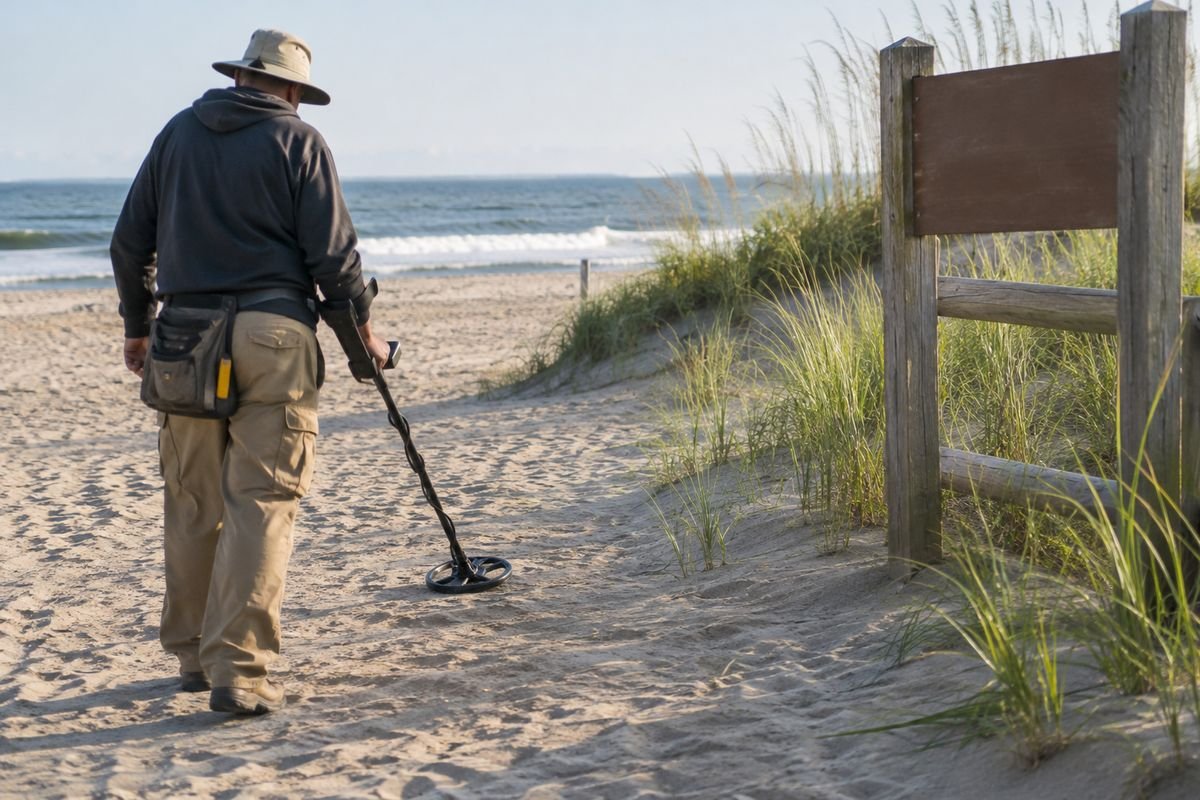
Public beaches
Many state and county beaches allow recreational detecting on sand, often with rules about hours and digging depth. Always confirm with the managing agency first.
A sand scoop sifts targets out of wet sand far faster than a hand digger, which is the main reason beach hunters carry one.
Check local rules first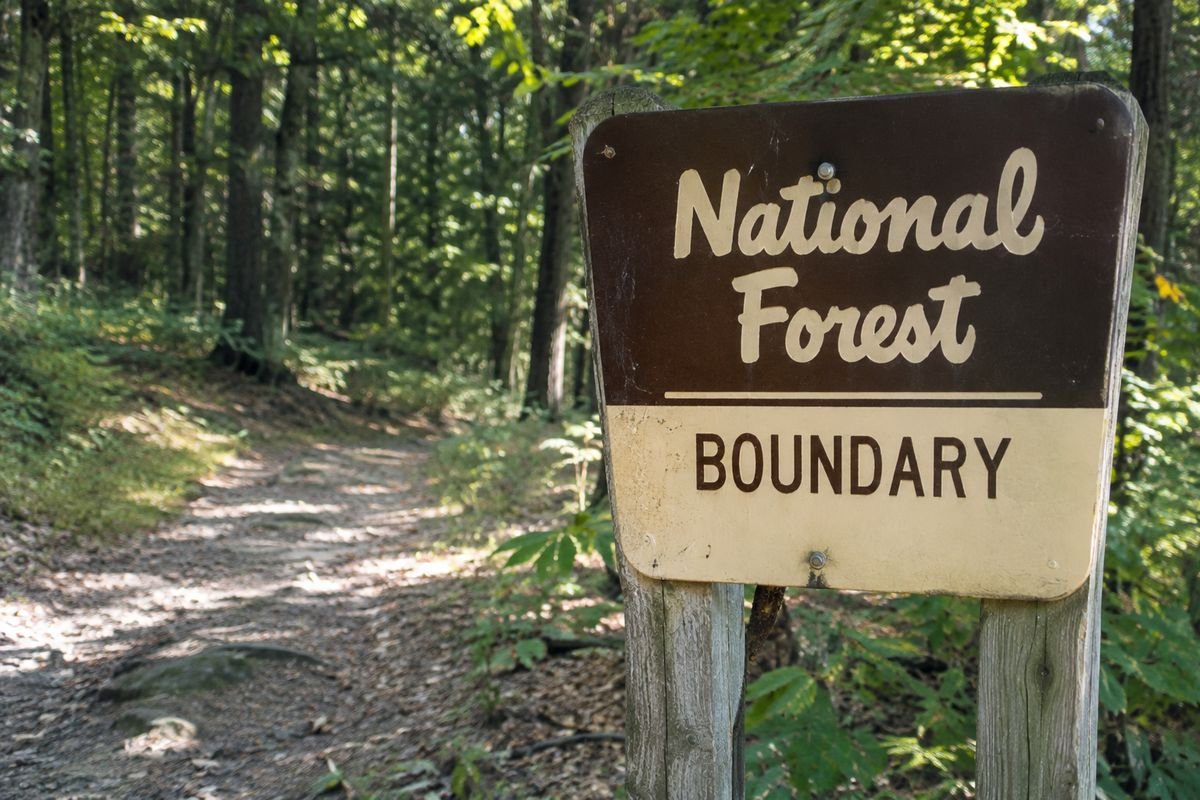
National Forests
US Forest Service rules vary by ranger district. Casual detecting away from historic sites is allowed in many ranger districts, but rules vary and artifact collecting needs a permit under ARPA. Confirm with the specific ranger district first.
Check the district
State parks
Many states require a per-park permit, a statewide registration, or restrict detecting to designated turf and beach areas. Use the state table below for your state.
Permit or registration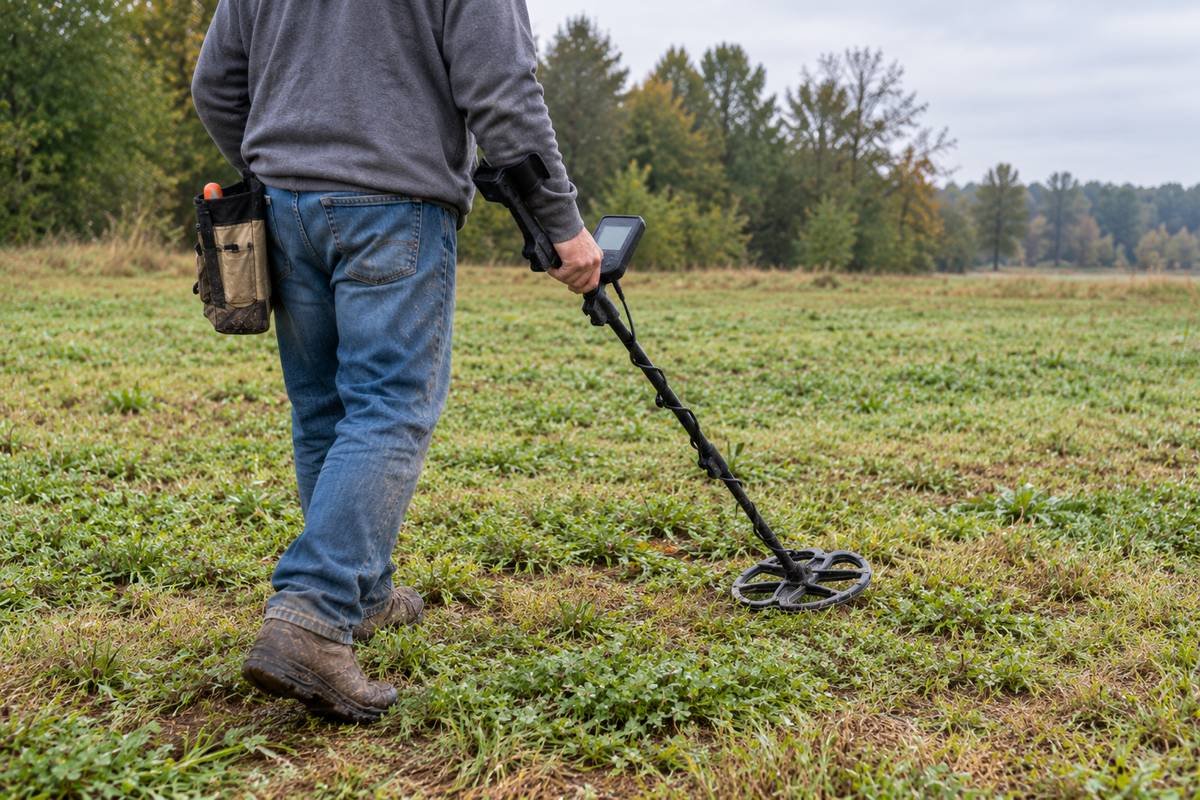
Private property
Always get the landowner's written permission before detecting, even on land that looks abandoned or vacant. Our free permission form below makes this easy.
Owner permission requiredQuick reference by property type
Rules differ sharply by property type and manager. Use this table for a fast property-type overview, then open the full 50-state table below for your specific state.
| Property type | General rule | Who grants permission |
|---|---|---|
| Private land | Legal only with the owner's explicit permission - never assume vacant or unfenced land is open. | The landowner |
| Public beaches | Varies by state and by which agency manages that stretch - many allow it with rules on hours and depth, some restrict or ban it. | State or local beach/parks agency |
| City/county parks | Set independently by each city or county - can differ between neighboring towns in the same state. | The city or county parks department |
| Schools | Almost always off-limits without specific written authorization from the district. | The school district |
| State parks | Varies by state and often by individual park - see the full state table below. | The state parks agency |
| National Forests (USFS) | Casual non-artifact detecting is allowed in many areas, but collecting historic or prehistoric artifacts requires an ARPA permit. | The local ranger district |
| BLM land | Generally allowed for casual recreational detecting away from protected sites, subject to mining claim and cultural-resource rules. | The local BLM field office |
| National Park Service (NPS) | Prohibited under 36 CFR 2.1(a)(7), with narrow exceptions only for broken-down devices, navigation equipment, and authorized scientific or administrative permits. | Not grantable for recreational use |
| US Army Corps of Engineers (USACE) | Varies by specific property and project office - some recreation areas allow it, others restrict it. | The local USACE project office |
| Protected archaeological/historic sites | Never permitted, regardless of land type - disturbing these sites can violate ARPA and other federal or state law. | Not grantable by anyone on-site |
Private land
Legal only with the owner's explicit permission - never assume vacant or unfenced land is open.
Who grants permission: The landowner
Public beaches
Varies by state and by which agency manages that stretch - many allow it with rules on hours and depth, some restrict or ban it.
Who grants permission: State or local beach/parks agency
City/county parks
Set independently by each city or county - can differ between neighboring towns in the same state.
Who grants permission: The city or county parks department
Schools
Almost always off-limits without specific written authorization from the district.
Who grants permission: The school district
State parks
Varies by state and often by individual park - see the full state table below.
Who grants permission: The state parks agency
National Forests (USFS)
Casual non-artifact detecting is allowed in many areas, but collecting historic or prehistoric artifacts requires an ARPA permit.
Who grants permission: The local ranger district
BLM land
Generally allowed for casual recreational detecting away from protected sites, subject to mining claim and cultural-resource rules.
Who grants permission: The local BLM field office
National Park Service (NPS)
Prohibited under 36 CFR 2.1(a)(7), with narrow exceptions only for broken-down devices, navigation equipment, and authorized scientific or administrative permits.
Who grants permission: Not grantable for recreational use
US Army Corps of Engineers (USACE)
Varies by specific property and project office - some recreation areas allow it, others restrict it.
Who grants permission: The local USACE project office
Protected archaeological/historic sites
Never permitted, regardless of land type - disturbing these sites can violate ARPA and other federal or state law.
Who grants permission: Not grantable by anyone on-site
Compare All State Park Rules (all 50 states + DC)
| State | In short | Source verification |
|---|---|---|
| Alabama | Unauthorized use (without Park Manager permission) is unlawful statewide. | Specific rule located |
| Alaska | No disturbance of natural or cultural/archaeological material. Leave and report possible historic finds. | Specific rule located |
| Arizona | Blanket prohibition in state parks. | Specific rule located |
| Arkansas | Unconfirmed on any primary source. Contact Arkansas State Parks directly before detecting. | Contact agency before detecting |
| California | Varies by unit - many restrict historic/archaeological areas. Folsom Lake SRA restricts the entire unit. | Specific rule located |
| Colorado | General resource-protection rule applies (no removing/disturbing archaeological, geological, or historical objects). no detector-specific text located in the current regulation. | General rules only |
| Connecticut | Unclear. no detector-specific rule found. General park rules against disturbing/removing natural or historic/archaeological resources would likely apply by default. | General rules only |
| Delaware | Prohibited everywhere in the park system except on ocean beaches east of the dune line, and only during normal park operating hours. | Specific rule located |
| Florida | Beach areas only, above the high-water line (toe of dune to high-water line). no submerged searching. no keeping of historic objects over 50 years old. | Specific rule located |
| Georgia | Blanket prohibition on state-owned property (which includes state parks). the landowner-permission provision applies only to private land. | Specific rule located |
| Hawaii | Sand beaches only. no detecting elsewhere in state parks. | Specific rule located |
| Idaho | Must not interfere with traditional uses or park-resource preservation. no digging or removal of historical or cultural resources without written permission. | Specific rule located |
| Illinois | Only small hand tools (pen knife, ice pick, screwdriver) may be used to recover finds. no shovels, picks, or entrenching tools of any size. the work area must be restored. | Specific rule located |
| Indiana | Prohibited DNR property-wide except on sand swimming beaches approved by an authorized department representative. | Specific rule located |
| Iowa | Designated beach areas only, 4am-11am, May 22-Sept 7 season. drained lakebeds allowed only after archaeological survey sign-off. | Specific rule located |
| Kansas | No digging holes/pits or removing historic/archaeological relics without department authorization. | General rules only |
| Kentucky | Blanket statewide prohibition for the public. | Specific rule located |
| Louisiana | Blanket prohibition on state park property. | Specific rule located |
| Maine | No detecting at historic sites under any circumstance. | Specific rule located |
| Maryland | Beach exception excludes Point Lookout and Calvert Cliffs State Parks. beach detecting is barred from 9:00 a.m. until dusk from May 30 through Labor Day, and the Park Manager may further restrict use if it disrupts other visitors. | Specific rule located |
| Massachusetts | Blanket prohibition on DCR property. | Specific rule located |
| Michigan | No detecting at historic/archaeological sites. only probes or small hand trowels may be used, with disturbed ground replaced. large-scale digging requires a DNR-authorized archaeological permit. | Specific rule located |
| Minnesota | Lost-item searches only. no general recreational detecting. | Specific rule located |
| Mississippi | Blanket statewide prohibition. | Specific rule located |
| Missouri | Allowed only in designated beach areas at the 11 listed state parks. historic/archaeological sites and other areas excluded. | Specific rule located |
| Montana | To protect sensitive cultural/heritage/natural resources. | Specific rule located |
| Nebraska | General artifact/relic protection rule applies. no detector-specific text located. | General rules only |
| Nevada | Default is prohibition. detecting only happens where the park supervisor specifically authorizes it (historic/archaeological sites such as Valley of Fire and Berlin-Ichthyosaur are typically excluded from any such authorization). | Specific rule located |
| New Hampshire | Banned at historic sites, natural areas, and Odiorne Point State Park. | Specific rule located |
| New Jersey | No permit issued for areas of significant historical or other value, or where use would be incompatible with resource protection or would interfere with public use of the facility. | Specific rule located |
| New Mexico | General state parks regulations apply. no detector-specific text located. | General rules only |
| New York | Historic/archaeological sites excluded. no detecting in landscaped areas, beach dune areas, golf courses/driving ranges, or residences. digging tools capped at 1.5 in. wide by 6 in. long. ground must be restored immediately. no interference with wildlife or piping plover nesting areas. | Specific rule located |
| North Carolina | Archaeological/historic sites excluded. general recreational detecting for artifacts is not permitted. | Specific rule located |
| North Dakota | Blanket prohibition outside staff-supervised lost-item searches or director-approved archaeological/law-enforcement exceptions. | Specific rule located |
| Ohio | Excluded mowed areas (golf/rental/campground). Restoration required. No blanket statewide ban. | Specific rule located |
| Oklahoma | Blanket statewide prohibition. | Specific rule located |
| Oregon | Shipwrecks are protected archaeological sites. items of possible historic/cultural significance must be left in place and reported. only an ice pick, screwdriver, or small knife may be used for digging. turf/dirt must be restored. no vegetation cutting or driving to the dig site. | Specific rule located |
| Pennsylvania | No digging in turf/vegetated ground with anything but narrow hand tools. daylight hours only. historic areas may be closed to detecting. | Specific rule located |
| Rhode Island | Designated areas and specified time periods only. | Specific rule located |
| South Carolina | Blanket prohibition on state park property. | Specific rule located |
| South Dakota | Digging tools limited to probes no more than 6 in. long/1 in. wide/1/4 in. thick and sand scoops/sieves no more than 10 in. diameter. holes no deeper than 6 inches. excavations must be restored before further digging or leaving. litter must be collected and disposed of properly. only department staff may approve exceptions. | Specific rule located |
| Tennessee | Close to a blanket prohibition on casual detecting, not merely archaeological-site protection. | Specific rule located |
| Texas | General collecting prohibition (plants, animals, artifacts) applies. detector use without a permit is an offense under the administrative code. | General rules only |
| Utah | Varies by park. generally no detecting in historical/archaeological zones, developed campgrounds/facility areas, or environmentally sensitive zones (including some beaches). Holes must be refilled completely. | Specific rule located |
| Vermont | Default is prohibition, not merely permission required near historic sites. the restriction applies to State-owned or controlled land and waters generally, not just historic-site areas specifically. | Specific rule located |
| Virginia | Limited to designated man-made beaches only. | Specific rule located |
| Washington | Historic/archaeological finds must not be removed and must be reported immediately with the area closed. only ice picks, screwdrivers, probes up to 2 in. wide, or limited sand scoops may be used, on sand surfaces only, holes no deeper than 6 in. and refilled. detector sounds must be inaudible to other visitors. violation is an infraction under RCW ch. 7.84. | Specific rule located |
| West Virginia | General park rules and removal prohibitions apply. no detector-specific text located anywhere in WV DNR's public rules or in Title 58 Series 31 of the WV Code of State Rules. | General rules only |
| Wisconsin | Permit is item-specific and area/time-limited (May 1 - Oct. 15 search window). detecting in recorded archaeological sites needs DNR archaeologist approval and is generally barred in reported burial areas. | Specific rule located |
| Wyoming | Blanket prohibition at historic/archaeological sites (official use only). permission-based (not banned) at ordinary state parks/recreation areas. | Specific rule located |
| District of Columbia | Effectively prohibited on both NPS land (36 CFR 2.1) and DC city parks (DPR permit denial policy). | Specific rule located |
Federal land: National Park Service, National Forest, BLM, and Army Corps of Engineers
Federal agency rules apply on the land that agency manages, and those rules differ sharply by agency - but other applicable laws, including some state and local rules, may still matter depending on the specific site and activity.
National Park Service land
Agency: National Park Service / Dept. of the Interior
36 CFR § 2.1(a)(7) prohibits possessing or using a metal detector, and disturbing or removing natural, cultural, or archaeological material, in any unit of the National Park System. This is enforced alongside the Archaeological Resources Protection Act (ARPA) for cultural material.
36 CFR 2.1(a)(7) prohibits possessing or using a metal detector in any unit of the National Park System, with narrow exceptions only for a device that is broken down and unusable, navigation electronics, and detecting carried out under an authorized scientific, mining, or administrative permit. No NPS unit was found offering a public permission route for recreational detecting. Treat NPS land as off-limits.
National Forest (US Forest Service) land
Agency: US Forest Service / USDA
Casual collecting of common rocks and minerals is generally allowed, but historic and prehistoric artifacts are protected under ARPA. Detecting specifically for artifacts requires a permit, and rules vary by individual national forest and ranger district - some forests restrict detecting in developed recreation sites, historic areas, or wilderness.
Generally more permissive than NPS land for casual, non-artifact detecting away from historic or developed sites - but always check the specific forest's own rules, since this varies district by district.
BLM land
Agency: Bureau of Land Management / Dept. of the Interior
Recreational metal detecting and casual collecting of common rock, mineral, and invertebrate fossil specimens is generally allowed in small quantities for personal use, away from withdrawn, developed, or otherwise restricted areas. Collecting historic or prehistoric artifacts is prohibited without a permit under ARPA.
The most permissive of the federal categories for casual detecting, but artifact collection is still federally protected and off-limits without a permit.
On land like this, a pinpointer and a hand digger let you recover a target with one small hole instead of excavating a wide area - exactly the minimal-disturbance standard most agencies expect.
US Army Corps of Engineers (USACE) land
Agency: US Army Corps of Engineers / Dept. of Defense
36 CFR 327.14(d) permits metal detector use on designated beaches or other previously disturbed areas unless prohibited by the District Commander for protection of archaeological, historical, or paleontological resources. Destroying, removing, or altering public property, including historical, archaeological, or paleontological features, is prohibited without written District Commander permission.
Generally permitted on designated beaches or previously disturbed areas, but varies by lake and district - some district offices run their own permit or registration requirement, so always verify with the specific lake's office.
Getting permission on private property
Permission from a landowner is about being allowed on their land - it does not by itself override state, local, or federal law covering what you find or where you dig. It also does not automatically cover digging: confirm with the owner or manager that recovering a target, not just detecting, is allowed. A written record of permission is recommended for your own protection, but check the specific rules for the land you want to search - some public-land programs require a specific written authorization rather than informal consent.
Carry a finds and trash pouch with separate compartments so you can pack out everything you dig, including trash, separately from items you keep.
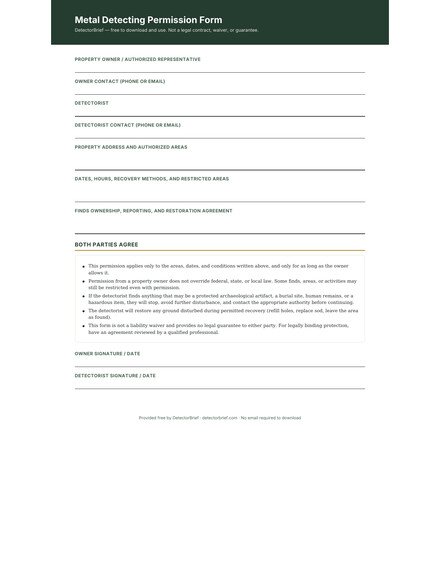
Free metal detecting permission form
A single printable page covering contact details, authorized areas and dates, finds and restoration terms, and signatures. No email required.
Download the permission form (PDF)Sample permission email (copy and customize)
Subject: Permission to metal detect on your property
Hi [Owner's name],
My name is [your name], and I'm a hobbyist metal detectorist based in [area]. I'm reaching out to ask whether I could have your permission to search part of your property at [address] for lost coins, jewelry, and other modern items.
A few specifics, so you know exactly what I'm asking for: I'd like to search [describe the area], on [proposed date/time], for about [length of time]. I use a hand digger and pinpointer and refill every hole I dig. Anything I find, I'm happy to show you first, and we can agree in advance on what I keep versus what belongs to you. If I come across anything that looks historically or archaeologically significant, I'll stop and let you know rather than removing it.
If that works for you, I can put the details in writing on a simple permission form so we both have a record. Happy to answer any questions.
Thanks for considering it,
[Your name] - [Phone / email]
Sample in-person or phone script
"Hi, my name is [name] - I'm a local metal detectorist. I was wondering if you'd be open to me searching part of your property for old coins and lost items, probably around [area of the property]. I always refill any holes I dig, and if it's okay with you I'll show you anything I find before I keep it. Would that be something you're comfortable with? … Great - would [date/time] work, or is there a better time? I can also send over a simple written permission form if you'd like something in writing for both of us."
Finds and reporting
Who owns what you find depends on state lost-and-found law, the specific property's rules, and whether the item qualifies as treasure trove, abandoned property, or protected archaeological material. Do not assume ownership automatically transfers to the finder. Check your state's lost property statute and the property owner's or agency's own rules before assuming you can keep anything.
If you find something that may be a protected archaeological artifact, a burial site, human remains, or a hazardous item (such as unexploded ordnance or an old fuel container), stop, avoid further disturbance, and contact the appropriate authority - a park office, state historic preservation office, or local law enforcement - before continuing. Removing archaeological material from federal or many state/local lands without authorization can be a serious legal violation, independent of whether you had permission to be there.
Gear that helps you detect responsibly
None of this gear makes a location legal to detect - but the right recovery tools make it easier to follow the rules you've already confirmed: minimal disturbance, fast recovery, no unnecessary digging. Four categories cover most of what you need: a pinpointer, a sand scoop for beach sites, a digging tool for parks and fields, and a pouch to carry out what you find (and what you don't keep).

Garrett Pro-Pointer AT
- Waterproof
- 20 ft submersible
- Sensitivity
- 3 adjustable levels
Why we like it: three sensitivity levels, a bright orange body for visibility, and a 20 ft waterproof rating for wading and shallow-water recovery.
Limitation: a pinpointer is designed for short-range target location and recovery. It is not a substitute for a full-size metal detector when searching larger areas.

GADFISH Sand Scoop
- Material
- 201 stainless steel
- Handle
- detachable, segmented pole
Why we like it: the detachable pole means one scoop covers both hand-digging and standing surf work.
Limitation: built for sifting sand, wet or dry - it is not designed for gravel, mud, or turf, where a hand digger works better.

CKG Metal Detecting Digging Tool with Sheath
- Material
- stainless steel, double serrated edge
- Length
- hand trowel, about 12 inches, with sheath
Why we like it: this is a single double-serrated digging tool shaped like a knife, not a shovel plus a separate knife - it comes with its own protective carry sheath for compact carry in the field.
Limitation: sized for turf and topsoil plugs, not deep or large-scale digging, and only where digging itself is permitted by the property or agency.

CKG Metal Detecting Finds Bag Waist Digger Pouch
- Pockets
- two separate pockets, one for keepers and one for trash
- Extra features
- pinpointer holster, digger loops, drain holes
Why we like it: packing out the trash you dig is part of responsible recovery, and the drain holes let water and sand out instead of sitting in the bag.
Limitation: a carry pouch for finds and trash, not a protective case - it will not keep contents dry or crush-proof.
Pre-trip checklist
Review this checklist before each detecting trip, every time - a new site means new conditions even if you've hunted nearby before.
- Identify who manages the land - a state park, city parks department, school district, HOA, or private owner each set their own rules.
- Read the current posted rules for that specific property, not just the general category.
- Confirm what recovery tools and methods are allowed (hand digger vs. shovel, depth limits, whether refilling is required).
- Get permission in writing where the land isn't public.
- Record the conditions you agreed to (dates, areas, what happens to finds).
- Know the reporting rule for what you find before you dig.
- Pack out everything you dig - keep only what the landowner and local rules say you may keep, and remove any litter you find along with your own.
Frequently asked questions
Is it legal to metal detect on public beaches?
It depends on who manages that specific beach. Many public beaches allow detecting in some form, but the exact rule - permitted areas, hours, depth limits - is set by whichever city, county, or state agency manages that stretch of coastline. Always check that beach's own posted rules first.
Can I metal detect in state parks?
Rules vary by state and sometimes by individual park within the same state system. See the state-by-state table above for your state's current rule and official source.
Do I need a permit to metal detect?
Sometimes. A number of states or individual parks require registration or a permit before you detect, even in areas where detecting itself is generally allowed.
Can I detect in city parks?
City and county parks set their own rules independent of state park rules, and those rules can differ between neighboring cities. Contact the parks department that manages the specific park.
Is metal detecting allowed on federal land?
It depends which agency manages the land. National Park Service land generally prohibits metal detecting. National Forest land is more permissive for small modern-item recreational detecting in appropriate areas. BLM land is generally more open to recreational detecting away from withdrawn or sensitive areas. See the federal land section above for specifics.
If a property owner gives me permission, does that make detecting legal?
Not by itself. Permission from a private landowner lets you be on their land, but it doesn't override state, local, or federal law.
Can I keep jewelry or coins I find?
Ownership depends on state lost-and-found law and the specific property's or agency's own rules. Do not assume you automatically own what you find. Check your state's lost property statute and the property rules before assuming you can keep an item.
What if I find something that looks historic or archaeological?
Stop digging in that spot, avoid further disturbance, and contact the land manager or your state historic preservation office. Removing archaeological material without authorization can be a serious legal violation, independent of whether you had permission to be there.
What should I do if I'm not sure whether a spot is legal to detect?
Contact the managing authority directly before you dig. When no clear official answer is available, treat the area as off-limits until you can confirm it.
Related buying guides


Summary
There is no single nationwide answer. Private property always needs the owner's written permission. Public land splits by manager: state and local land follows the state table above, and federal land depends entirely on the agency - National Park Service land generally prohibits detecting; National Forest, BLM, and Army Corps of Engineers land are more permissive for casual detecting away from historic or sensitive areas, subject to local district rules. Always verify with the official source for the specific place you want to hunt before you go.
Official sources and review policy
Every state and federal entry above links to a cited source and the date we checked it (25 Nov 2026). Most link directly to an official government agency page. A few states without a clear official rule page instead cite a state statute hosted on a non-government legal research site such as Cornell Law or Justia, which is noted in that state's entry. This guide is updated as rules change. If you find a broken link or an outdated rule, contact us so we can correct it.