
A metal detector finds buried objects without digging a single hole first, and the science behind that is simpler than it looks. If you're new to the hobby, our beginner's guide covers picking your first machine. This guide explains how metal detectors work, from the coil swinging over the ground to the beep in your ear.
DetectorBrief is a participant in the Amazon Services LLC Associates Program, an affiliate advertising program designed to provide a means for sites to earn advertising fees by advertising and linking to Amazon.com.
Table of Contents

The basic idea: electromagnetic induction
Every metal detector runs on the same core principle. A coil of wire carrying an electrical current creates a magnetic field around itself. When that field passes over a piece of metal, it induces a small electrical current inside the metal, called an eddy current. That eddy current creates its own tiny magnetic field, and the detector's coil picks up this second field as a disturbance in the first one. The control box turns that disturbance into the tone, number, or vibration that tells you something's there.
That's the short version. Everything else (the different detector types, the depth you get, the way it tells a coin from a nail) comes down to how a given machine generates and reads that magnetic field.
Inside the machine: the main components
Strip any detector down and you're left with four parts doing the work.
Search coil
The disc at the end of the shaft, the part you sweep over the ground. It contains the wire loops that transmit the magnetic field and, in most designs, a second set of loops that receive the return signal. A larger coil covers more ground per swing and reaches deeper on big targets, while a smaller coil is more precise in ground full of trash or rocks.
Control box
The electronics hub, usually mounted just above the shaft's armrest. It processes the coil's signal, runs the discrimination and target ID logic, and drives the display, speaker, and headphone jack. This is also where you set sensitivity, ground balance, and discrimination patterns.
Shaft and armrest
The pole connecting the coil to the control box, usually adjustable for height and foldable for travel. The armrest keeps the machine stable and balanced during a long swing, which you'll notice after a few hours in the field.
VLF detectors: how most machines work
Very low frequency, or VLF, is the technology behind the large majority of detectors sold today, including most beginner and mid-range machines. A VLF coil has two windings: an outer transmit coil that sends a continuous signal into the ground, typically between about 3 and 30 kHz or higher, and an inner receive coil that listens for the return. Lower frequencies favor larger, more conductive targets like silver coins, while higher frequencies are more sensitive to small or low-conductivity targets like gold.
VLF's main strength is target identification. Because the machine can read how a target's eddy current behaves, it can estimate the target's conductivity (how easily a metal carries electric current). On most machines, it also shows you a number or icon guessing what you've found before you dig. The tradeoff is that heavily mineralized (full of natural minerals that can confuse a detector) soil confuses a VLF coil unless the ground balance is set correctly.
Pulse induction: depth in difficult ground
Pulse induction, or PI, detectors work differently. Instead of a continuous signal, they fire short, high-amperage pulses through the coil. Each pulse builds a magnetic field and then collapses it instantly, and any metal nearby keeps a faint trace of that field for a fraction of a second longer than the surrounding ground. The detector reads that decay curve to find a target.
That mechanism makes PI machines close to immune to ground mineralization and saltwater, which is why they dominate gold prospecting and underwater detecting, where VLF machines struggle. The cost is target ID: PI detectors are generally poor at telling different metals apart, so most PI-only machines are simple go, no-go tools rather than discriminators. For hunting wet salt sand, see our beach metal detector guide.
Multi-frequency: running both at once
Simultaneous multi-frequency detectors transmit several VLF frequencies at once instead of one fixed frequency, then process each separately. This gives the machine strong performance across a wider range of target sizes and conductivities without you having to manually switch frequencies, and it handles mineralized ground better than a single-frequency VLF. It's the technology behind most high-end detectors released in the last several years, and it costs noticeably more than single-frequency VLF.
How discrimination and target ID work
Different metals respond to a magnetic field differently based on their conductivity and how the eddy currents form inside them. Iron and steel produce a different signal phase than copper, silver, or gold. A VLF detector's control box compares the phase and strength of the returning signal against known patterns. It maps that onto a target ID number or icon, usually on a scale where low numbers mean iron or foil and high numbers mean copper or silver.
Discrimination lets you set the machine to ignore a range of those target ID values, usually to skip iron and pull tabs. It's a useful time-saver, but it also means the machine will silently skip a good target that happens to share a signal range with trash. That is why many experienced detectorists (people who hunt with metal detectors) dig more than the display strictly tells them to.
Ground balance, explained
Soil itself contains trace minerals, mostly iron oxides, that generate their own weak signal. Ground balance is the process of tuning the detector to ignore that background signal so it isn't mistaken for a target. Most modern machines handle this automatically, but manual or semi-automatic ground balance is still common on detectors built for heavily mineralized soil or gold prospecting, where automatic settings can struggle to keep up.
What affects detection depth
Detection depth isn't a single number a manufacturer can promise, because it depends on several things at once.
- Target size and mass, since a large object produces a stronger, more detectable signal than a small one at the same depth
- Target conductivity, since silver and copper read deeper than gold or small iron at the same depth
- Target orientation, since a coin lying flat under the coil reads deeper than one standing on edge
- Soil mineralization, since heavily mineralized ground shortens effective depth on most VLF machines
- Coil size, since a larger coil generally reaches deeper on larger targets, at the cost of precision where there's a lot of trash
For context on what's realistic, our gold detector guide covers how prospecting machines push depth and sensitivity further for small, low-conductivity targets specifically. For a general sense of how the manufacturers themselves frame detection technology, this VLF explainer is a reasonable technical starting point.
Two things that confuse new detectorists
The halo effect
A buried target slowly leaches trace minerals into the surrounding soil over years, which creates a "halo" of mineralization around it that's often larger and easier to detect than the object itself. This is why a small, deep coin can sometimes read stronger or larger than its actual size suggests, and why digging a signal that seems too big for what you eventually find isn't a sign your detector is broken.
Air testing before you dig
Before heading out, hold a few known items (a coin, a ring, a pull tab) a few inches from the coil in the air to see how your specific machine reads them. Ground and real targets always behave a little differently than an air test, but it's the fastest way to learn your detector's tones and target ID numbers before you're trying to interpret them on a real find.
Gear for this guide3 items

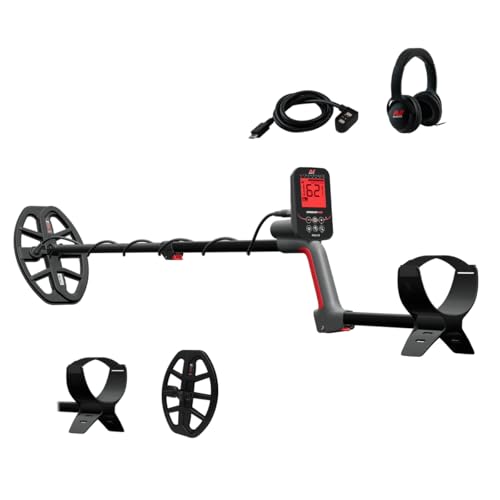
Multi frequency VLF
Minelab Vanquish 460
Runs several frequencies at once with Multi-IQ
Check Price on Amazon
Frequently asked questions
How do metal detectors work, in simple terms?
A coil sends out a magnetic field, and metal in the ground disturbs that field. The detector's electronics pick up the disturbance and turn it into a tone or a number on the display, which is how you know something's there before you dig.
What's the difference between VLF and pulse induction?
VLF detectors read the phase and strength of a returning signal to identify what kind of metal is buried, which makes them good at discrimination. Pulse induction detectors read how long a magnetic field takes to decay near metal, which ignores mineralized ground and salt water but can't tell one metal from another nearly as well.
Why does my detector beep at everything?
Usually it's either discrimination set too low, so it's flagging iron and foil along with real targets, or ground mineralization confusing the signal because ground balance hasn't been set correctly. Both are adjustable in the control box settings.
How deep can a metal detector detect?
It depends on the target, not just the machine. A large silver platter might read at two feet, while a small gold ring at the same depth could be invisible. Most coin-sized targets in average soil show up somewhere between 6 and 12 inches on a good VLF detector.
Summary
In one sentence: a coil disturbs a magnetic field, and the control box reads that disturbance. VLF machines are the best all-around choice for most people because they identify targets well and cost less. Pulse induction and multi-frequency machines handle mineralized ground and reach more depth, at a cost in either target ID or price. Once you know which tradeoff you're making, the choice is much easier.