

You need less than the gold panning supplies aisle makes you think. A 14-inch plastic pan with riffles, a classifier screen, a snuffer bottle, a glass vial, a trowel, and a 5-gallon bucket will find gold in any creek that has it. That whole kit runs about the price of a tank of gas.
DetectorBrief is a participant in the Amazon Services LLC Associates Program, an affiliate advertising program designed to provide a means for sites to earn advertising fees by advertising and linking to Amazon.com.
Everything else is either a nice upgrade (a pocket sluice, a black sand magnet, a stack of finer screens) or marketing (most bags of paydirt and the 19-piece kits with three pans you'll never use). This guide sorts the two, shows you what to buy, explains where you can legally pan, and walks through a simple panning routine.
Table of Contents
The gold panning supplies you need
Here is the short checklist.
| Item | What it does | What to buy |
|---|---|---|
| Gold pan | Concentrates heavy gold at the bottom as you wash lighter material out | 14-inch plastic pan with riffles, green or black |
| Classifier screen | Sifts out rocks so you only pan fine material | Stackable screen that sits on your pan or bucket |
| Snuffer bottle | Sucks gold flakes out of the black sand in your pan | Soft plastic bottle with a narrow tube |
| Glass vial | Holds what you find, filled with water so flakes sink | Screw-top glass vials |
| Trowel or shovel | Digs gravel from bedrock cracks and behind boulders | Sturdy hand trowel or short shovel |
| 5-gallon bucket | Carries gravel and holds classified material | Any bucket with a lid |
| Optional: tweezers and magnet | Picks out flakes and pulls magnetic black sand | Fine tweezers, a pocket separator magnet |

A 14-inch pan with riffles
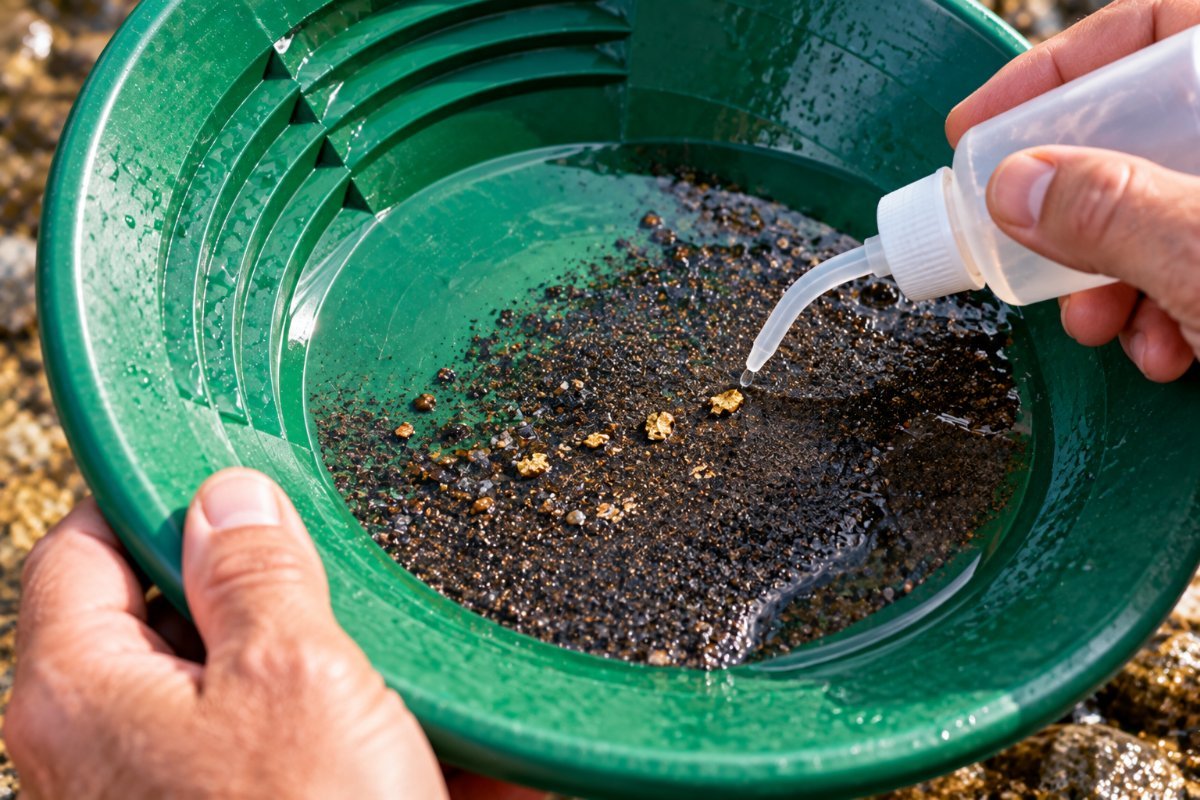
The pan is the one item on the list worth thinking about. Plastic beats steel for beginners because it's light, doesn't rust, and has molded riffles (the ridges along one side) that trap gold while you wash off the top layers. A dark green or black pan makes small yellow flakes easy to see. A 14-inch pan holds enough to be efficient without wearing out your arms. The 10-inch and 8-inch pans that come in kits are for cleaning up concentrates (the heavy material left at the end of panning), not for digging into a creek. Our gold pan guide compares sizes, riffle types, and six pans in more detail.
A classifier screen
A classifier is a sieve that sits on top of your pan or bucket. You dump in a scoop of gravel, shake it, and throw away the rocks left on top. Panning only the fine material is faster and loses less gold. A half-inch screen is the standard first pass. Finer screens (an eighth of an inch and smaller) stack under it when you want to work very fine material or feed a sluice.
A snuffer bottle and vials
At the end of every pan you're left with a little black sand (heavy, dark mineral grit) and, with luck, some gold. A snuffer bottle (squeeze, touch the tube to the flake, release) lifts the gold out. Glass vials with screw tops hold it. Fill the vial with water first so the flakes sink instead of sticking to the sides.
Something to dig with and something to carry it in
The digging tool gets the hardest use. Most of the gold in a creek sits low, in cracks in the bedrock and in the gravel behind big rocks, so you need a sturdy trowel or short shovel to reach it. Our guide to the best metal detecting shovel covers tools that do double duty. A 5-gallon bucket carries gravel back to where you pan.
Why panning works (and why gold stays in the pan)
Gold is heavy, and panning gear is designed to take advantage of that. Pure gold has a specific gravity of 19.3, and the gold you find in a creek is usually 16 to 18, according to the U.S. Geological Survey. The sand and gravel around it is about 2.5. That difference is why panning works: when you swirl and tip the pan underwater, the light material washes over the edge and the gold drops to the bottom and hides behind the riffles.
The same physics tells you where to dig. The U.S. Geological Survey (USGS) notes that fine gold collects where the current slackens, in depressions and pockets in sand and gravel bars. On a creek, that means the inside of bends, the downstream side of boulders, and cracks in exposed bedrock.
Best gold panning supplies to buy
These are all widely reviewed products on Amazon. You can buy a full kit, or build your own from the separate pieces and spend a little less.
SE 11-Piece Gold Panning Kit: best all-in-one kit
The SE 11-Piece Gold Panning Kit covers every item on the checklist except the bucket and shovel. You get three dual-riffle pans (8, 10, and 14 inches), two sifting screens, a black sand separator magnet, magnifying tweezers, a snuffer bottle, and glass vials. It has one of the strongest review records of any panning kit, and it's the easiest way to get everything in one box.

SE 11-Piece Gold Panning Kit
- Pans
- 8, 10 and 14 in
- Screens
- 2 sifting screens
- Extras
- Magnet, tweezers, snuffer, vials
Good for: getting every item on the checklist except the bucket and shovel in one box.
Skip if: you only want the gear you will use every trip. Build your own instead.
Pros
- Complete starter set
- 14 inch main pan
- Black sand separator magnet included
Cons
- The small pans see little use
- The screens are on the small side for bucket work
Build your own: SE 14-inch pan, classifier and snuffer bottle
If you only want the gear you'll use every trip, buy the pieces separately. The SE 14-inch dual-riffle gold pan is the standard green beginner pan and has thousands of reviews. Add the SE 13.25-inch stackable classifier, which stacks with SE's other screens, and the SE 3 oz snuffer bottle. That classifier uses a very fine 1/30-inch stainless mesh, so it's best for working fine material. For your first pass in a creek, screen through something coarser first or dig with a classifier that has a half-inch screen.

SE 14-inch pan, classifier and snuffer bottle
- Pan
- SE 14 in, dual riffles
- Classifier
- SE 13.25 in, 1/30 in mesh
- Bottle
- SE 3 oz snuffer
Good for: buying only the pieces you will use every trip.
Skip if: you want everything in one box. The SE 11-piece kit covers that.
Pros
- Only the pieces you need
- Full-size pan
- Highly rated parts
Cons
- The fine classifier is slow for raw creek gravel, so pair it with a coarser screen
Compact Gold Prospecting Kit with 12-inch pocket sluice: best for moving water
This compact prospecting kit adds a 12-inch pocket sluice with miner's moss and a rubber riffle mat to 9-inch and 11-inch spiral-riffle pans, a mini classifier, a separator magnet, a snuffer bottle, tweezers, and vials, all in a carry bag. A pocket sluice lets the creek do some of the work: set it in the current, feed it classified gravel, and pan out only what the mat catches. When you are ready for a bigger box, our guide to the best sluice box for gold compares sizes and shows how to set one up.

Compact Gold Prospecting Kit with 12-inch pocket sluice
- Sluice
- 12 in pocket sluice
- Pans
- 9 and 11 in
- Extras
- Classifier, magnet, snuffer, bag
Good for: creeks with steady current, where the water can do some of the work.
Skip if: you want a full-size pan in the kit. These pans are smaller than 14 inches.
Pros
- Adds a sluice for more material per hour
- Packs small for hiking
Cons
- The pans are smaller than 14 inches, so you may want a full-size pan too
Backpack Gold Prospecting Kit: best budget pick
The Backpack Gold Prospecting Kit is the lowest-cost way to try the hobby with gear that still works. It includes two spiral-riffle pans in different sizes, a classifier, a black sand magnet, a snuffer bottle, a scoop, magnifying tweezers, and three glass vials, all packed into a carry bag. It's a good gift kit or a second set for kids.

Backpack Gold Prospecting Kit
- Pans
- 2 spiral-riffle pans
- Includes
- Classifier, magnet, snuffer, scoop
- Packs
- In a carry bag
Good for: the lowest-cost way to try the hobby, a gift, or a second set for kids.
Skip if: you want heavier-duty gear. The SE parts are sturdier.
Pros
- Low cost
- Everything packs together
- Three glass vials included
Cons
- Lighter-duty parts than the SE gear
Side by side:
| Pick | Pans | Classifier | Extras | Best for |
|---|---|---|---|---|
| SE 11-Piece Kit (see details) | 8, 10, and 14 inch | Two sifting screens | Magnet, tweezers, snuffer, vials | One-box starter |
| Build your own (SE) (see details) | 14 inch | 13.25-inch stackable, 1/30-inch mesh | Snuffer bottle | Buying only what you use |
| Compact kit with pocket sluice (see details) | 9- and 11-inch | Mini classifier | 12-inch sluice, magnet, bag | Creeks with steady current |
| Backpack kit (see details) | Two spiral pans | Included | Magnet, snuffer, scoop, vials, bag | Lowest cost, kids |
Gold mining tools for when you outgrow the pan
Panning is the most accurate way to separate gold, but it's slow. Once you know a spot holds gold, these gold mining tools move more gravel. Check local rules first, since anything bigger than hand tools can need approval on public land.
- Sluice box. A longer trough, usually 24 to 50 inches, set in the stream. It processes many buckets an hour, and you pan out the concentrates at the end of the day.
- Highbanker. A pump-fed sluice, so you can work gravel away from the water's edge. It needs a water source and usually more permission.
- Blue bowl. A spinning water bowl for separating very fine gold from black sand at home.
- Metal detector. For nuggets rather than fine flakes. See our picks for the best metal detector for gold.
Gold panning supplies that are mostly marketing
Much of what's sold as gold panning supplies is poor value. Some of it is worse.
- Paydirt (gravel or dirt that holds gold) bags. These are bags of gravel with gold added, sold for practice. Several of the best-selling bags on Amazon carry ratings in the low 3s out of 5, so read the reviews before you buy. Treat a bag as a practice session, not an investment, and check the stated gold weight.
- Giant kits. A 19-piece kit usually reaches that number with extra small pans and vials. You need one good 14-inch pan.
- Chemicals. Anything that promises to dissolve or extract gold at home (mercury, cyanide, or acids) is dangerous and has no place in recreational panning.
- Magnets as gold finders. Gold isn't magnetic. A magnet only helps by pulling magnetic black sand away from your gold.
Where you can legally pan for gold
Check where you're allowed to pan before you go.
- National forests. Many allow recreational panning with no permit. The Pike and San Isabel National Forests state that you don't need a permit for gold panning, hand sluicing, or metal detecting. You must dig below the high water mark, don't cave or undermine banks, and backfill your holes. Anything mechanized, or larger-scale digging, goes through the district ranger.
- Closed areas. The Black Hills National Forest lists wilderness areas, acquired mineral lands, mineral withdrawal areas, and archaeological sites as off-limits.
- Mining claims. Much of the best ground is already claimed, and panning on someone's claim without permission is trespassing. Look for claim markers, check county records, or search the Bureau of Land Management's Mineral and Land Records System (MLRS) before you dig.
- State parks and private land. Rules vary widely from park to park, and some don't allow digging at all. Private land always needs the owner's permission.
- Prospecting clubs. Clubs, including the Gold Prospectors Association of America, give members access to club claims, which removes the guesswork about where you can dig.
Always confirm with the local ranger district or land office. Rules change, and they differ from one forest to the next.
Gold, pyrite, or mica? A quick field test
| What you see | Gold | Pyrite (fool's gold) | Mica |
|---|---|---|---|
| Color in shade | Stays warm butter yellow | Brassy, looks duller | Shiny only in direct sun |
| Poke it with a pin | Dents or flattens, never breaks | Crumbles or shatters | Flakes apart in thin sheets |
| Swirl in the pan | Stays put at the bottom | Lighter, moves with the sand | Floats and washes away easily |
| Shape | Rounded flakes and specks | Often cubes or sharp crystals | Flat, papery flakes |
A 10-minute panning routine
- Classify a scoop of gravel into your pan so it's about three-quarters full.
- Submerge the pan and work the material with your fingers to break up clay and wash off stones.
- Shake the pan side to side underwater so the heavy material settles to the bottom.
- Tilt the pan forward, riffles down, and swirl so the top layer washes over the edge.
- Repeat shake and swirl until you're down to a cup or so of dark material.
- Use a gentle back-and-forth wash with a little water to spread the black sand and look for gold.
- Pick out gold with the snuffer bottle or tweezers and move it to your water-filled vial.
Expect your first few pans to be slow. The classic beginner mistake is tipping the pan too steeply and washing gold out with the sand, so go slower than feels necessary.
Frequently asked questions
What supplies do I need for gold panning?
Essential gold panning supplies include a 14-inch plastic gold pan with riffles, a classifier screen, a snuffer bottle, glass vials, a trowel or small shovel, and a 5-gallon bucket. Tweezers and a black sand magnet are useful extras.
What size gold pan is best for beginners?
A 14-inch plastic pan with riffles is the standard beginner choice. It holds enough material to be efficient, and smaller 8- to 10-inch pans are best kept for cleaning up concentrates.
Do I need a permit to pan for gold?
Often not for simple hand panning. Many national forests allow recreational panning and hand sluicing without a permit, but wilderness areas, withdrawn lands, and existing mining claims are off-limits, and state parks and private land have their own rules. Check with the local ranger district first.
Are gold paydirt bags worth it?
They are useful for practice but are often poor value. Several of the best-selling paydirt bags on Amazon carry ratings in the low 3s out of 5. Treat one as a lesson, not a way to make money.
What color gold pan is best?
Green or black. Dark plastic makes small yellow flakes stand out, which matters most when you are down to the last bit of black sand.
Which Supplies to Buy
Good gold panning supplies are cheap and simple. Get a 14-inch riffled pan, a classifier, a snuffer bottle and a vial, then spend the rest of your effort learning to read a creek and checking where you're allowed to dig. The SE 11-Piece Kit is the easiest one-box start. Building your own from SE parts gets you only what you need, and a pocket sluice kit is the next step once you've found a spot that produces gold.