

A sluice box is a long, open channel with small ridges called riffles along the bottom. You set it in moving water and shovel gravel into the top. The water carries light sand and rock out the end, while heavy gold drops behind the riffles and stays in the box. For most beginners, the best sluice box for gold is a light 2-foot model that fits in a backpack. A 50-inch folding sluice makes more sense once you know a spot is worth working and you can park close to the water.
DetectorBrief is a participant in the Amazon Services LLC Associates Program, an affiliate advertising program designed to provide a means for sites to earn advertising fees by advertising and linking to Amazon.com.
The right choice depends on three things: where you will run it, how far you will carry it, and how much gravel you want to move. The Sluice Box Finder below sorts the picks on this page by those answers. After the picks, you will find how to set up a sluice so it catches gold, how to clean it out, and where you are allowed to use one.
Table of Contents
How a Sluice Box Catches Gold
Gold is about 19 times heavier than water and much heavier than the sand and rock around it. A sluice uses that difference. As water flows over each riffle, it forms a small swirl just downstream, called an eddy. Light material gets swept up and carried away, but heavy pieces, including gold and black sand, sink into the calm spot behind the riffle and stay put.
Most sluices also have a mat under the riffles. Many sluices use miner's moss, a thick mat of loops that traps fine gold. Molded mats, such as the Dream Mat, use shaped cells instead of separate riffles. Either way, the goal is the same: keep the water moving fast enough to clear out the light material, but slow enough behind the riffles for gold to settle.
A sluice does not finish the job. It concentrates the heavy material from many buckets of gravel into a small amount, called concentrates. You still pan those concentrates to separate the gold. If you do not have a pan yet, our gold pan guide covers sizes and how to use one.
Types of Sluice Boxes
Pocket and mini sluices are about 12 to 24 inches long and weigh a few pounds or less. They are made for hiking to a creek, testing a spot or cleaning up concentrates at home in a tub.
Stream sluices, sometimes called hand sluices, are 24 to 50 inches long. You set them right in the creek, and the current moves the gravel through. Longer and wider boxes handle more gravel but weigh more, so the 50-inch folding models are best when you can park nearby.
Highbankers sit on legs on the bank instead of in the water. A pump pushes water from the creek into a hopper at the top, so you can work gravel that is away from the stream. They move a lot of material but cost more, weigh more, and fall under stricter rules in many places because they use a motor.
Recirculating setups run a small sluice in a tub with a pump that sends the same water back to the top. They let you work concentrates or bagged gravel at home or at camp with no stream at all.
Sluice Box Finder
Answer the three questions to see which sluices on this page fit how you plan to prospect.
Sluice Box Finder
Answer three questions about how you plan to prospect. The finder shows which sluices on this page fit, with their listed size and weight.
1. Where will you run the sluice?
2. How far will you carry it?
3. What is your main goal?
Sluice Box Finder by DetectorBrief.com. Free to use. Sizes and weights come from each product's Amazon listing and can change, so check the listing before you buy.
The Best Sluice Boxes on Amazon
These picks cover every type a beginner or weekend prospector is likely to need. The sizes and weights come from each product's Amazon listing.
Best for a Backpack: Dream Mat 4 x 16 Adventure Sluice
At about 1.4 pounds, the Dream Mat 4 x 16 Adventure Sluice is the lightest sluice here. It is a single molded piece with vortex cells instead of riffles, so there are no parts to lose. It fits in a daypack for testing creeks and also works in a tub for cleaning up concentrates. The trade-off is size. A 4-inch-wide box handles small amounts of gravel at a time.

Dream Mat 4 x 16 Adventure Sluice
- Size
- 4 x 16 in
- Weight
- About 1.4 lb
- Build
- One molded piece
Good for: hiking to test creeks, or cleaning up concentrates in a tub at home.
Skip if: you want to run a lot of gravel. A 4 inch box handles small amounts at a time.
Pros
- Lightest sluice on this list
- Vortex cells instead of riffles, so no parts to lose
- Works in a small stream or a tub
Cons
- Narrow channel handles small amounts of gravel at a time
Best Starter Kit: Sluice Fox 12 Inch Pocket Sluice Kit
The Sluice Fox pocket sluice kit pairs a 12-inch sluice with gold pans, so beginners get everything they need for a first trip in one box. The sluice has a rubber riffle mat over miner's moss. The listing describes it as a way to test a gravel bar before you bring in bigger gear and to clean up concentrates at home.

Sluice Fox 12 Inch Pocket Sluice Kit
- Sluice
- 12 in
- Mat
- Rubber riffle mat over miner's moss
- Kit weight
- About 3.2 lb with pans
Good for: a first trip, with the sluice and gold pans in one box.
Skip if: you want to move a lot of gravel. It is a pocket sluice for testing and cleanup.
Pros
- Comes with gold pans
- Small enough for any pack
- Tests a gravel bar or cleans up concentrates at home
Cons
- Shortest sluice on this list
- Made for testing and cleanup, not volume
Best Small Metal Sluice: Royal Compact 24 Mini Sluice
The Royal Compact 24 is a traditional aluminum sluice, 24 inches long and 7 inches wide, with zinc-plated steel riffles. At about 3 pounds, it is still light enough to strap to a pack. Metal riffles are easy to see and adjust, which helps when you are learning how water and gravel should move through a box.

Royal Compact 24 Mini Sluice
- Size
- 24 x 7 in
- Build
- Aluminum, steel riffles
- Weight
- About 3 lb
Good for: learning how water and gravel should move through a classic riffle box.
Skip if: every ounce counts. The Dream Mat 4 x 16 weighs less than half as much.
Pros
- Metal riffles are easy to see and adjust
- Light enough to strap to a pack
- Classic design that makes learning easier
Cons
- About twice the weight of the Dream Mat 4 x 16
Best Expandable Sluice: Sluice Fox Portable Expandable Sluice
The Sluice Fox Portable Expandable Sluice is a plastic module that weighs about 2.5 pounds and widens to about 12 inches at the flare, the funnel-shaped front that guides water into the box. You can use one module alone or connect more end to end or side by side later. That makes it a good choice if you want to start small and grow without buying a whole new sluice.

Sluice Fox Portable Expandable Sluice
- Length
- 24 in
- Flare
- About 12 in wide
- Weight
- About 2.5 lb
Good for: starting small and adding modules later instead of buying a whole new sluice.
Skip if: you want metal riffles. This is a plastic module.
Pros
- Light at about 2.5 lb
- Modules connect end to end or side by side
- Grows with you
Cons
- Plastic, not metal
- One module alone is still a mini sluice
Best Wide Mini Sluice: Dream Mat 6 x 24 Trek Sluice
The Dream Mat 6 x 24 Trek is 24 inches long and weighs about 3 pounds, but its wider channel lets you feed more gravel than a 4-inch mini. It is a good middle ground for someone who hikes in but wants to run more than a few buckets.

Dream Mat 6 x 24 Trek Sluice
- Channel
- 6 x 24 in
- Weight
- About 3 lb
- Type
- Wide mini
Good for: hiking in but still running more than a few buckets.
Skip if: you want the lightest pack. The 4 x 16 Adventure weighs about half as much.
Pros
- Wider channel than a 4 inch mini
- Still packs well
- Good middle ground for hike-in trips
Cons
- About twice the weight of the 4 x 16
Best Folding Sluice: ASR Outdoor 50 Inch Folding Sluice
The ASR Outdoor 50-inch sluice folds down small enough to carry inside a 5-gallon bucket, then opens to full length at the creek. It weighs about 8.4 pounds. A longer box gives gold more chances to settle, so this is a good step up once you have found a spot worth working.
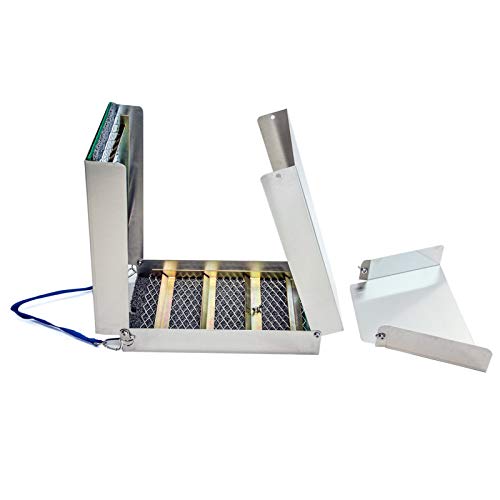
ASR Outdoor 50 Inch Folding Sluice
- Length
- 50 in
- Weight
- About 8.4 lb
- Folds
- To fit in a 5 gallon bucket
Good for: a step up once you have found a spot worth working.
Skip if: you hike far to the creek. Folding 50 inch sluices are best when you can park nearby.
Pros
- Longer box gives gold more chances to settle
- Folds small for the trip in
- Opens to full length at the creek
Cons
- About 8.4 lb, heavy for long hikes
Best Wide Folding Sluice: VEVOR 50 Inch Folding Sluice
The VEVOR 50-inch folding sluice is 50 inches long, 9 inches wide, and weighs about 9 pounds. It covers the same job as the ASR with a slightly wider channel.

VEVOR 50 Inch Folding Sluice
- Size
- 50 x 9 in
- Weight
- About 9 lb
- Type
- Folding
Good for: full-size sluicing with a slightly wider channel than the ASR.
Skip if: you hike far to the creek. It is best close to where you park.
Pros
- Slightly wider channel than the ASR
- Full 50 inch length
- Folds for the trip in
Cons
- About 9 lb, heavy for long hikes
Best Heavy Duty Sluice: Keene A52 High Production Hand Sluice
Keene has made prospecting equipment for decades, and the Keene A52 is its larger hand sluice. It is 51 inches long, has an 18-inch removable flare to gather more water, and uses a 25-inch riffle board with sections for both fast and slow water. At about 16 pounds, it is not a hiking sluice. Choose it for long days near the truck.

Keene A52 High Production Hand Sluice
- Length
- 51 in
- Flare
- 18 in, removable
- Weight
- About 16 lb
Good for: long days near the truck, moving more gravel.
Skip if: you need to hike in. At about 16 lb it is not a hiking sluice.
Pros
- Removable flare gathers more water
- Riffle board with sections for fast and slow water
- From a maker with decades in prospecting gear
Cons
- Heaviest pick at about 16 lb
- Not a hiking sluice
Side-by-Side Comparison
| Sluice | Type | Size (listed) | Weight (listed) | Best for |
|---|---|---|---|---|
| Dream Mat 4 x 16 Adventure (see details) | Mini | 4 x 16 in | 1.4 lb | Backpacking, testing, cleanup |
| Sluice Fox Pocket Kit (see details) | 12 in sluice | 3.2 lb (whole kit) | First trip, cleanup at home | |
| Royal Compact 24 (see details) | Mini, metal | 24 x 7 in | 3 lb | Learning on a classic sluice |
| Sluice Fox Expandable (see details) | Modular | 24 in, 12 in flare | 2.5 lb | Starting small, adding later |
| Dream Mat 6 x 24 Trek (see details) | Wide mini | 6 x 24 in channel | 3 lb | Hiking in, more gravel |
| ASR Outdoor 50 in (see details) | Folding | 50 in long | 8.4 lb | Weekend volume near the car |
| VEVOR 50 in (see details) | Folding | 50 x 9 in | 9 lb | Full size, wider channel |
| Keene A52 (see details) | Heavy duty | 51 in, 18 in flare | 16 lb | Long days, more gravel |
How to Set Up a Sluice Box in a Stream
Setup matters as much as the sluice itself. These steps get a box working.
- Pick the spot. Look for a place where the water runs fairly fast and deep enough to flow through the whole box, ideally where the creek drops a little. Flat, slow water makes it hard to get enough flow.
- Set the slope. A common starting point is about 1 inch of drop for every foot of sluice, so a 4-foot box sits about 4 inches lower at the end. Keep it level from side to side, and make sure water exits the end of the box instead of backing up.
- Check the water. The water should cover the riffles with a fairly shallow flow and carry small pebbles out the end. If water pours over the sides, move the box or narrow the flow with a few rocks in front of the flare.
- Screen your gravel. Run material through a classifier, a sieve that sits on a bucket, to remove rocks larger than about 1/2 inch. Big rocks tumble through the box and can stir up the material settled behind the riffles.
- Feed it slowly. Add one scoop at a time at the top end of the sluice. You should always be able to see the tops of the riffles. If gravel buries them, you are feeding too fast.
- Adjust as you go. If gravel packs up behind the riffles, add slope or water. If the riffles look scrubbed clean with no dark black sand behind them, the flow is too strong, so lower the slope.

How to Clean Out a Sluice Box
Run the box until black sand builds up behind the riffles, then clean it out before it overloads. Lift the sluice straight up out of the water while keeping it level, so nothing washes out. Set it over a large tub or bucket. Remove the riffles and mat, then rinse them and the bottom of the box into the tub. Pan the concentrates in the tub, or bag them and pan them at home. Our guide to gold panning supplies lists the classifiers, pans, and snuffer bottles that make this step easier.

Where You Can Use a Sluice Box
Rules depend on who manages the land and the stream, so check before you dig.
On public land managed by the Bureau of Land Management, hand panning and non-motorized sluicing are listed as casual use, activities that normally cause little disturbance. Bigger operations, including setups with pumps, may need a notice or approval. Ask the local BLM field office before you bring a pump.
States add their own rules on top of that. In Washington, for example, the state's Gold and Fish pamphlet works as the permit for common prospecting methods, limits sluice size on some waters, and sets work windows to protect fish. Some areas welcome sluices outright. The BLM and Forest Service guide to the Kenai Peninsula in Alaska allows year-round panning and hand-fed sluice boxes in the streams it lists.
A few rules apply almost everywhere. Work in the active stream channel or on bare gravel bars, not in the banks. Put back rocks you move. Do not prospect on an active mining claim or private land without the owner's permission.
Sluice Box FAQ
What size sluice box is best for a beginner?
A sluice about 24 inches long is a good place to start. It is light enough to carry, easy to set up, and big enough to process real gravel. Move up to a 50-inch folding sluice once you find a spot worth working and can park close to the water.
How much slope should a sluice box have?
Start with about 1 inch of drop for every foot of sluice, then adjust. Add slope if gravel packs up behind the riffles. Lower it if the riffles are scrubbed clean and no black sand stays behind them.
Do you need a pump to use a sluice box?
Not if you set it in a stream with moving water. The current moves the gravel through the box. You only need a pump for a highbanker or to run a small sluice in a tub when there is no stream nearby.
Can you use a sluice box without a stream?
Yes, but only on a small scale. You can set up a mini sluice in a large tub and pour water through it, or use a small pump to recirculate the water. This works well for cleaning concentrates but is too slow for large amounts of gravel.
Do you need a permit to use a sluice box?
It depends on where you are. On BLM land, non-motorized sluicing is listed as casual use. Many states have their own rules, such as size limits and seasons, and some require a permit. Check with the land manager and your state wildlife or natural resources agency first.
Which Sluice to Buy
If you are new to prospecting, start with a 2 foot sluice like the Royal Compact 24 or the Dream Mat 6 x 24 Trek and learn how water, slope and riffles work together. Add a 50 inch folding sluice like the ASR Outdoor once you find gold worth working. If you mostly hike to remote creeks, the Dream Mat 4 x 16 is the lightest way to test a spot. If you have a metal detector too, our guide to the best metal detector for gold covers how detecting and sluicing work together on the same trip.