

A gold pan is the cheapest prospecting tool and the one that decides whether you find gold or go home empty-handed. Every other piece of gear, from a classifier (a screen that sifts out rocks) to a sluice (a trough that catches gold in running water), exists to feed material into a pan. Get the size, riffles, and color right, and panning goes from frustrating to fun in an afternoon.
DetectorBrief is a participant in the Amazon Services LLC Associates Program, an affiliate advertising program designed to provide a means for sites to earn advertising fees by advertising and linking to Amazon.com.
This guide covers how a gold pan works, plastic vs. steel, which size to start with, what the riffles do, and six pans and accessories sold on Amazon. The picks are based on maker specs and buyer feedback, not hands-on testing. If you want the full starter kit, our guide to gold panning supplies covers everything else you need.
Table of Contents
How a Gold Pan Works
The U.S. Geological Survey publication Prospecting for Gold in the United States describes the pan as a shallow vessel with sloping sides and a flat bottom, used to wash gravel that contains heavy minerals. It calls panning the simplest, most common, and least expensive way for a prospector to separate gold from stream silt, sand, and gravel.
The whole method rests on weight. Gold is far heavier than the sand and gravel around it, so when you swirl a pan of material under water, the gold sinks to the bottom while lighter material washes over the side. The same USGS publication also warns that panning is slow, physically tiring work that takes practice. A well-designed pan makes that practice shorter.
Plastic vs Steel Gold Pans
The classic gold pan was steel, and steel pans are still sold. Most beginners do better with plastic.
- Plastic pans are light, don't rust, and come with molded riffles along one side. They also come in dark colors that make tiny flakes easier to spot.
- Steel pans are tough and handle heat, but they are heavier, they can rust, and they rarely have riffles. New steel pans usually carry a factory oil coating, and many prospectors burn it off before use, because oil can let fine gold float.
For a first pan, plastic wins on almost every count. Every pan in this guide is plastic.
What Size Gold Pan Should You Buy?
- 14 to 15 inches. The standard working size. It holds enough material to make each pan worth the effort, and it is still light enough to swirl for an hour. Start here.
- 10 to 12 inches. A finishing pan. Once your big pan is down to black sand and gold, move the last bit into a smaller pan for cleaner, more controlled final washing.
- 8 inches and smaller. Pocket and backpack pans, good for testing a spot for gold before you bring in more gear, and easy for kids to handle.
Many prospectors carry two: a 14-inch pan for the main work and a 10-inch pan for finishing.
Riffles and Color: The Two Features That Matter Most
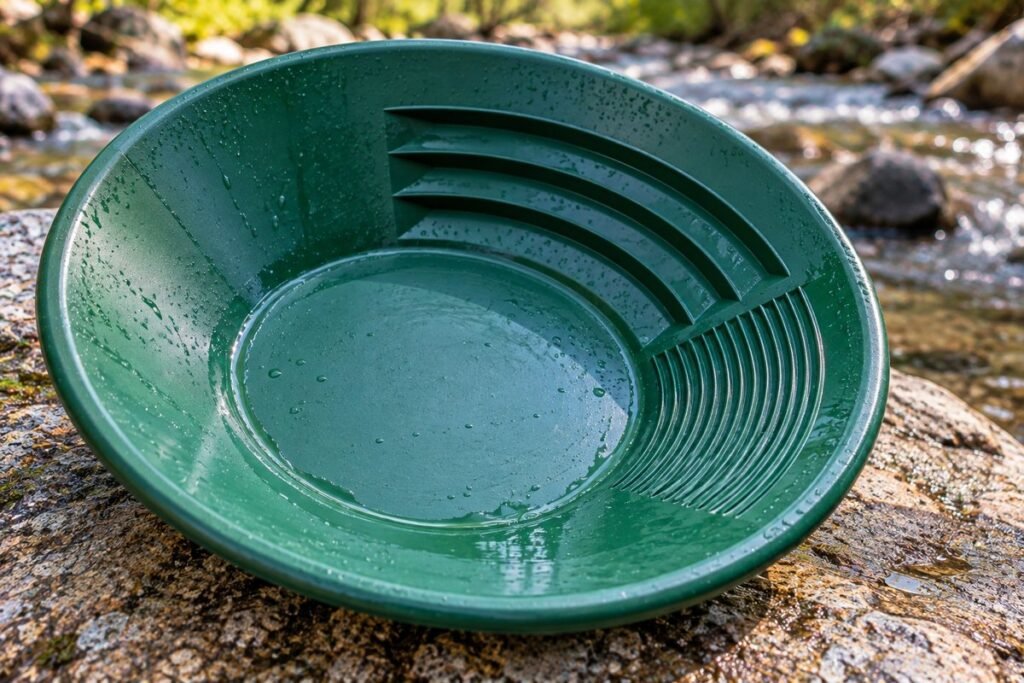
Riffles are the ridges molded into one side of a plastic pan. They act like small dams. When you tilt the pan and wash material forward, heavy particles catch behind the riffles while lighter sand washes out. Many pans have two sets: deep, coarse riffles to work through gravel fast, and shallow micro riffles to hold fine gold at the end.
Color matters because most gold you find will be flakes and specks, not nuggets. Green, blue, and black pans give bright yellow gold high contrast, which makes it much easier to see what you are keeping and what you are about to wash away. Not sure a shiny piece is gold? Our guide on how to tell if gold is real shows how to rule out fool's gold.
The Best Gold Pans on Amazon
These six picks cover a main working pan, a complete set, a fast high-volume pan, a finishing pan, a pocket pan, and the classifier that sits on top of any of them.
1. SE 14 Inch Gold Panning Pan with Dual Riffles: best overall pick
The SE 14 Inch Gold Panning Pan is a plain, well-designed working pan. SE molds two sets of riffles: deep quarter-inch riffles to work through larger sediment, sand, and rocks, and micro riffles to hold fine material and black sand at the end. A one-eighth-inch base helps trap gold, and SE notes the pan holds fine flakes better as it becomes seasoned with use. It comes in green and black.

SE 14 Inch Gold Panning Pan with Dual Riffles
- Size
- 14 in
- Riffles
- Deep 1/4 in plus micro riffles
- Colors
- Green or black
Good for: everyday panning, from the rough wash to the fine finish.
Skip if: you want everything in one box. This is just a pan.
Pros
- Dual riffles handle both the rough wash and the fine finish
- Light enough to swirl for long sessions
- Sold in several colors, so you can pick the one you see gold on best
Cons
- Just a pan, so you will still want a classifier and snuffer bottle
2. Garrett Complete Gold Pan Kit: best complete set
If you would rather buy once, the Garrett Complete Gold Pan Kit bundles a 14-inch Gold Trap pan, a 14-inch sifter, a 10-inch Backpacker pan, a Gold Guzzler suction bottle, and two vials. Garrett uses 90-degree riffles that it says help trap gold in wet or dry conditions, and the green color is meant to make fine gold easier to spot.

Garrett Complete Gold Pan Kit
- Pans
- 14 in Gold Trap, 10 in Backpacker
- Sifter
- 14 in
- Also
- Gold Guzzler bottle, 2 vials
Good for: buying once and getting a main pan, a finishing pan and a classifier together.
Skip if: you already own some panning gear.
Pros
- A main pan, a finishing pan, and a classifier in one box
- Includes the bottle and vials you need to collect fine gold
- Green color meant to make fine gold easier to spot
Cons
- You pay for pieces you may already own if you have started a kit
3. Garrett Supersluice 15 Inch Pan: best for moving more material
The Garrett Supersluice Gold Pan is a bigger pan built for speed. At 15 inches, it holds more material per pan, and Garrett gives it twin half-inch riffles and a deep-throat funnel. Garrett says it traps everything from fine gold up to one-ounce nuggets.

Garrett Supersluice 15 Inch Pan
- Size
- 15 in
- Riffles
- Twin 1/2 in
- Throat
- Deep funnel
Good for: moving more material at a productive spot.
Skip if: you are just learning. It is heavier to swirl when full.
Pros
- Larger capacity means fewer refills
- Deep riffles move gravel out fast
Cons
- Heavier to swirl when full, which tires beginners sooner
- Pair it with a smaller pan for finishing
4. SE 10 Inch Green Pan with Dual Riffles: best finishing pan
A finishing pan does the last, careful wash. The SE 10 Inch Green Plastic Gold Pan has the same two riffle types as the 14 inch model and a one-eighth-inch deep round base to trap gold. Its smaller size gives you more control as you work down to the last few flakes.
SE 10 Inch Green Pan with Dual Riffles
- Size
- 10 in
- Riffles
- Dual, same as the 14 in
- Base
- 1/8 in deep
Good for: the last, careful wash down to the final few flakes.
Skip if: you want just one pan. It is too small to be your only gold pan.
Pros
- Easy to control for final cleanup
- Doubles as a light backpack pan
Cons
- Too small to be your only gold pan
5. SE 8 Inch Gold Panning Pan: best pocket and kids pan
The SE 8 Inch Gold Panning Pan carries the same dual riffle design in a size that slips into a backpack. Use it to test a creek for gold before you carry in a bucket and a big pan, or hand it to a child who wants a pan they can manage. If that test turns up gold, our guide to the best sluice box for gold shows how to work more gravel in a day.

SE 8 Inch Gold Panning Pan
- Size
- 8 in
- Riffles
- Dual
- Best use
- Sampling and kids
Good for: testing a creek on a hike, or a child who wants a pan they can manage.
Skip if: you plan to work a lot of gravel. It holds little material.
Pros
- Packs small for hiking and sampling
- Sized for smaller hands
Cons
- Holds little material, so it is slow for real work
6. SE 13.25 Inch Stackable Classifier: the best add-on for any pan
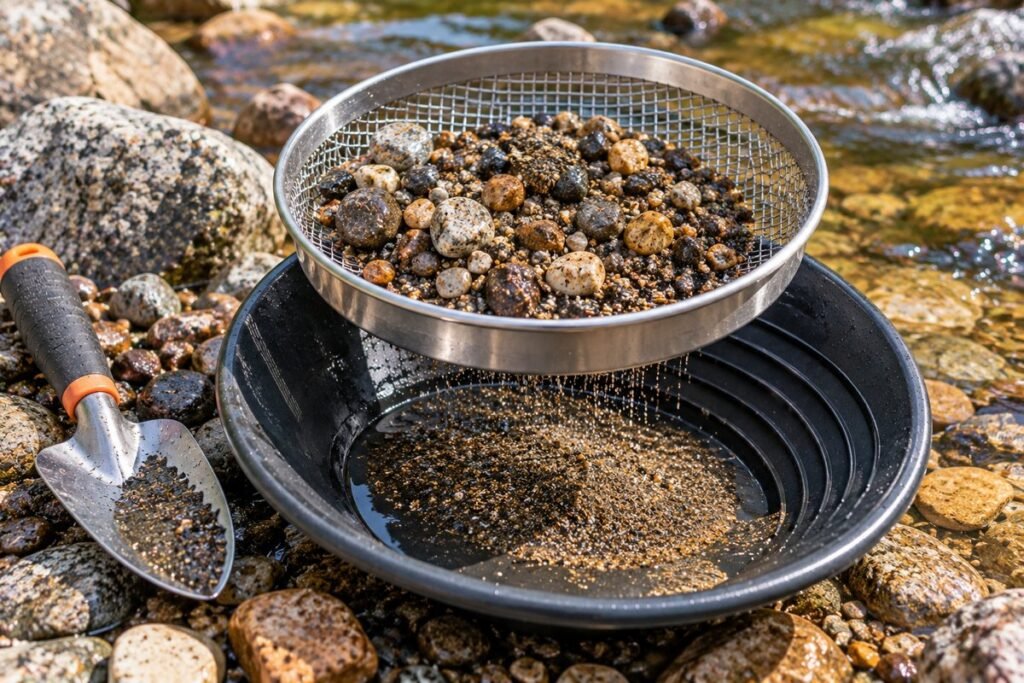
A classifier is a screen that sits on top of your gold pan and filters out rocks before they go in. The SE 13.25 Inch Stackable Classifier uses a rust-resistant stainless steel mesh with one-eighth-inch openings, and SE designed it to stack and pack into a finds bag. Screening first means your pan only handles material small enough to hold gold, which makes every pan faster.

SE 13.25 Inch Stackable Classifier
- Size
- 13.25 in
- Mesh
- 1/8 in stainless steel
- Packs
- Stacks into a finds bag
Good for: any pan. Screening first means every pan goes faster.
Skip if: it will not fit over your pan. Check the size first.
Pros
- Speeds up panning more than any other accessory
- Stainless mesh resists rust
- Stacks and packs small
Cons
- Check that it fits over your pan before you buy
Side-by-Side Comparison
| Pick | Size | Riffles | Best for |
|---|---|---|---|
| SE 14 Inch Gold Panning Pan (see details) | 14 inches | Deep and micro | Main working pan |
| Garrett Complete Gold Pan Kit (see details) | 14 and 10 inches plus sifter | 90 degree | Buying a full set at once |
| Garrett Supersluice (see details) | 15 inches | Twin half-inch | Moving more material |
| SE 10 Inch Green Pan (see details) | 10 inches | Deep and shallow | Finishing |
| SE 8 Inch Gold Panning Pan (see details) | 8 inches | Dual | Sampling, kids, backpacks |
| SE 13.25 Inch Classifier (see details) | 13.25 inches | Screen, not a pan | Screening before panning |
How to Use a Gold Pan
- Screen your material through a classifier into the pan so only sand and small gravel go in.
- Fill the pan about three-quarters full and sink it completely under calm water.
- Shake the pan hard side to side underwater to let heavy material settle to the bottom.
- Break up clay and pick out the larger rocks by hand, checking them for gold before you toss them.
- Tilt the pan forward with the riffles on the low side, and use a gentle forward-and-back motion to wash light material over the edge of the pan.
- Shake every few washes again to keep gold moving down, and keep going until only black sand is left. Black sand is the heavy, dark mineral grit that settles to the bottom along with gold.
- Swirl a little water over the black sand to reveal the gold, then suck it up with a snuffer bottle, a small squeeze bottle made for picking up gold flakes.
For a longer step-by-step routine and the gear that goes with it, see our guide to gold panning supplies. If you want to find gold before you pan for it, our roundup of the best metal detector for gold covers machines built for small nuggets.
Common Panning Mistakes
- Washing too fast. Most lost gold washes over the edge in the first few minutes because the pan was tipped too far.
- Skipping the shake. Gold only sinks when the material around it is loosened, so shake before every round of washing.
- Starting with a pan too large to control. A 14 inch pan is plenty for most people.
- Panning gravel from the wrong place. A great pan cannot find gold that is not there. Look on the inside of creek bends, behind boulders, and in cracks in the bedrock.
Gold Pan FAQ
What size gold pan is best for beginners?
A 14-inch gold pan is the usual starting point. It holds enough material to be productive and is still easy to handle. Add a 10-inch pan later for finishing.
Are plastic or steel gold pans better?
For most beginners, plastic. Plastic pans are lighter, do not rust, come with riffles, and come in dark colors that make gold easier to see. Steel pans are tougher but heavier and usually lack riffles.
What color gold pan is best?
Green, blue, and black are the most popular because bright yellow gold stands out against them. Pick the color you find easiest to see small flakes on.
What are the ridges in a gold pan for?
They are riffles. They catch heavy particles, including gold, while you wash lighter sand and gravel out of the pan.
Do I need a classifier with a gold pan?
You can pan without one, but a classifier screens out rocks first, so every pan goes much faster. It is the most useful add-on for any pan.
Can kids use a gold pan?
Yes. An 8-inch pan is light and small enough for most kids to handle with an adult nearby, especially in shallow, calm water.
Which Pan to Buy
Start with the SE 14 Inch Gold Panning Pan and a classifier, and you have the core of a working setup. If you want everything in one box, the Garrett Complete Gold Pan Kit adds a finishing pan, a sifter, and a bottle. Whichever pan you choose, slow down on the wash, shake often, and pan where heavy material naturally collects.