

The best kids' metal detector is light enough for small arms, simple enough for a first try, and tough enough to survive a drop in the sand. Most kids do not need the frequency selectors and discrimination charts built for adults. They need something they can turn on and start swinging in the first five minutes.
DetectorBrief is a participant in the Amazon Services LLC Associates Program, an affiliate advertising program designed to provide a means for sites to earn advertising fees by advertising and linking to Amazon.com.
Below are seven kid-friendly detectors: four toy-grade kits, two kid-sized detectors from hobby brands Nokta and Minelab, and one real entry-level machine for an older kid ready to grow into the hobby. Every spec comes from the maker's own pages or the Amazon listing, checked on November 13, 2026. We haven't run these seven side by side, so treat this as a spec-based shortlist, and read how we research if you want the details.
Table of Contents
Compare all 7 kids' metal detectors
Weights are the detector weights from each maker's listing. Ages in the second column are what the maker or listing says, and our own age advice is in the next section. On a phone, swipe the table sideways to see every column.
| Detector | Maker's age | Weight | Controls | Water protection | Best for | Main drawback |
|---|---|---|---|---|---|---|
| Best overallNational Geographic Starter Kit (see details) | 8 to 12 | 1.2 to 1.43 lb (listing figures differ) | On/off only. Beep and LED alert | Coil only, waterproof to 4 in | A first detector with nothing to set | Shallowest listed depth (4 in) |
| National Geographic Pinpoint (see details) | Not stated in listing | 1.4 lb | LCD, 3 modes, sensitivity, pinpoint | Coil only, waterproof (depth not stated) | Kids who want a screen and more to try | More buttons than a first-timer needs |
| Bounty Hunter Junior (see details) | 6 and up | 1.3 lb | Discrimination knob, target meter, one tone | Coil only, weather resistant (not waterproof) | Ages 6 and 7, sturdy aluminum stem | Not waterproof, runs on 2 x 9V |
| RIPTIC Kids Detector (see details) | Listing says 3 and up | 1.7 lb | Buzzer and LED screen | Coil only, waterproof, but not for saltwater or wet sea sand | A ready-to-go kit with shovel, rake and bag | Few published specs |
| Nokta Midi Hoard (see details) | 8 to 12 and up | 1.9 lb | LCD, pinpoint, discrimination, 3 sensitivity levels, depth indicator | Whole unit, waterproof to 3 ft (IP68) | Beach and creek trips with real controls | No published detection depth |
| Minelab GO-FIND 22 (see details) | Not stated | 2.2 lb | 2 modes, 3 sensitivity levels, icons, 2 tones | Coil only, waterproof to 2 ft | Family trips, folds to about 22 in | Control box must stay dry |
| Minelab Vanquish 360 (see details) | Not stated (we suggest 10 and up) | 2.6 lb | Target ID, 3 modes plus custom, pinpoint, 5 sensitivity levels | Whole unit, waterproof to 16 ft (IP68) | An older kid ready for a real detector | Heaviest and longest pick, costs the most |
Which metal detector fits your kid's age?
These age brackets are our editorial guidance, not maker certifications. A kid's height, strength, attention span and experience often matter more than age alone, so a tall 7-year-old who has detected before may handle a detector that tires a first-time 9-year-old. Use the brackets as a starting point, then check the fit using the steps further down.
Ages 6 to 7
What matters
A light detector, one or two controls, and short hunts with an adult right there. At this age the goal is hearing a beep and digging something up, not reading a screen.
Good fits from this list
- Bounty Hunter Junior: listed for 6 and up, 1.3 lb, one tone
- RIPTIC kit: 1.7 lb, tools included
- National Geographic Starter: listed for 8 to 12, but at about 1.2 to 1.4 lb a tall 7-year-old may manage it
Ages 8 to 9
What matters
A shaft that adjusts to their height, a clear sound or light when the coil finds metal, and a trowel they can use on their own so recovering a find does not need an adult every time.
Good fits from this list
- National Geographic Starter: nothing to set
- National Geographic Pinpoint: adds a screen and pinpoint
- Nokta Midi Hoard: listed for 8 to 12 and up, if they want real controls
Ages 10 to 12
What matters
Pinpoint and discrimination start to pay off, and water protection matters if you visit beaches or creeks. Most kids this age can learn what a discrimination setting does and why it is not perfect.
Good fits from this list
- Nokta Midi Hoard: whole unit waterproof to 3 ft, pinpoint and discrimination
- Minelab GO-FIND 22: two simple modes, folds for trips
- National Geographic Pinpoint: a lighter, simpler option
Ages 13 and up
What matters
A hobby-grade detector makes sense if the weight, length and controls suit them. Check that they can swing it for a full hunt and reach the grip with the armrest just below the elbow.
Good fits from this list
- Minelab Vanquish 360: 2.6 lb, shaft 31 to 56 in, target ID
- Minelab GO-FIND 22: a lighter, simpler hobby detector
- More adult options in our best metal detector for beginners guide
How we chose these detectors
We started with kids' metal detectors sold on Amazon in the US and checked every listing on November 13, 2026. Specs come from the maker's own pages where they exist (Nokta, Minelab, and Bresser, which distributes Bounty Hunter), and from the Amazon listing otherwise. Where a listing leaves something out, like a detection depth, a coil size or what batteries it takes, we say so instead of guessing. We compared published information only. We haven't tested these seven detectors hands-on.
We judged them on what matters for a kid:
- Age fit: the maker's stated age, plus our own guidance where the maker gives none.
- Weight: lighter is better for small arms, so we list the detector weight for every pick.
- Comfort and fit: a shaft that adjusts as a kid grows.
- Controls: how much a kid has to learn before the first find.
- Water protection: coil only, weather resistant, or the whole unit, and to what depth.
- Accessories: trowels, shovels, bags, and batteries in the box.
- Cost: how each one compares with the others here, without quoting prices that change daily.
- Limitations: every pick has at least one, and we list it.
The list covers three steps: toy-grade kits for a first try, kid-sized detectors from hobby brands for kids who want real controls, and one full entry-level detector for an older kid who's hooked.
How to choose a metal detector for kids
Match the weight to the kid, not the specs
The seven detectors here weigh between 1.2 and 2.6 pounds, according to their makers, and that difference matters more than any feature list. A detector that feels light in a store can feel heavy after twenty minutes of swinging. Look for an adjustable stem so the detector grows with your kid instead of getting left in the closet after one hunt.
Toy-grade or real detector?
Toy-grade detectors use a tone and a light to flag metal, which is exactly what a first-time user needs. A real detector like the Vanquish 360 adds target ID (a number that hints at what kind of metal is buried) and discrimination settings that help a more experienced kid tell a bottle cap from a coin before digging. Neither is a guarantee. Target ID and discrimination are educated guesses, so some trash will still beep and some good targets can be filtered out. This quick comparison uses only the published specs for the picks on this page.
| Feature | Toy-grade kit | Kid-sized hobby detector | Entry-level real detector |
|---|---|---|---|
| On this list | National Geographic Starter and Pinpoint, Bounty Hunter Junior, RIPTIC | Nokta Midi Hoard, Minelab GO-FIND 22 | Minelab Vanquish 360 |
| Weight here | 1.2 to 1.7 lb | 1.9 to 2.2 lb | 2.6 lb |
| Controls | On/off, a beep or light, sometimes one knob or a pinpoint button | Two to three modes, sensitivity, simple icons or tones | Target ID numbers, several search modes, discrimination settings |
| Published warranty | Not stated for three of the four, 1 year for the Bounty Hunter | 2 years | 3 years |
| Room to grow | Fine for a first season, then many kids want more | Several years for a kid who sticks with it | Built for adults, so it lasts into the teens and beyond |
Start with a toy-grade or kid-sized model for a first detector, and move to a real one once your kid keeps asking to go out.
Water rating for the beach
Water protection varies a lot on this list. The two National Geographic kits, the RIPTIC, and the Minelab GO-FIND 22 list a waterproof coil only (the RIPTIC's photos add that it isn't designed for saltwater or wet sea sand). The National Geographic Starter's coil is rated waterproof to 4 inches, and the GO-FIND 22's to 2 feet. The Bounty Hunter Junior's coil is described as weather-resistant, not waterproof, so keep it out of water. The Nokta Midi Hoard and the Minelab Vanquish 360 are the only ones that are waterproof as a whole unit, rated IP68 to 3 ft and 16 ft. On every other pick, keep the control box and screen dry and stick to wet sand and very shallow water.
Simple modes beat lots of buttons
A kids detector with one button and a light will get more use than one with five menus a kid has to ask an adult to explain. Save the discrimination charts and sensitivity dials for when your kid asks for them.
Safety and supervision come first
Many kids' kits come with a small hand trowel or shovel, so treat digging tools the same way you would treat any yard tool. Stay with younger kids near roads, water or uneven ground, and set the rule that finds get shown to an adult before anything goes in a pocket.
Detection depth and age fit
The toy-grade makers here list detection depths of 4 to 6 inches, and the Bounty Hunter Junior lists coins to 5 inches. Treat those as best-case numbers. Real depth depends on the size of the target, the soil, moisture, and how low and level the coil is swung, so most finds will come up shallower. The Nokta and Minelab detectors don't publish a depth figure at all.
Shallow depth is fine for most families. A younger kid digging finds in a yard or park won't notice the difference, and a shallower detector means smaller holes. Once a kid finds targets regularly and wants a chance at older coins, it's time to step up to a full-size detector like our Vanquish 360 pick below.
The 7 best metal detectors for kids
Each of these suits a different age or need. Every review lists the published specs, who should buy it and who should skip it, its strengths and limits, how it compares with the closest alternative, and our verdict.
1. National Geographic Starter Metal Detector Kit: best all-around first detector
The Starter Metal Detector Kit is listed for ages 8 to 12 and comes with a heavy-duty trowel and a full-color learning guide about the history of metal detecting. Its 7.4-inch dual coil is waterproof to a depth of 4 inches, and it detects objects up to 4 inches deep. The listing text lists the detector weight as 1.2 pounds, but the product photo shows 1.43 pounds, so plan on something in that range.
Turning it on is the only setup step. It beeps and lights an LED when it passes over metal, with no menus or sensitivity dial to adjust. The arm adjusts in length, and the product photos show it running from 33.5 to 40.5 inches and folding down to 13 inches, so it can be resized as your kid grows. The photos also say it needs one 9V battery, which isn't included. The listing doesn't mention a headphone socket.

National Geographic Starter Metal Detector Kit
- Maker age
- 8 to 12
- Weight
- 1.2 to 1.43 lb (listing figures differ)
- Coil
- 7.4 in, waterproof to 4 in
- Controls
- On/off, beep and LED
- Listed depth
- Up to 4 in
Good for: a first detector with nothing to set. Turn it on and go.
Skip if: your kid wants a screen or pinpoint. The Pinpoint model has both.
Verdict: the easiest first detector here for most kids 8 and up.
Pros
- Nothing to set up or adjust
- Among the lightest picks here
- Trowel and learning guide included
Cons
- Shallowest listed depth of the picks that publish one
- Coil only waterproof to 4 in
Compared with the National Geographic Pinpoint: both use the same 7.4 in coil and come with a trowel. The Starter is simpler and about the same weight. The Pinpoint adds an LCD, adjustable sensitivity, 3 modes and pinpoint, and lists a deeper 6 in detection depth. Choose the Starter for a first try and the Pinpoint for a kid who wants more to learn.
2. National Geographic Metal Detector for Kids with Pinpoint Function: best with a display
The Pinpoint Function model is National Geographic's step-up kit. It adds an LCD screen, adjustable sensitivity, and 3 selectable detection modes to the same 7.4-inch waterproof coil, and it's rated to detect objects up to 6 inches deep. The detector weighs 1.4 pounds, has a telescoping arm, and comes with a trowel and the same learning guide.
Pinpoint mode narrows down where a target sits once the coil finds the general area, meaning smaller holes and less digging. The listing doesn't give an age range, how deep the coil can go underwater, or what batteries it takes. We'd treat it as an 8-and-up detector, like the Starter, for a kid ready for a few more buttons.

National Geographic Metal Detector for Kids with Pinpoint Function
- Maker age
- Not stated (we suggest 8 and up)
- Weight
- 1.4 lb
- Coil
- 7.4 in, listed as waterproof
- Controls
- LCD, 3 modes, sensitivity, pinpoint
- Listed depth
- Up to 6 in
Good for: a kid who wants a screen and a pinpoint button.
Skip if: it's a very first detector for a younger kid. The Starter has fewer buttons.
Verdict: the best toy-grade pick for a kid who wants more than a beep.
Pros
- Pinpoint helps keep holes small
- Adjustable sensitivity and 3 modes
- Deepest listed depth of the toy-grade kits
Cons
- No age range or battery details in the listing
- More controls to learn than the Starter
Compared with the Nokta Midi Hoard: both have a screen and pinpoint. The Pinpoint is 0.5 lb lighter and publishes a depth figure. The Midi Hoard adds discrimination and a depth indicator and is waterproof as a whole unit to 3 ft, so it is the better choice near water.
3. Bounty Hunter Junior: best for younger kids
The Bounty Hunter Junior is listed for ages 6 and up, and its Amazon listing says it's made in the USA. It weighs 1.3 pounds, has a 6.5-inch coil, and its aluminum stem adjusts in length. Bresser, which distributes Bounty Hunter, lists the stem as adjusting from about 21 to 32 inches.
It runs on two 9-volt batteries, which aren't included. A target meter and volume that rises as the coil gets closer help a kid home in on a find, and the maker lists coins to 5 inches deep. A discrimination knob can tune out iron and some trash, but no discrimination setting is perfect, so some junk will still beep. The coil is described as weather-resistant, not waterproof, and it comes with a 1-year limited warranty.

Bounty Hunter Junior
- Maker age
- 6 and up
- Weight
- 1.3 lb
- Coil
- 6.5 in, weather resistant
- Controls
- Iron filter knob, target meter
- Power
- 2 x 9V (not included)
Good for: the youngest kids on this list.
Skip if: you'll detect at the waterline. The coil isn't waterproof.
Verdict: the best fit for kids 6 and 7, as long as you keep it dry.
Pros
- Rated from age 6, the youngest here
- Light at 1.3 lb with an aluminum stem
- Discrimination knob to learn on as they grow
Cons
- Coil is weather resistant, not waterproof
- 9V batteries not included
Compared with the RIPTIC kit: the Bounty Hunter has a known maker, a 1-year warranty, a discrimination control and a published depth. The RIPTIC is a fuller bundle with a shovel, rake, bag and battery, and its coil is listed as waterproof, but its listing publishes far fewer specs.
4. RIPTIC Metal Detector for Kids: most complete starter bundle
The RIPTIC kit comes with a shovel, rake, carry bag, and battery, so you don't need anything else for a first hunt. It weighs 1.7 pounds and has an adjustable stem made of aluminum and plastic. The product photos call the search coil IP68 waterproof, but say it's best for parks, fields, dry sand, and fresh water, and that it isn't designed for saltwater or wet sea sand. The listing doesn't give a coil size.
Finds are flagged by a buzzer and an LED screen. The listing title calls it an LED depth display, but the feature list says the screen shows battery status, so don't count on depth readings. The listing labels it for ages 3 and up, which is a toy safety label rather than a skill level, and we'd suggest it for about ages 6 to 9. It doesn't publish a detection depth, discrimination features, or warranty terms.

RIPTIC Metal Detector for Kids
- Listed age
- 3 and up (we suggest 6 to 9)
- Weight
- 1.7 lb
- Coil
- Size not stated, waterproof, not for saltwater
- Controls
- Buzzer and LED screen
- In the box
- Shovel, rake, bag, battery
Good for: a gift that's ready to go with tools included.
Skip if: you want published specs, a warranty or discrimination. The Bounty Hunter Junior lists all three.
Verdict: a complete starter bundle, but the least documented pick here.
Pros
- Shovel, rake, bag and battery included
- IP68 waterproof coil for fresh water
- Adjustable stem
Cons
- Few published specs and no detection depth
- Not designed for saltwater or wet sea sand
Compared with the National Geographic Starter: both are simple beep-and-alert detectors. The Starter is lighter and publishes its coil size, detection depth and how deep the coil is waterproof. The RIPTIC adds a rake and a carry bag.
5. Nokta Midi Hoard: best fully waterproof kids detector
The Nokta Midi Hoard comes from Nokta, a company that makes full-size hobby detectors, and it's built for ages 8 to 12 and up. Unlike the toy-grade picks, the whole detector is waterproof, rated IP68 to 3 ft, so it can go into shallow water at the beach or a creek, not just over wet sand. It weighs 1.9 lb with a 7 in coil and a shaft that adjusts from 32.5 to 43 in.
It works like a small version of an adult detector. It has a pinpoint button, a discrimination button that separates good targets from iron, a 3-level depth indicator, 3 sensitivity levels, 3 audio tones, and an LCD screen. Nokta's spec sheet doesn't list a headphone socket. It runs on 2 AA batteries (not included), and Nokta offers a 2-year warranty. Nokta also makes a smaller Mini Hoard for younger kids, but we couldn't find it sold on Amazon in the US, so it isn't one of our picks.

Nokta Midi Hoard
- Maker age
- 8 to 12 and up
- Weight
- 1.9 lb
- Water
- Whole unit, IP68 to 3 ft
- Controls
- Pinpoint, iron filter, 3 sensitivity levels
- Power
- 2 x AA (not included)
Good for: beach and creek trips, or a kid who wants pinpoint and discrimination like an adult detector.
Skip if: your kid is under 8. The Bounty Hunter Junior is listed for younger kids.
Verdict: the best pick for kids 8 to 12 who'll detect near water or want real controls.
Pros
- Whole unit waterproof to 3 ft (IP68)
- Pinpoint, discrimination and depth indicator
- 2-year warranty
Cons
- No published detection depth
- No headphone socket listed
Compared with the Minelab GO-FIND 22 and Vanquish 360: the Midi Hoard is the lightest of the three at 1.9 lb and the only one built for kids. It can go underwater to 3 ft, while the GO-FIND 22's control box has to stay dry. The Vanquish 360 is rated deeper underwater (16 ft) and adds target ID numbers, but it's 0.7 lb heavier and built for adults.
6. Minelab GO-FIND 22: best for family trips
The Minelab GO-FIND 22 comes from Minelab, the maker of our Vanquish 360 pick, and its Amazon listing says it's for adults and kids. It weighs 2.2 lb, has an 8 in coil that's waterproof to 2 ft, and collapses to about 22 in, so it fits in a backpack or a suitcase for camping and beach trips.
The controls are simple. It has 2 find modes, all-metal and reject-iron, 3 sensitivity levels, and large icons on the screen that show signal strength and the target type. A low tone means iron and a high tone means coins and other good targets, which is an easy rule for a kid to learn. It takes 4 AA batteries (not included), has an earbud socket, and comes with a 2-year warranty. Minelab doesn't give an age range, and at 2.2 lb, it's heavier than the kids' models here, so it suits older kids or a family that shares one detector.

Minelab GO-FIND 22
- Maker age
- Not stated
- Weight
- 2.2 lb
- Coil
- 8 in, waterproof to 2 ft
- Controls
- 2 modes, 3 sensitivity levels, 2 tones
- Power
- 4 x AA (not included)
Good for: families who travel and want one detector everyone can share.
Skip if: you want to take it into the water. Only the coil is waterproof, and the Midi Hoard handles water better.
Verdict: the best choice for families who travel and want one detector to share.
Pros
- Folds to about 22 in for travel
- Two-tone audio is easy to learn
- Earbud socket and 2-year warranty
Cons
- Control box isn't waterproof
- At 2.2 lb, heavier than every kids model here
Compared with the Nokta Midi Hoard: the GO-FIND 22 folds smaller and has an earbud socket. The Midi Hoard is 0.3 lb lighter, adds a pinpoint button and is waterproof as a whole unit.
7. Minelab Vanquish 360: best real detector to grow into
The Vanquish 360 is a real entry-level detector, not a toy, and it's the pick for a kid who has outgrown the simpler models above. It's Minelab's newer version of the Vanquish 340, running Multi-IQ multi-frequency technology with Park, Beach, and All Metal modes, a custom search profile, and pinpoint. It weighs 2.6 lb and comes with a 10 x 7 in Double-D coil.
The whole detector is waterproof, rated IP68 to 16 ft, so a drop in a creek or the surf won't hurt it. Unlike the kids' models, it shows target ID numbers and has 6 discrimination segments, 5 sensitivity levels, and a wired 3.5 mm headphone socket (headphones not included). It has a built-in rechargeable battery and a 3-year warranty. Minelab doesn't give an age range, and the shaft runs from 31 to 56 in, so it's built for adults. We only suggest it for kids about 10 and up who are tall enough to swing it comfortably and are sure this is a hobby they want to keep. For more full-size options, see our best metal detector for beginners guide.

Minelab Vanquish 360
- Maker age
- Not stated (we suggest 10 and up)
- Weight
- 2.6 lb
- Water
- Whole unit, IP68 to 16 ft
- Controls
- Target ID, 3 modes plus custom, pinpoint
- Power
- Built-in rechargeable
Good for: a kid who's already hooked and ready for a real detector that can go to the beach and into the water.
Skip if: it's your kid's first detector. Start with a kids model and step up later.
Verdict: the pick for an older kid who's already hooked.
Pros
- Whole unit waterproof to 16 ft (IP68)
- Target ID and discrimination to learn on
- Rechargeable battery and 3-year warranty
Cons
- Heaviest and longest pick here
- Costs more than the kids models
Compared with the Nokta Midi Hoard: both are waterproof as a whole unit. The Vanquish adds target ID, Multi-IQ and a rechargeable battery, and it's rated to 16 ft underwater. The Midi Hoard is 0.7 lb lighter and built for kids.
How to fit a metal detector to your kid
A detector that fits gets used for a whole hunt. One that's too long or heavy gets dropped after ten minutes. Set it up before the first trip, with your kid standing on flat ground in the shoes they'll wear.
- Armrest just below the elbow, not on the upper arm.
- Arm relaxed and nearly straight, hand on the grip.
- Shaft long enough that the coil reaches the ground ahead without leaning over.
- Coil level and just above the ground, as close as it can go without dragging.
- An adult close by, especially for younger kids (shown on larger screens).
Signs the detector is too long or too heavy:
- The armrest sits on the upper arm or past the elbow.
- Your kid bends the wrist up or leans forward to keep the coil on the ground.
- The coil lifts into an arc at the end of each swing instead of staying low and level.
- They switch hands, rest the detector on a hip, or ask for a break after a few minutes.
- The coil keeps hitting the ground in front of their feet, which means the shaft is too short.
Shorten the shaft first. If it's still too heavy at its shortest setting, a lighter detector from the comparison table will be a better match than pushing through.
Your kid's first 15-minute hunt
Before the first real trip, try this in the yard or a sandbox. It takes about 15 minutes and teaches more than an hour of wandering.
- Minutes 0 to 3: An adult places a coin, a bottle cap, and a nail in three separate spots a few feet apart, somewhere safe to dig and away from paths.
- Minutes 3 to 6: Fit the detector using the steps above. Then show a slow, level swing over empty ground, so your kid hears what nothing sounds like.
- Minutes 6 to 10: Pass the coil over each object in turn. Say out loud what you hear and see: the tone, the light, and the number or icon if the detector has one.
- Minutes 10 to 13: Bury the three objects shallowly and mix up the order. Let your kid find each one and guess what it is before digging.
- Minutes 13 to 15: Talk about the surprises. A bottle cap can sound a lot like a coin, and target ID and discrimination are good guesses, not certainties. Digging is how you find out.
After that, a few habits help a kid stick with it:
- Dig every signal at first. Leave discrimination off for the first few hunts, so your kid learns what different targets sound like. Turn it on once they can tell a coin from a bottle cap by ear.
- Teach a slow, low swing. Keep the coil flat and just above the ground, and walk slowly. Swinging too fast or too high makes it easy to miss targets.
- Keep the first hunts short. Swinging a detector tires small arms, so stop while it's still fun and plan the next trip.
- Fill every hole and take trash home. Make it part of the routine from day one. It helps keep places open to detecting.
- Keep a finds jar or log. Write down what turned up and where. A pile of bottle caps becomes a record of how much better they're getting.
For more on technique, see our guide on how to use a metal detector.
What else kids need to start
Most kids' detectors come with the basics, but a few extras make the first few hunts go smoother.
- A small trowel or hand shovel. Several kits include one, and a dedicated digging tool beats using bare hands in rocky or wet ground.
- A finds pouch or small bag. A place to keep bottle caps, coins, and pull tabs so pockets don't fill up with scrap metal.
- Gloves. Worth having for digging in areas with broken glass or sharp debris.
- Headphones, for older kids. The Minelab GO-FIND 22 has an earbud socket, and the Vanquish 360 has a 3.5 mm headphone socket. The listings for the other five picks don't mention one. Our metal detector headphones guide covers options.
Where kids can detect, and what to leave alone
Rules for detecting, digging and keeping finds vary by city, county, state, landowner and beach, so don't assume a public park or beach allows it. Check the posted rules or ask the parks department before you go. Metal detecting isn't allowed in national parks, and many historic sites and state parks restrict it or limit digging. On private land, get the owner's permission first, and fill in every hole.
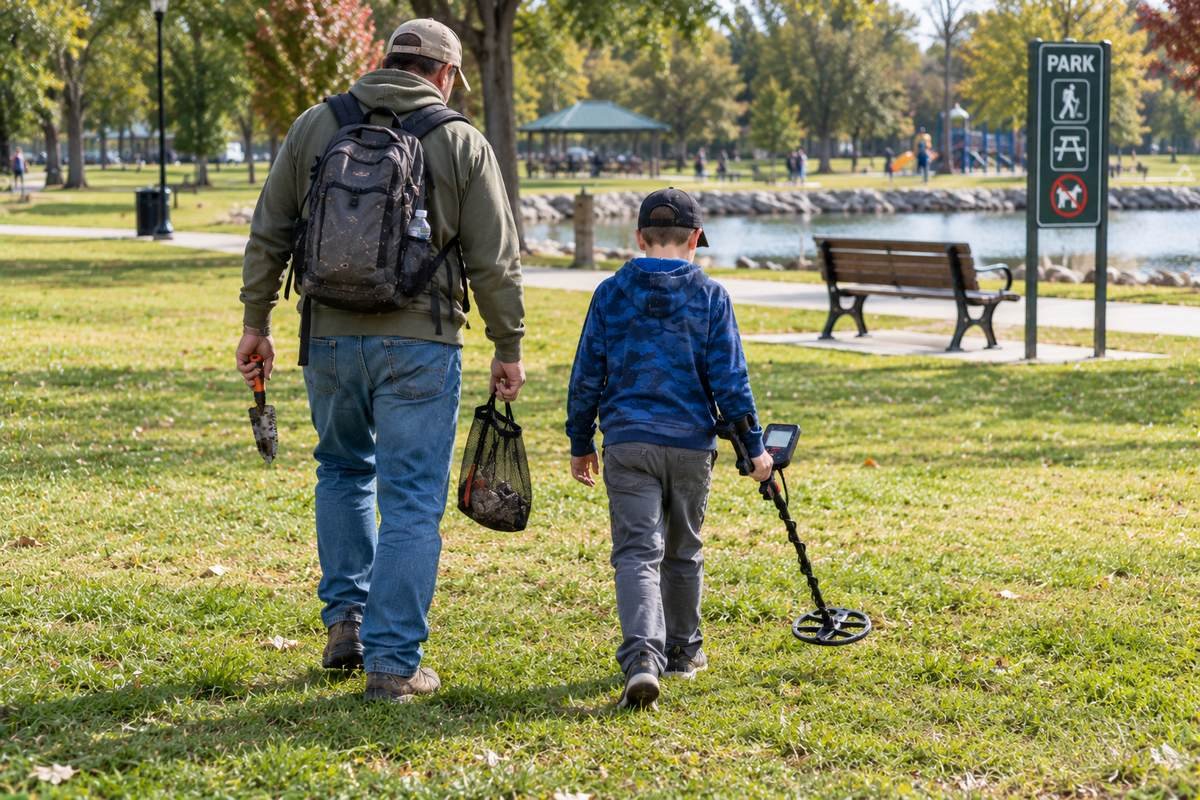
Teach kids one rule above all others: if a find is sharp, jagged, or rusty, looks like ammunition, a shell casing, or anything military, or just looks like it could be dangerous, leave it where it is and tell an adult. Don't pick it up or put it in a bag. If it might be ordnance, the adult should move everyone away and call local police.
Beach trips have their own rules and etiquette, covered in our best beach metal detector guide.
Frequently asked questions
What age can a kid start metal detecting?
Most kids' detectors are built for ages 6 to 12. The Bounty Hunter Junior is rated for ages 6 and up, while the National Geographic kits are aimed at ages 8 to 12. Younger kids can still join the hunt with an adult holding the detector.
Do kids' metal detectors find real treasure?
They find real metal, mostly coins, pull tabs, bottle caps, and the occasional piece of jewelry. None of the toy-grade detectors on this list have the depth or discrimination of a real detector like the Vanquish 360, so do not expect relic-hunting results from a starter kit.
Are kids metal detectors waterproof?
Most have a waterproof coil but not a waterproof control box. On this list, the two National Geographic kits, the RIPTIC, and the Minelab GO-FIND 22 list a waterproof coil only (the RIPTIC's photos add that it isn't designed for saltwater or wet sea sand), and the National Geographic Starter's coil is rated to just 4 inches deep. The Bounty Hunter Junior's coil is weather-resistant, not waterproof. The Nokta Midi Hoard (to 3 ft) and the Minelab Vanquish 360 (to 16 ft) are waterproof as a whole unit. On the others, keep the control box and screen dry.
How deep can a kids metal detector find objects?
It depends on the model and the ground. The National Geographic Starter Kit lists 4 inches, the National Geographic Pinpoint model 6 inches, and the Bounty Hunter Junior lists coins to 5 inches. Those are the makers' best-case figures. Real depth also depends on target size, soil, moisture, and how low the coil is swung, so expect most finds to be shallower. The Nokta and Minelab picks don't publish a depth figure.
What's the warranty on a kids metal detector?
It varies, so check the listing before you buy. On this list, the Bounty Hunter Junior has a 1-year limited warranty, the Nokta Midi Hoard and the Minelab GO-FIND 22 have 2 years, and the Minelab Vanquish 360 has 3 years. The National Geographic and RIPTIC listings don't state warranty terms. Buying through Amazon also gives you the standard return window if the detector arrives faulty, so keep the original packaging until you have tested it in the yard a few times.
Will my kid outgrow a toy-grade detector?
Many kids outgrow the simplest starter kit once they notice how shallow it digs compared to what a real detector could find. The Minelab Vanquish 360 on this list is the one pick built to grow with them. It is a real hobbyist detector rather than a toy, so it is worth considering directly if your kid is already serious about the hobby.
Is a fully waterproof kids metal detector worth it?
If your kid will detect at the beach or in a creek, yes. Most kids' detectors only have a waterproof coil, so the control box has to stay dry. The Nokta Midi Hoard is waterproof as a whole unit to 3 ft, so a splash or a dropped detector in shallow water won't end the day.
Should a 10-year-old get a toy or a real metal detector?
For a first detector, a kids model like the National Geographic Starter Kit or the Nokta Midi Hoard is easier to learn. If they've already used one and keep asking to go out, a real entry-level detector like the Minelab Vanquish 360, which we suggest from about age 10, reaches deeper and will last into their teens.
What's the best metal detector for a 7-year-old?
For most 7-year-olds, a light detector with one or two controls works best. The Bounty Hunter Junior is listed for ages 6 and up and weighs 1.3 lb. A tall or experienced 7-year-old may also manage the National Geographic Starter Kit, listed for ages 8 to 12 and weighing about 1.2 to 1.4 lb. Fit and attention span matter more than age, so keep the first hunts short and supervised.
Which one to buy
For most families, the National Geographic Starter Metal Detector Kit is the easiest first detector for kids 8 and up: light, simple, and sold with a trowel and learning guide. If your kid wants a screen and pinpoint mode, step up to the National Geographic Pinpoint model. For kids 6 and 7, the Bounty Hunter Junior is the lightest detector with a stated age that young, and the RIPTIC kit is the most complete bundle if you want a shovel, rake, and bag included. For beach and creek trips, the Nokta Midi Hoard is the only kids' model here that is waterproof as a whole unit, and the Minelab GO-FIND 22 folds small enough to pack for family trips. Once a kid is serious about the hobby, the Minelab Vanquish 360 is a real detector that will keep them digging for years, not just a summer.