
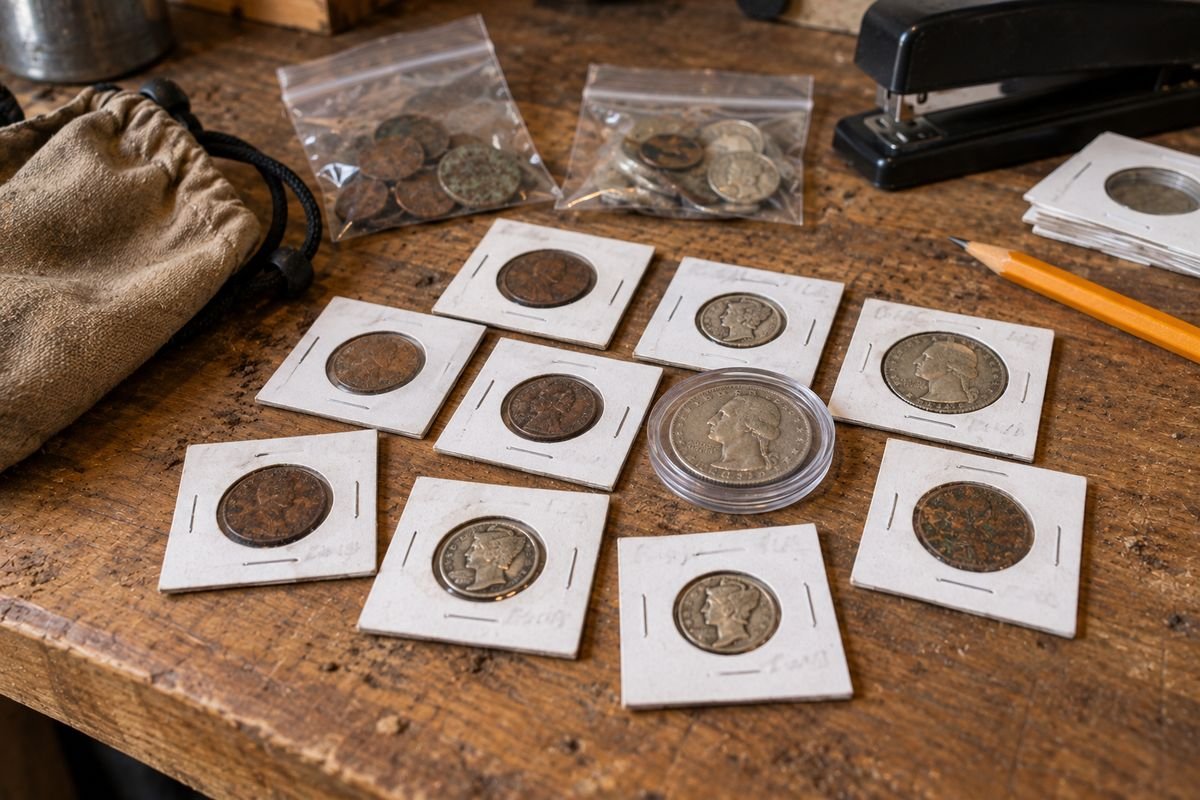
A coin can sit in the ground for 100 years and then start to fall apart in a bad holder within a few months. Soft vinyl flips, damp air, and the wrong box can all leave green slime, dark spots, or fresh corrosion on a coin you worked hard to find.
DetectorBrief is a participant in the Amazon Services LLC Associates Program, an affiliate advertising program designed to provide a means for sites to earn advertising fees by advertising and linking to Amazon.com.
This guide shows which coin holders and storage are safe for coins you dig up, based on guidance from the Canadian Conservation Institute and the American Numismatic Association. Use the Coin Holder Finder to match a holder to your coin, then see the picks we would buy first.
Table of Contents
Table of Contents
Quick Answer: What to Put Your Coins In
- Most dug coins: a 2x2 cardboard holder with a clear plastic window. It is cheap. You can write the find date and place on the cardboard, and it keeps the coin from rubbing against other coins.
- Your best finds: a hard acrylic capsule sized to the coin. It seals better and protects the surfaces.
- Never: soft vinyl (PVC) flips. Their plasticizer can leave a sticky green film on copper coins.
- The box: keep holders in a closed box in a dry room, with silica gel packs if your house is humid.
- Corroded copper with light green powder: keep it apart from the rest of your coins, in a sealed container with silica gel.
Coin Holder Finder
Pick the coin, its metal, and how you want to keep it. The finder suggests a holder, the right window or capsule size, and any extra care the metal needs.
Coin Holder Finder
Coin Holder Finder by DetectorBrief.com. Free to use. Sizes for US coins come from the US Mint. Care notes follow CCI Notes 9/2 and 9/4 from the Canadian Conservation Institute.
What Damages Dug Coins in Storage
Coins from the ground have already been through a lot. Many have light corrosion and dirt, and some still retain moisture. In storage, four things cause most of the damage:
- Damp air. The Canadian Conservation Institute says corrosion risk rises with humidity. It suggests keeping metal collections between 35% and 55% relative humidity, and as low as practical. Keep actively corroding metals below 35% (CCI Note 9/2).
- PVC. Soft vinyl flips are made of poly(vinyl chloride). CCI says the plasticizer in them causes "green slime" on copper alloys and that vinyl flips should be avoided (CCI Note 9/4). The ANA calls soft PVC flips dangerous.
- Sulfur and acid sources. Wood and wood pulp products give off sulfur compounds and organic acid vapors. Rubber can release sulfur compounds that tarnish silver, and wool and felt are listed with them. CCI says to avoid oak cabinets in particular, and acid vapors from wood easily corrode lead (CCI Note 9/2).
- Rubbing. Loose coins in a jar or pouch scratch each other. A holder for each coin stops that.
bronze-disease
Copper and bronze coins that come out of the ground sometimes develop bronze disease. CCI describes it as active corrosion that shows up as light green powder in spots on the surface. CCI recommends storing these objects separately at below 35% relative humidity and asking a conservator for advice on valuable pieces.
Types of Coin Holders
| Type | What it is | Good for | Watch out for |
|---|---|---|---|
| 2x2 cardboard holder | A folded card with a clear plastic window. You staple or tape it shut. | Cheap, easy to label, stores in standard 2x2 boxes | Not airtight. Remove dust first and press staples flat so they cannot scratch the coin. |
| Polyester (Mylar) flip | A clear plastic sleeve with two pockets, one for the coin and one for a paper label. | See both sides, quick to swap coins | Can be stiff. Not airtight, so keep flips in a closed box. |
| Hard capsule | A two-part acrylic shell that snaps around a coin. | Best seal and protection, good for display | Costs more per coin. Must match the coin size. |
| Polyethylene zip bag | A small 2 x 2 inch reclosable bag. | Great in the field and for sorting | Coins can rub inside. Use as a first stop, not long-term storage. |
| Storage box | A box made to hold 2x2 holders in rows. | Keeps holders upright, in the dark, and in order | Choose a closed box. Add silica gel in humid places. |
CCI lists polyethylene, polypropylene, polyester (Mylar), polystyrene, and acrylic as safe plastics for coin holders. It also says hobby cardboard is acidic, so the plastic window should sit between the coin and the card (CCI Note 9/4). For valuable coins, CCI suggests asking the supplier what a holder is made of, and choosing another supplier if they will not say.
The Best Coin Holders and Storage on Amazon
We have not tested these products in our own collection. We base our picks on the materials and sizes each seller lists, matched to the conservation guidance above. Check the listing before you buy, because details can change.
Best starter pack for mixed finds: Boen 2x2 Cardboard Coin Holders, 300 in 6 Sizes
Dug coins come in every size, so a mixed pack saves you from buying six separate boxes. This pack has 50 holders in each of six window sizes: 20.5, 23, 25, 27.5, 31.5, and 40 mm. The listing says the window film is OPP, a type of polypropylene, which CCI lists as safe.

Boen 2x2 Cardboard Coin Holders, 300 in 6 Sizes
- Holders
- 300 (50 per size)
- Window sizes
- 20.5 to 40 mm
- Window film
- OPP (polypropylene)
Good for: mixed finds of every size, with room to write where and when you found each coin.
Skip if: you want an airtight seal for your best coins. Use a capsule instead.
Pros
- Covers cents and dimes up to large dollars
- Room on the card to write where and when you found it
- Fits standard 2x2 storage boxes
Cons
- Not airtight
- Needs a stapler or tape, with staples pressed flat
Best flip without PVC: SAFLIP Double Pocket Polyester Coin Flips, 2 x 2 in, 100
If you prefer flips, these are listed as Mylar with no vinyl or polyvinyl chloride. The second pocket holds a paper note with your find details, so the label never touches the coin.

SAFLIP Double Pocket Polyester Coin Flips, 2 x 2 in, 100
- Count
- 100 flips
- Size
- 2 x 2 in
- Material
- Mylar (polyester), no PVC
Good for: coins you want to see on both sides, with a paper label in the second pocket.
Skip if: you want an airtight holder. Flips need a closed box.
Pros
- Mylar with no PVC, per the listing
- Two pockets, one for a label
- Easy to see both sides of a coin
Cons
- Stiffer than vinyl flips
- Not airtight
Best for your best silver quarters: Air-Tite A24 Direct Fit Coin Capsules, 25 Pack
For a silver Washington or Barber quarter you are proud of, a hard capsule is worth the extra cost. The listing gives an inside diameter of 24.3 mm and says the capsules are PVC-free, archival-safe, and made of acrylic plastic. Air-Tite sells other sizes too, so match the size to your coin.

Air-Tite A24 Direct Fit Coin Capsules, 25 Pack
- Count
- 25 capsules
- Inside diameter
- 24.3 mm
- Material
- Acrylic, PVC free
Good for: a silver quarter you are proud of and want to show off.
Skip if: your coin is a different size. Air-Tite sells other sizes, so match the size to your coin.
Pros
- Acrylic, a plastic CCI lists as safe
- Snaps shut for a tight seal
- Good for display
Cons
- Fits one coin size only (24.3 mm)
- Costs more per coin than a 2x2
Best for the field: Spartan Industrial 2 x 2 in Zip Bags, 200 Count
Drop each good find in its own bag as you dig, and write the spot on the bag with a marker. The listing says the bags are 2 mil clear virgin LDPE (polyethylene).

Spartan Industrial 2 x 2 in Zip Bags, 200 Count
- Count
- 200 bags
- Size
- 2 x 2 in
- Material
- 2 mil LDPE (polyethylene)
Good for: the trip home from the dig, one find per bag with the spot written on it.
Skip if: you want long-term storage. Move coins to holders once they are dry.
Pros
- Polyethylene, safe for short-term storage
- Cheap and light in a finds pouch
- Keeps finds from rubbing on the way home
Cons
- Coins can still move inside
- Not for long-term storage
Best for keeping storage dry: Dry and Dry 10 Gram Orange Indicating Silica Gel, 100 Packets
Silica gel pulls moisture out of a closed box. The beads change color when they are full, and the listing says you can dry and reuse them. Each packet is listed as covering about 1,200 cubic inches.

Dry and Dry 10 Gram Orange Indicating Silica Gel, 100 Packets
- Count
- 100 packets
- Packet size
- 10 g
- Covers
- About 1,200 cu in each
Good for: keeping a closed coin box dry, especially in a humid house.
Skip if: your coins sit in an open tray. Silica gel only works in a closed box or container.
Pros
- Changes color when it needs drying
- Rechargeable, per the listing
- Small packets fit in a 2x2 box
Cons
- Only works in a closed container
- Check and dry the packets regularly
Best box for a growing collection: BCW Double Row 2x2 Coin Box
This box holds up to 102 thick 2x2 holders or more than 330 stapled cardboard holders in two removable trays, according to the listing. It is made of cardboard, so the coins should always be inside holders with plastic windows, never loose in the box.

BCW Double Row 2x2 Coin Box
- Holds
- 102 thick or 330+ stapled 2x2s
- Trays
- 2, removable
- Material
- Cardboard
Good for: keeping a growing collection of 2x2 holders in order and out of the light.
Skip if: you want to store loose coins. Every coin needs a holder with a plastic window first.
Pros
- Large capacity with removable trays
- Keeps holders in order and out of the light
- Fits standard 2x2 holders
Cons
- Cardboard, so no loose coins
- In a humid house, keep it in a sealed tub with silica gel
Side-by-Side Comparison
| Product | Type and material | Pack | Best for | Link |
|---|---|---|---|---|
| Boen 2x2 holders, 6 sizes | 2x2 cardboard, OPP window | 300 holders | Sorting and storing most finds | Amazon |
| SAFLIP flips | Polyester (Mylar) flip | 100 flips | Coins you want to see both sides of | Amazon |
| Air-Tite A24 capsules | Acrylic capsule, 24.3 mm | 25 capsules | Best silver quarters | Amazon |
| Spartan 2 x 2 zip bags | LDPE bag | 200 bags | The trip home from the dig | Amazon |
| Dry and Dry silica gel | Indicating silica gel | 100 packets, 10 g | Keeping boxes dry | Amazon |
| BCW double row box | Cardboard 2x2 box | Up to 102 thick or 330+ paper holders | Organizing a collection | Amazon |
How to Store Coins You Just Dug Up
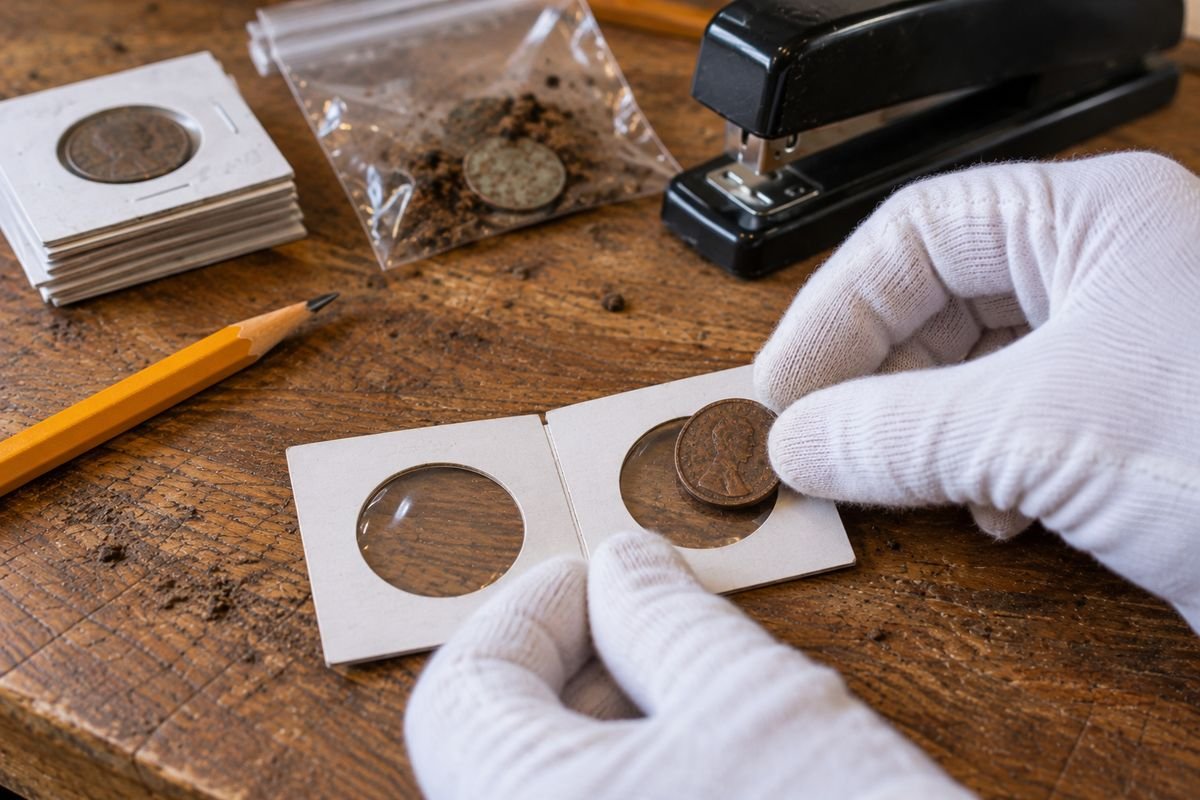
- Bag it in the field. Put each keeper in its own polyethylene bag and write the place and date on it. Do not toss good coins loose into a pouch full of pull tabs.
- Do not scrub. Let loose dirt dry and fall away, and leave hard dirt and corrosion alone. CCI says to leave corrosion removal to a conservator. See our coin detecting guide for more on what to do with old coins.
- Let it dry completely. Leave damp coins in an open dish indoors before sealing them, so you don't trap moisture inside a holder.
- Handle by the edges. CCI recommends holding coins by their edges and wearing clean cotton or plastic gloves. Use cotton, not latex, for silver, because the sulfur in latex causes silver to tarnish. If a find needs washing first, see how to clean old coins.
- Pick the holder. Use the finder above. Measure the coin across if you are not sure of the size.
- Write it down. Note the find site, date, and coin on the 2x2 card or the flip label. That record is part of what makes a find interesting later.
- Store it dry and closed. Store holders in a closed box in a room that doesn't get damp, away from wood cabinets and rubber bands. Add silica gel packets in humid areas and dry them when they change color.
- Check a few times a year. Look for new green spots, sticky film, or tarnish. Move any coin with light green powder to its own sealed container with silica gel.
pvc-check
If an old flip is soft and floppy, or has left a green or sticky film on a coin, treat it as PVC. CCI describes a lab test for PVC called the Beilstein test, but it uses a flame, so the easiest rule at home is simple: if you cannot confirm what a soft flip is made of, move the coin to a holder that is clearly labeled PVC-free.
Displaying Your Best Finds
For a few special finds, hard capsules look good and protect the coin. CCI notes that wood display cases can release acid vapors, so a closed metal or plastic case is safer than a new wooden box.
For the rest of the gear that helps you find coins in the first place, see our metal detecting accessories guide.
Coin Holder FAQ
Are coin flips safe for coins?
Polyester (Mylar) or other inert plastic flips are safe. Soft vinyl flips made of PVC are not safe for long-term storage. The Canadian Conservation Institute says their plasticizer causes green slime on copper coins.
What is the best way to store old coins you dig up?
Let each coin dry, do not scrub it, and put it in its own PVC-free holder, such as a 2x2 cardboard holder with a plastic window or a hard capsule. Keep the holders in a closed box in a dry room, with silica gel if your house is humid.
Can you store coins in plastic bags?
Small polyethylene zip bags are fine for carrying finds home and for short-term sorting. For long-term storage, a holder that keeps each coin from moving is better, because coins can rub inside a bag.
What humidity is best for storing coins?
The Canadian Conservation Institute suggests 35% to 55% relative humidity for mixed-metal collections, and below 35% for metals actively corroding, such as copper with bronze disease. Lower is better for coins.
What size 2x2 holder do I need?
Pick a window just larger than the coin. US Mint figures give a dime 17.91 mm, a cent 19.05 mm, a nickel 21.21 mm, a quarter 24.26 mm, and a half dollar 30.61 mm across. Measure any coin you are not sure about.
What to Buy First
Start with a mixed pack of 2x2 cardboard holders, a bag of small polyethylene zip bags for the field, and a pack of silica gel. That covers almost every coin you will dig. Add hard capsules for your best silver, and a 2x2 box once the holders start to pile up. Skip soft vinyl flips completely.
Coin sizes are from the US Mint coin specifications. Storage guidance is from CCI Note 9/4, CCI Note 9/2, and the ANA article "Storage Solutions" (The Numismatist, December 2005).