

The best metal detector headphones fit your detector's headphone jack, block out wind and traffic, and let you adjust the volume at your ear. For most detectors with a 1/4 inch jack, our top pick is the Garrett MS-2. If your detector has built-in wireless audio, the headphones made for that system are usually the best choice, because ordinary Bluetooth headphones can play the beep a split second late.
DetectorBrief is a participant in the Amazon Services LLC Associates Program, an affiliate advertising program designed to provide a means for sites to earn advertising fees by advertising and linking to Amazon.com.
We built this guide from manufacturer manuals and spec sheets, owner reports on detecting forums, and Amazon ratings checked on October 12, 2026. We have not tested these headphones side by side. When a number comes from a maker's own claim, such as a wireless delay figure, we say so.
Table of Contents
Our Picks at a Glance
- Best wired pick for 1/4 inch jacks: Garrett MS-2 Headphones
- Best budget pick: Garrett ClearSound Easy Stow Headphones
- Best premium wired pick: DetectorPro Ultimate Gray Ghost
- Best wireless pick for Garrett detectors: Garrett MS-3 Z-Lynk Wireless Headphones
- Best way to add wireless to an older detector: Garrett Z-Lynk Wireless System
- Best for newer Minelab detectors: Minelab ML 85 Wireless Headphones
- Best for underwater hunting: Garrett Submersible Headphones
Check Your Detector's Headphone Jack First
Not all metal detectors use the same headphone plug. Many use the large 1/4 inch plug, which is 6.35 mm across. Others use the smaller 3.5 mm plug, also called 1/8 inch, the same size as most phone earbuds. Waterproof detectors often use a sealed connector, and some have no headphone jack at all. If you buy the wrong plug, the headphones will not fit without an adapter.
Here is what the makers list for some popular detectors:
| Detector | Wired headphones | Wireless headphones |
|---|---|---|
| Garrett ACE 300 and ACE 400 | 1/4 inch jack | None built in. A Z-Lynk kit can add it. |
| Garrett ACE Apex | 1/8 inch (3.5 mm) jack | Garrett Z-Lynk built in. No Bluetooth. |
| Garrett AT Pro | Waterproof 2-pin AT connector | None built in. A Z-Lynk kit can add it. |
| Garrett AT Max | Waterproof 2-pin AT connector | Garrett Z-Lynk built in. MS-3 headphones included. |
| Minelab Vanquish 340, 440 and 540 | 3.5 mm jack | Bluetooth on the 540 only |
| Minelab Equinox 700 and 900 | 3.5 mm jack | Minelab low-latency wireless. ML 85 headphones included. |
| Minelab X-Terra Pro and X-Terra Elite | 3.5 mm jack (plug body must be under 9 mm wide) | Minelab low-latency wireless (ML 85 recommended) |
| Nokta Simplex Ultra | The headphone socket is also the charging socket. Standard headphones need Nokta's optional 1/4 inch adapter, which is for land use only. | Bluetooth, including aptX Low Latency |
| XP Deus II | No jack on the detector. Wired headphones connect through XP's remote or WS6 module. | XP's own wireless system |
| Fisher F44 | 1/4 inch jack | None built in |
Sources: Garrett's ACE 400 manual, AT Pro manual and AT Max manual, Minelab's Vanquish 340 manual, Vanquish 440 and 540 manual, X-Terra Pro manual and X-Terra Elite manual, Nokta's Simplex manual and Simplex Ultra accessory list, XP's Deus II remote manual and the Fisher F44 manual. The ACE Apex and Equinox details come from Garrett's and Minelab's product spec pages. Garrett's ACE 300 manual lists a 1/4-inch plug, and Garrett sells the ACE 300 in a bundle with 1/4-inch ClearSound headphones.
To check your own detector:
- Look at the jack. A 1/4 inch plug is almost twice as wide as a 3.5 mm plug. If your phone earbuds fit, the jack is 3.5 mm.
- Read the specs in your manual. Search the PDF for the word headphone. Most manuals list the jack size and whether it supports wireless.
- Check for a cap or seal. A rubber cap or a screw-on connector usually means the detector is waterproof. Read what the manual says about using headphones in water before you buy.

How We Chose These Headphones
We looked for metal detector headphones that fit the jacks and wireless systems on popular detectors, have published specs from the maker and were in stock on Amazon with a buy button when we checked. We read owner threads on TreasureNet and DetectorProspector and added problems that came up more than once as cons. Prices change often, so we did not use them to rank the picks.
The 7 Best Metal Detector Headphones
1. Garrett MS-2: best wired pick for 1/4 inch jacks
The Garrett MS-2 has a 1/4 inch right-angle stereo plug and a reinforced 10-foot coiled cord. It has its own volume control, so you can turn down a loud signal without reaching for the detector. It is not submersible, so keep it for dry ground. It is the most popular pick here.
Garrett also sells an MS-2 with its waterproof 2-pin AT connector for the AT Pro and AT Max. These are not submersible either. Check which plug you are ordering.

Garrett MS-2
- Plug
- 1/4 in, right angle
- Cord
- 10 ft, coiled
- Water
- Not submersible
Good for: ACE 300 and ACE 400 owners, Fisher F44 owners, and anyone with a 1/4 inch jack who wants full-size headphones and a long cord.
Skip if: your detector has a 3.5 mm jack, or you plan to hunt in the water.
Pros
- Right-angle plug sits close to the detector
- Long coiled cord gives room to kneel and dig
- Volume control on the headphones
Cons
- Not made for wet use
- Garrett does not publish a weight or noise-blocking figure
2. Garrett ClearSound Easy Stow: best budget pick
The Garrett ClearSound Easy Stow headphones have a 1/4 inch plug, an in-line volume control, and a 41-inch coiled cord that stretches to 82 inches. They fold flat, so they fit in a finds pouch or a glove box. Garrett also makes a 1/8 inch version for detectors with a small jack, such as the ACE Apex. They were the lowest-priced pick on this list when we checked.
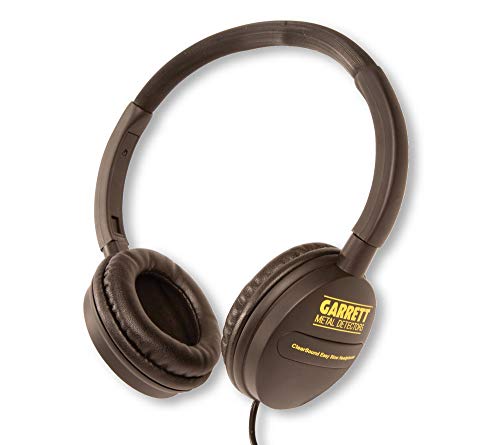
Garrett ClearSound Easy Stow
- Plug
- 1/4 in (1/8 in version sold)
- Cord
- 41 in coiled, stretches to 82 in
- Use
- Land only
Good for: new detectorists, a spare pair for the car, or anyone who wants basic headphones without spending much.
Skip if: you want a long cord or plan to hunt in wet conditions.
Pros
- Low cost
- Folds flat for a pouch or glove box
- Volume control on the cord
Cons
- Shorter cord than the MS-2
- Garrett lists them as land use only
3. DetectorPro Ultimate Gray Ghost: best premium wired pick
DetectorPro makes headphones only for metal detecting. The Ultimate Gray Ghost has a 1/4 inch plug set at a 90-degree angle, a heavy-duty 48-inch coiled cord, and a single volume knob with click stops. It also has a selector switch. DetectorPro says the switch lets it work with more detectors without an adapter.
Two features stand out. A built-in volume limiter softens very loud signals, and you can turn it off with a switch. A nylon strain relief where the cord meets the plug reduces stress on the cable. That spot matters. In a 2010 TreasureNet thread on cord problems, one owner said Gray Ghost cords tend to fail where the wire meets the right-angle plug. The headphones fold for storage and come with a limited lifetime warranty.
Owner feedback is weaker than for the Garrett wired picks.

DetectorPro Ultimate Gray Ghost
- Plug
- 1/4 in, 90 degree
- Cord
- 48 in heavy-duty coiled
- Extras
- Volume limiter, compatibility switch
Good for: long hunts and detectorists who want sturdy, detecting-specific headphones with a volume limiter.
Skip if: you want the lowest price. It costs several times more than the Garrett wired picks.
Pros
- Built only for detecting
- Volume limiter you can switch off
- Strain relief where the cord meets the plug
- Limited lifetime warranty
Cons
- Costs several times more than the Garrett wired picks
- Lower Amazon rating than the Garrett wired picks
4. Garrett MS-3 Z-Lynk: best wireless pick for Garrett detectors
The Garrett MS-3 has a built-in Z-Lynk receiver. It pairs directly with Garrett detectors with Z-Lynk built in, such as the ACE Apex and AT Max. In its Z-Lynk user's guide, Garrett says the system has a 17-millisecond audio delay, which it calls six times faster than Bluetooth. The battery is rated for up to 30 hours per charge.
The headphones are rated IP52, which Garrett describes as protected against light rain, and the AT Max manual says they should never be submerged.
Garrett now also sells the CS-3 Z-Lynk headphones, which it lists at 5.4 ounces with USB-C charging. That model was too new to have Amazon ratings when we checked.
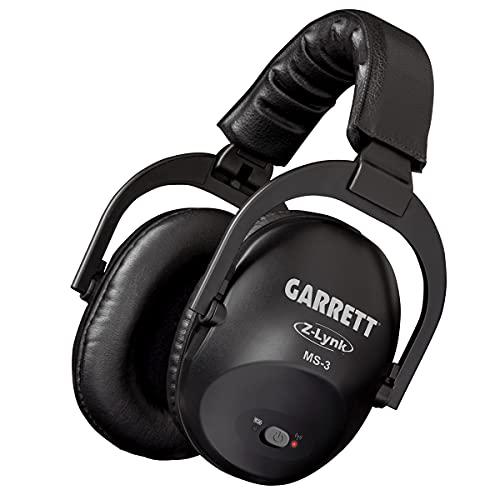
Garrett MS-3 Z-Lynk
- Wireless
- Garrett Z-Lynk
- Delay
- 17 ms (Garrett figure)
- Battery
- Up to 30 hours
Good for: ACE Apex and AT Max owners who want to dig without a cord in the way.
Skip if: your detector uses Bluetooth instead of Z-Lynk, or you hunt in the water.
Pros
- Low published delay
- Long battery life
- No cord to snag while digging
Cons
- Not for water, and no Bluetooth
- Wireless use cuts AT Max battery life from 15 to 25 hours to 10 to 20 hours
- Some owners report the sound cutting out (TreasureNet thread)
5. Garrett Z-Lynk Wireless System: best way to add wireless to an older detector
The Garrett Z-Lynk Wireless System is a pair of small modules, not headphones. The WT-1 transmitter plugs into your detector's 1/4 inch headphone jack. The WR-1 receiver clips to you, and you plug your own wired headphones into it. Garrett's user's guide says it works with nearly any brand and model of VLF (very low frequency) and pulse induction detector, with the same 17-millisecond delay and up to 30 hours per charge for both modules. The guide rates the receiver IP52 and the transmitter IP64.
Steve Herschbach, a well-known detectorist who runs the DetectorProspector forum, wrote that he prefers using the WR-1 receiver with his own wired headphones over the MS-3.

Garrett Z-Lynk Wireless System
- Fits
- 1/4 in headphone jack
- Delay
- 17 ms (Garrett figure)
- Battery
- Up to 30 hours per module
Good for: owners of an ACE 300, ACE 400, Fisher F44, or other detector with a 1/4 inch jack who want to go wireless and keep their favorite headphones.
Skip if: you do not already own wired headphones you like. You still need a pair to plug in.
Pros
- Works with most detectors
- Lets you keep the headphones you like
- Same low published delay as the MS-3
Cons
- Two modules to charge
- You still need headphones
- Other jack sizes need an adapter
6. Minelab ML 85: best for newer Minelab detectors
The Minelab ML 85 uses Minelab's own low-latency wireless system. Minelab says it is faster and clearer than standard Bluetooth. Its ML 85 manual lists 35 to 40 hours of use per charge, a 3-hour charge time, a range of up to 10 meters, and a weight of 221 g, which is just under 8 ounces. The manual gives no delay figure.
It includes a 3.5 mm cable, so you can keep hunting with a wire if the battery runs flat. The manual also says the ML 85 is not waterproof. It comes with the Equinox 700 and 900, and Minelab also lists it for the Manticore, X-Terra Pro, and X-Terra Elite.
Check your model before you buy. Minelab's X-Terra Pro manual recommends the ML 85 and says the older ML 80 and ML 100 headphones are not compatible. If you own an Equinox 600 or 800, a Vanquish 540 or a GPX 6000, Minelab lists its ML 80 Bluetooth aptX Low Latency headphones for those models instead.

Minelab ML 85
- Wireless
- Minelab low latency
- Battery
- 35 to 40 hours
- Weight
- 221 g (just under 8 oz)
Good for: Equinox 700 and 900, Manticore, and X-Terra Pro or Elite owners who want a spare or replacement pair.
Skip if: you own an Equinox 600 or 800, a Vanquish 540, or a GPX 6000. Minelab lists the ML 80 for those.
Pros
- Made for these detectors
- Long battery life
- Includes a 3.5 mm backup cable
Cons
- Works only with newer Minelab models
- Not waterproof
- No published delay figure
7. Garrett Submersible Headphones: best for underwater hunting
The Garrett Submersible Headphones use Garrett's 2-position underwater AT connector and work with the ATX, AT Max, AT Pro, AT Gold, and Sea Hunter Mk II. This matters because the AT Pro and AT Max can go 10 feet underwater, but the included headphones can't. The AT Pro manual says the headphones in the box are for dry use only and that you need optional waterproof headphones for submersion.
If you hunt with a different detector, DetectorPro makes its Gray Ghost Amphibian II in versions for Garrett AT detectors, Minelab Equinox and Manticore, XP Deus II, and several Nokta models. DetectorPro says they can go as deep as 200 feet.
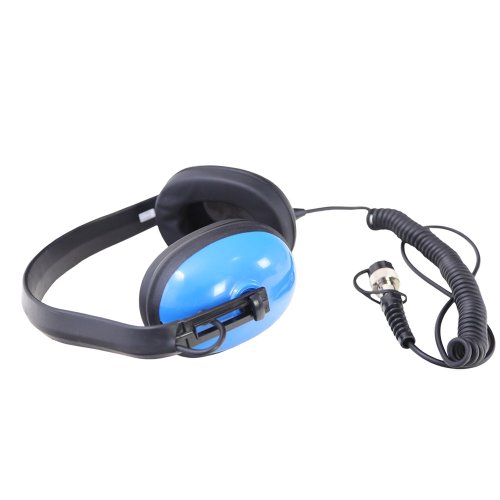
Garrett Submersible Headphones
- Connector
- Garrett 2-position AT
- Fits
- AT Pro, AT Max, AT Gold, ATX, Sea Hunter Mk II
- Water
- Submersible
Good for: AT Pro and AT Max owners who wade or snorkel. See our guide to the best underwater metal detectors for more on hunting in the water.
Skip if: your detector is not a Garrett AT model. Look at the DetectorPro Gray Ghost Amphibian II instead.
Pros
- Sealed connector made for Garrett AT detectors
- Fully submersible
Cons
- Fits only the AT connector
- Garrett does not publish a depth rating for the headphones
Comparison Table
| Headphones | Type | Connection | Water rating | Best for | Amazon rating |
|---|---|---|---|---|---|
| Garrett MS-2 (see details) | Wired | 1/4 inch right-angle plug, 10-foot coiled cord | Not submersible | 1/4 inch detectors | 4.7 (495) |
| Garrett ClearSound Easy Stow (see details) | Wired | 1/4 inch plug (1/8 inch version sold), 41 inch coiled cord | Not submersible | Budget and spares | 4.4 (477) |
| DetectorPro Ultimate Gray Ghost (see details) | Wired | 1/4 inch 90-degree plug, 48-inch coiled cord | Not listed | Long hunts, volume limiter | 4.1 (46) |
| Garrett MS-3 Z-Lynk (see details) | Wireless | Garrett Z-Lynk | IP52, light rain | ACE Apex, AT Max | 4.4 (74) |
| Garrett Z-Lynk Wireless System (see details) | Wireless add-on | Transmitter in a 1/4 inch jack, your own headphones | Receiver IP52, transmitter IP64 | Older 1/4 inch detectors | 4.6 (80) |
| Minelab ML 85 (see details) | Wireless | Minelab low-latency, 3.5 mm backup cable | Not waterproof | Equinox 700 and 900, Manticore, X-Terra Pro and Elite | 4.6 (58) |
| Garrett Submersible (see details) | Wired | 2-position AT connector | Submersible | AT Pro and AT Max in the water | 4.7 (231) |
Amazon ratings and counts were checked on October 12, 2026, and they change over time.
Wired vs Wireless: Why Delay Matters
When your coil passes over a coin, the detector beeps. You use that beep to stop the swing and find the spot to dig. If the sound reaches your ears late, the coil has already moved past the target. Garrett makes this point in its support FAQ, saying that with standard Bluetooth the delay can let you swing several inches past a target.
Here is what each maker says about its delay. These are the companies' own figures, not independent tests:
- Wired headphones: no wireless delay.
- XP's wireless system: 4 milliseconds, compared with 40 to 100 milliseconds for Bluetooth, according to XP's FAQ.
- DetectorPro Gray Ghost Wireless: 12.5 milliseconds, according to DetectorPro.
- Garrett Z-Lynk: 17 milliseconds, according to Garrett.
- Bluetooth aptX Low Latency: about 40 milliseconds, according to Qualcomm, which makes the aptX codec.
- Minelab ML 85: no figure published.
Wired headphones cost less, never need charging, and have no delay. Wireless headphones remove the cord, which helps when you kneel to dig or walk through brush. They can also cut your detector battery life. Garrett's AT Max manual lists 15 to 25 hours of use without wireless headphones and 10 to 20 hours with them.
Can You Use Bluetooth Headphones or Earbuds?
It depends on the detector. Regular Bluetooth headphones only work if the detector has Bluetooth, and many do not.
- Minelab Vanquish 540: Minelab's manual says you can use any standard Bluetooth headphones or earbuds, but it recommends aptX Low Latency headphones.
- Nokta Simplex Ultra: The manual shows separate screen icons for standard Bluetooth headphones and aptX Low Latency headphones. Nokta's own BT Low Latency headphones use aptX Low Latency.
- Garrett ACE Apex: Garrett's support FAQ says Bluetooth headphones will not work. It uses Z-Lynk only.
- Minelab X-Terra Pro and Elite: the Pro and Elite manuals say you must use compatible Minelab low-latency wireless headphones.
Wired earbuds will play the tones if the plug fits your jack. On the X-Terra, the plug body must be less than 9 mm wide to fit. Earbuds sit inside the ear rather than covering it, so they usually block less wind and surf noise than over-ear headphones.
Waterproof vs Water Resistant Headphones
A waterproof detector does not come with waterproof headphones. Minelab rates the Equinox 900 as waterproof to 5 meters (16 feet), but the ML 85 headphones that come with it are not waterproof. Here is what to watch for:
- Rain: Garrett's Z-Lynk headphones are rated IP52, which covers light rain. The Fisher F44 manual says not to use headphones during rain or very wet conditions.
- Adapters break the seal. Garrett says the 1/4-inch-to-AT adapter is not meant for underwater use, and Nokta says its headphones adapter is for land use only.
- Wireless stops underwater. Nokta's Simplex manual says the wireless connection will not work if the detector is underwater. Underwater hunting needs wired waterproof headphones.
- Water in your ears. XP's Deus II manual notes that with ordinary waterproof headphones, water fills the ear and often reduces hearing. XP also makes a bone conduction headset, the BH-01, which it says can be used at depths up to 20 meters.
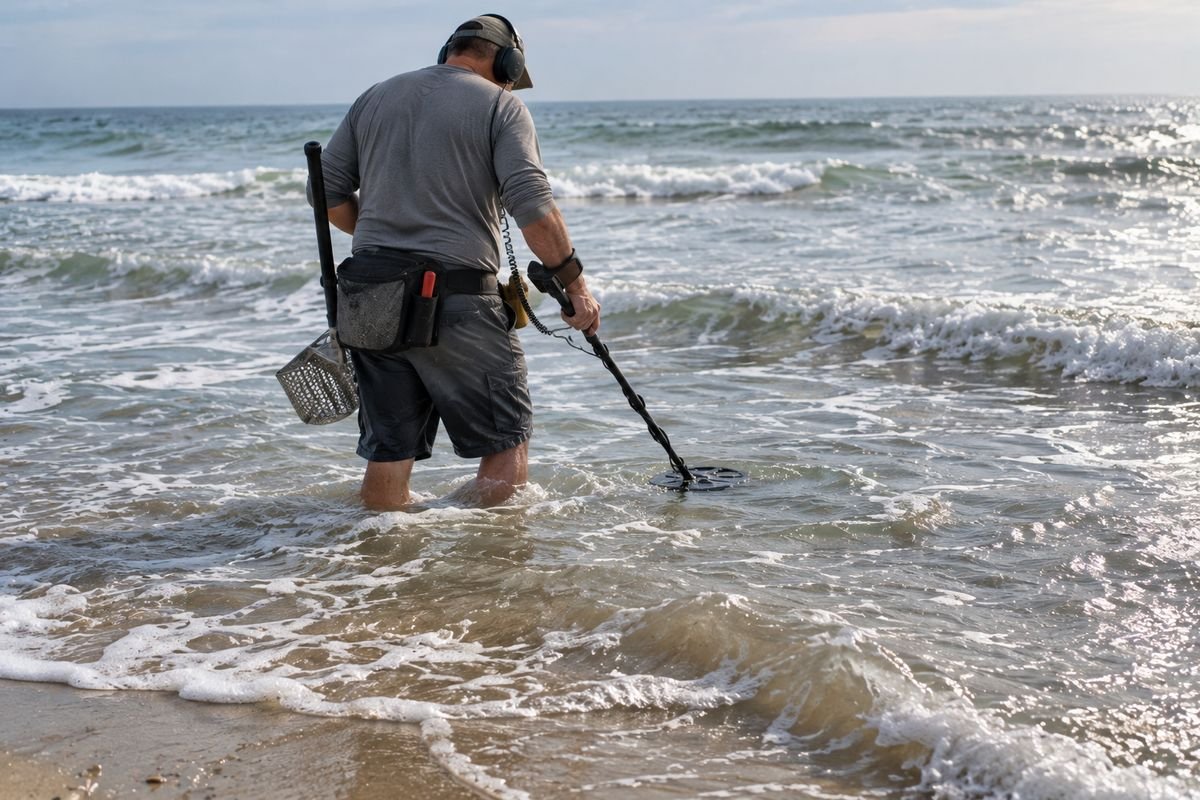
If you hunt the dry sand and only wade now and then, regular headphones with a little care are usually enough. Our guide to the best beach metal detectors covers the detector side of beach hunting.
What to Look for in Metal Detector Headphones
- Volume control on the headphones. A knob on the cup or cord lets you quickly turn down a loud signal. It also helps if one ear hears better than the other.
- A compatibility switch. Some headphones, like the Ultimate Gray Ghost, have a switch that helps them work with more detectors without an adapter.
- Coiled cord and right-angle plug. A coiled cord stretches when you kneel and pulls back when you stand. A right-angle plug sticks out less, so it is harder to snag. The plug end is where cords wear out most, based on an owner report, so a replaceable cord is a plus.
- Cups that cover your ears. Headphones help you hear faint signals, especially in noisy places. Full cups block more wind and traffic noise than small pads.
- Comfort over a long day. In a DetectorProspector thread, two owners said the headphones that came with the Minelab GPX 6000 got hot and pressed hard after a few hours. If you hunt in summer, look for soft pads and a headband that is not too tight.
- Battery life for wireless. Look for a full day of use. The ML 85 and Z-Lynk picks are rated at 30 hours or more by their makers.
For the rest of the gear worth carrying, see our list of metal detecting accessories.
Protect Your Hearing
Detecting sessions can last for hours, and some signals are loud. A target close to the coil or a large piece of metal can give a much louder tone than a small, deep one. Set the volume so loud signals from close or large targets don't hurt your ears.
The CDC's NIOSH noise guidance (NIOSH is the National Institute for Occupational Safety and Health) sets a recommended limit of 85 A-weighted decibels over an eight-hour shift. For each 3 decibel increase, the safe time is cut in half. The CDC also offers a simple test for headphones: if you turn them up to drown out the noise around you, they are too loud.
Start with the detector volume low and the headphone volume low, then raise it just until faint targets are clear. Some headphones have a built-in volume limiter. DetectorPro says the limiter on the Ultimate Gray Ghost protects your hearing from loud signals. Garrett's AT Max manual suggests setting the headphones to maximum and controlling the sound at the detector. If you follow that advice, start with the detector volume low. Near roads, consider keeping one cup off your ear. Don't use headphones near traffic or other dangers.
Frequently Asked Questions
Do you need headphones for metal detecting?
No, but they help a lot. Garrett says headphones are essential in noisy areas. They help you hear the faint tones that often mark deep or small targets. They also keep the beeps from bothering people nearby.
What size headphone jack does a metal detector use?
Most use a 1/4-inch (6.35 mm) jack or a 3.5 mm (1/8-inch) jack. Waterproof detectors like the Garrett AT Pro use a sealed connector, and the XP Deus II has no jack on the detector itself. Check the specs section of your manual.
Can I use AirPods or regular Bluetooth headphones with a metal detector?
Only if your detector has Bluetooth, like the Minelab Vanquish 540 or the Nokta Simplex Ultra. Standard Bluetooth can delay the sound, so aptX Low Latency headphones are a better choice. Garrett's ACE Apex does not work with Bluetooth headphones.
Can I use a headphone adapter with my detector?
Yes, on land. Garrett sells a 1/8-inch to 1/4-inch adapter for the ACE Apex, and Minelab and Nokta also sell adapters. Garrett and Nokta both say their adapters aren't for underwater use.
Do headphones save detector battery?
Wired headphones can. The Fisher F44 manual says using headphones extends battery life. Wireless headphones can do the opposite. Garrett's AT Max manual lists 15 to 25 hours of use without wireless headphones and 10 to 20 hours with them.
Do I need waterproof headphones for the beach?
Only if you plan to put the headphones underwater. For dry sand, regular headphones work fine. Wading in the surf or snorkeling calls for submersible headphones that match your detector's waterproof connector.
Which Headphones to Buy
The right metal detector headphones start with your detector's jack. If it has a 1/4 inch jack, the Garrett MS-2 is the best value, and the ClearSound Easy Stow is the budget choice. The Ultimate Gray Ghost costs more, but it adds a volume limiter and a heavy-duty cord. If your detector has Garrett Z-Lynk or Minelab's newer wireless built in, buy the matching headphones, since they have lower delay than standard Bluetooth. If you want wireless on an older detector, the Z-Lynk Wireless System adds it. For underwater hunting, buy submersible headphones made for your detector's sealed connector.
New to the hobby? Start with our guide to the best metal detector for beginners.