

Is magnet fishing legal? In much of the United States it is, as long as you are allowed on the bank, bridge or dock you use and you follow the rules of whoever manages the water. Magnet fishing means lowering a strong magnet on a rope into a river, lake or canal to pull up metal objects. No single national law covers it, so the answer changes from state to state and from one property to the next. For gear, knots, and safety tips, see our guide on how to start magnet fishing.
DetectorBrief is a participant in the Amazon Services LLC Associates Program, an affiliate advertising program designed to provide a means for sites to earn advertising fees by advertising and linking to Amazon.com.
This guide covers the states with written rules, federal land, private property, what to do with dangerous or historic finds, and a simple way to check the rules before your first trip. It is general information, not legal advice. Rules change, so confirm with the agency that manages the water before you go.
Table of Contents
The Short Answer: Is Magnet Fishing Legal?
Magnet fishing is allowed in many places, but not everywhere. Three things decide whether it is allowed where you want to go:
- Who owns the bank, bridge or dock. Private land needs the owner's permission.
- Who manages the water. State parks, wildlife areas, national parks and federal lakes each set their own rules.
- What you pull up. Guns, explosives and historic objects come with their own laws, even where magnet fishing itself is allowed.
When a property's rules do not mention magnet fishing, ask the office before you go. Written permission from the park office protects you better than a rule that says nothing.
Magnet Fishing Rules by Place
The table below sums up the places covered in this guide.
| Place | Allowed? | Who to ask |
|---|---|---|
| Private land or a private pond | Only with the owner's permission | The owner |
| City and county parks | Depends on the park | The parks department |
| State parks | Depends on the state. Banned in Oklahoma | The state park office |
| Indiana DNR properties | Yes, with a free permit | The property office |
| South Carolina waters | No | Banned statewide |
| National parks | No, unless the park says yes in writing | The park, in writing |
| Army Corps of Engineers lakes | Ask first | The lake's project office |
States With Written Magnet Fishing Rules
Most states have no law that names magnet fishing. A few do, and they show how much the rules can differ.
South Carolina: Banned in State Waters
South Carolina has the strictest rule we found. The South Carolina Institute of Archaeology and Anthropology (SCIAA) looks after underwater historic sites for the state. Its hobby license page says "Activities such as Magnet Fishing are prohibited in South Carolina waterways." It also says it does not issue hobby licenses for magnet fishing.
South Carolina's rules cover coastal waters out to three miles offshore and inland rivers, creeks and canals. This includes waterways that boats once traveled on, even if they no longer do. Divers can get a hobby license to pick up artifacts and fossils they can see on the bottom by hand, but that license does not cover magnets.
Indiana: Free Permit on DNR Properties
Indiana allows magnet fishing on Department of Natural Resources (DNR) properties with a permit. According to the Indiana DNR, the permit is free, but each property decides whether to issue one. Ask the office of the property you want to visit. The DNR also sets these conditions:
- The magnet must be carried and pulled up by hand, with no motorized equipment.
- Carry out what you find and throw it away properly.
- Rinse the shoreline where you worked when you finish.
- Report guns or other dangerous items to the property office or to DNR Law Enforcement Central Dispatch at 812-837-9536.
The permit only covers DNR land. For city parks or private property in Indiana, ask the owner or the people who manage the site.
Oklahoma: Banned in State Parks
Oklahoma's state park system bans magnet fishing. The Oklahoma State Parks FAQ says "Magnet fishing and metal detecting are prohibited at all state parks." That rule covers state parks only. Other public water in Oklahoma, such as a city lake, falls under the rules of whoever runs it.
Every Other State
In states without a written rule, each property's own rules decide. The agency that manages a property can still ban magnet fishing there. Oklahoma bans magnet fishing and metal detecting together, and other parks may treat the two the same way, so check the metal detecting rules too. When in doubt, call the park or the state's natural resources agency.
Federal Land: National Parks, Corps Lakes and Historic Sites
National Parks
National Park Service rules in 36 CFR 2.1 (part of the Code of Federal Regulations) ban using a metal detector, a magnetometer (a tool that finds metal by measuring magnetic fields) or any "other metal detecting device" in park areas. The same section bans removing or disturbing cultural or archaeological objects, which covers many things a magnet can bring up, such as old tools, coins and boat hardware. Treat national parks as closed to magnet fishing unless the park tells you otherwise in writing.
Army Corps of Engineers Lakes
Many large reservoirs are run by the U.S. Army Corps of Engineers. Its rules in 36 CFR 327.14 ban removing or changing public property, including historical and archaeological features, without written permission from the District Commander. The District Commander is the officer in charge of that Corps district. Metal detectors are allowed only on designated beaches or other areas where the ground has already been dug up or built on, and the District Commander can ban them to protect historic sites. Magnet fishing is not named in the rule, so call the lake's project office and ask before you go.
Historic Objects on Federal and Tribal Land
The Archaeological Resources Protection Act makes it illegal to remove or damage an archaeological resource on public or Indian lands without a permit. The law covers items that are at least 100 years old and of archaeological interest. If you pull up something that looks very old on federal land, stop, take a photo and contact the land manager before you take it anywhere.
Private Property and Getting to the Water
Even where the water is public, the land around it may not be. Standing on a private dock, yard or field to reach the water without permission can be trespassing. Ask the owner first, and get clear permission before you start.
Bridges, marinas and canal walkways can have their own rules too. Some cities ban fishing from certain bridges, and marinas often limit who can use the docks. Look for posted signs, and ask the marina office or city parks department if you are not sure.
A private pond with the owner's permission is often the easiest place to start. You know the rules, and you avoid most of the questions in this guide.
What You Can Keep and What You Must Report
Most of what a magnet brings up is scrap, such as nails, bottle caps, fishing hooks and rusty hardware. The bigger legal risks come from a few kinds of finds.
Guns, Ammunition and Explosives
Magnet fishers have pulled up loaded guns, hand grenades and even a pipe bomb. If you bring up anything that looks like a weapon, ammunition or an explosive, leave it where it is, keep people away and call local police. Old ammunition and military explosives can still go off, so do not clean, open or carry them.
A gun from the water may also be evidence in a crime. Handling it can wipe off fingerprints and other evidence police need.
Safes, Bikes and Other Possibly Stolen Items
Safes, bikes, scooters and cash boxes often end up in rivers after a theft. Call the police non-emergency line, describe the item and let them decide what happens to it. Keeping property you know or suspect was stolen can be a crime.
Old Coins, Tools and Boat Parts
Old objects are some of the most interesting finds, but whether you can keep them depends on where you found them. In South Carolina, artifacts in state waters are protected, and on federal land the law on items 100 years or older applies. Elsewhere, ask the land manager or your state historic preservation office if you think something is very old.
Trash
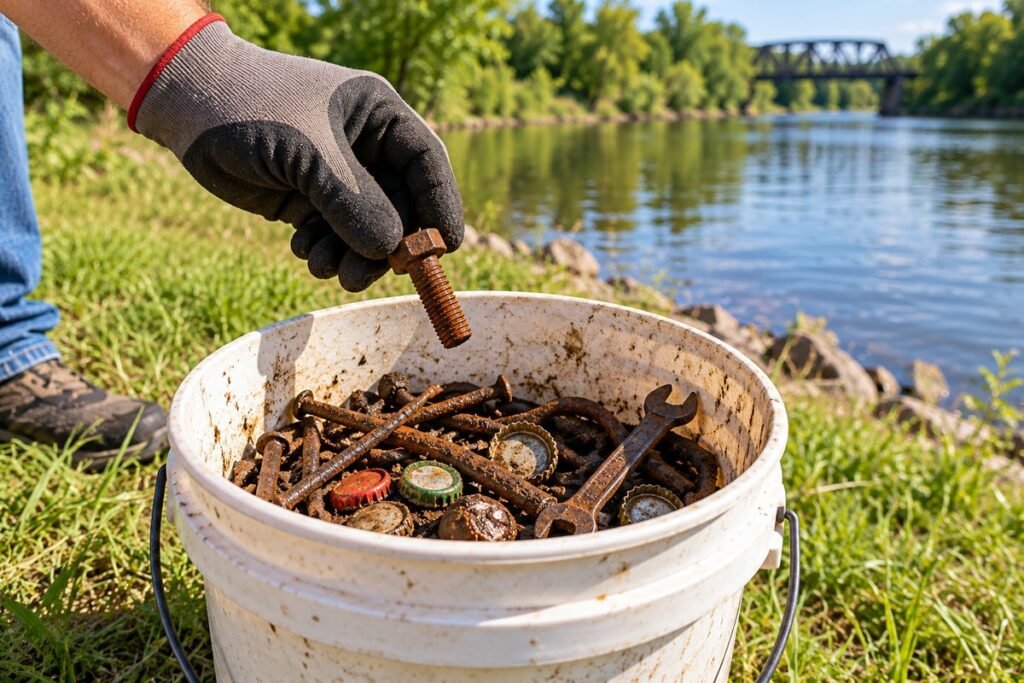
Do not leave scrap on the bank. It can count as littering, and it is one of the main reasons people complain about magnet fishing. Bring a bucket and a trash bag, and carry out everything you pull up.
How to Check the Rules Before You Go
- Find out who owns or manages the bank, bridge or dock you plan to use. A county property map or the park's website usually shows this.
- Search that agency's rules for "magnet fishing" and "metal detecting." Some places group the two together.
- If the rules say nothing, call or email the office and ask. Save the reply.
- Check whether you need a permit. Indiana DNR properties, for example, require one.
- Read the posted signs when you arrive. A sign at the site can be stricter than the website.
- Plan what you will do with trash and dangerous finds before you start.
Gear That Helps You Follow the Rules
The right gear will not make a place legal, but it helps you follow common rules, such as carrying out trash and handling finds safely. If you still need a magnet, our magnet fishing kit guide compares five kits.
1. 1320LB's Complete Magnet Fishing Kit: best complete kit for beginners
The 1320LB's Complete Magnet Fishing Kit pairs a 1,320 lb double-sided neodymium magnet (a very strong type of magnet) with 65 feet of rope, a carabiner (a metal clip), gloves, a grappling hook and a carry case. It suits a first trip to a pond or canal where you already have permission, and it is the top overall pick in our kit guide.

1320LB's Complete Magnet Fishing Kit
- Magnet
- 1,320 lb, double-sided
- Rope
- 65 ft
- Also in the box
- Gloves, carabiner, hook, case
Good for: a first trip to a pond or canal where you already have permission.
Skip if: you already own a magnet and only need gloves or a hook.
Pros
- Everything for a first trip in one box
- Double-sided neodymium magnet
- Carry case included
2. Schwer A7 Cut Resistant Fishing Gloves: best for handling sharp finds
Most finds are rusty and have sharp edges. The Schwer A7 Cut Resistant Fishing Gloves meet the ANSI A7 cut level (ANSI is the American National Standards Institute), near the top of the US cut resistance scale that runs from A1 to A9. Schwer describes this level as protection against medium to heavy cut hazards. A rough rubber coating on the palms helps you grip wet metal, and the pack holds two pairs, so a second person can help sort finds.

Schwer A7 Cut Resistant Fishing Gloves
- Cut level
- ANSI A7
- Palms
- Rough rubber coating
- Pack
- 2 pairs
Good for: handling rusty finds with sharp edges.
Pros
- A7 is near the top of the A1 to A9 cut scale
- Grippy palms for wet metal
- Two pairs, so a helper can sort finds
3. Ant Mag Grappling Hook with 65 Foot Rope: best for bulky trash
A magnet cannot hold everything. The Ant Mag Grappling Hook has four folding stainless steel claws and comes with 65 feet of 8 mm nylon rope, so you can drag bigger items such as bikes to shore and carry them out. Ant Mag notes that the rivets holding the claws are not stainless steel, so rinse and dry the hook after each trip.

Ant Mag Grappling Hook with 65 Foot Rope
- Claws
- 4, folding stainless steel
- Rope
- 65 ft, 8 mm nylon
- Pulls
- Bulky trash like bikes
Good for: dragging bigger items to shore that a magnet cannot hold.
Pros
- Pulls what a magnet cannot
- Claws fold for carrying
- Rope included
Cons
- Claw rivets are not stainless, so rinse and dry it after each trip
4. Loctite Threadlocker Blue 242: best for keeping your magnet attached
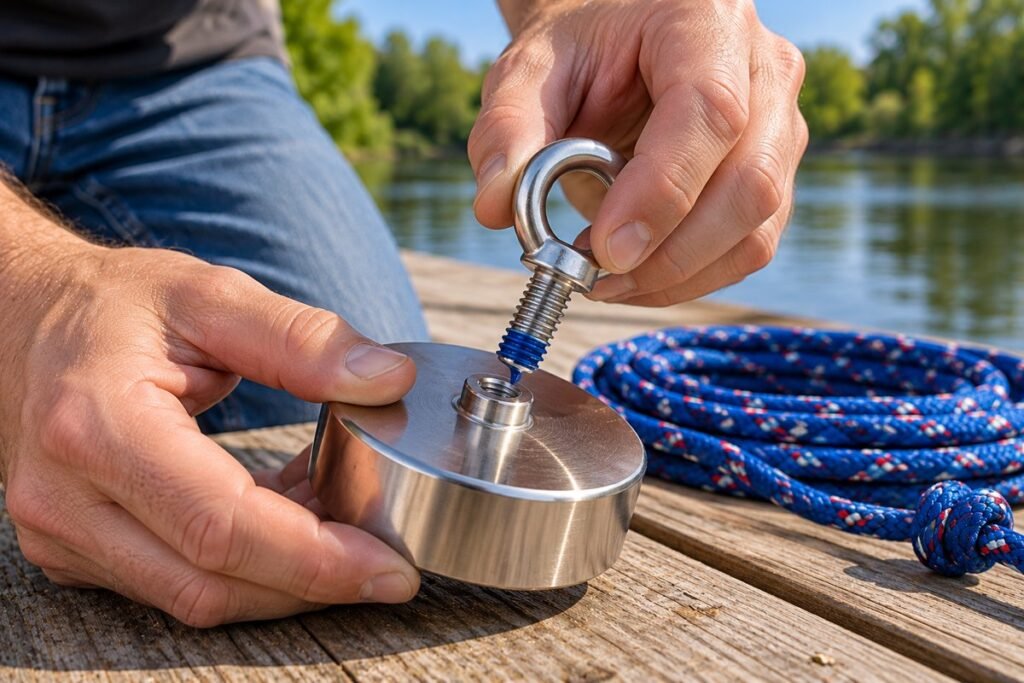
A magnet that unscrews from its eyebolt (the threaded ring the rope ties to) stays on the bottom as one more piece of litter. A drop of Loctite Threadlocker Blue 242 on the eyebolt threads stops it from slowly unscrewing. It is a medium strength glue made for 6 to 19 mm bolts, so you can still unscrew the eyebolt with hand tools later. It sets in 10 minutes and fully cures in 24 hours.
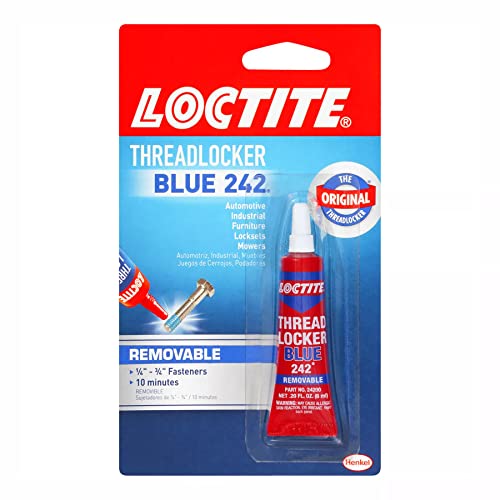
Loctite Threadlocker Blue 242
- Strength
- Medium
- Bolt size
- 6 to 19 mm
- Cure
- Sets in 10 min, full in 24 h
Good for: keeping your magnet's eyebolt from slowly unscrewing and leaving the magnet on the bottom.
Pros
- Stops the eyebolt working loose
- Still comes apart with hand tools
Cons
- Needs 24 hours to fully cure
FAQ
Is magnet fishing legal in every state?
No. South Carolina bans it in state waters, and Oklahoma bans it in state parks. Indiana requires a free permit on DNR properties. Most other states have no law that names it, so the rules of each property apply.
Do you need a permit to go magnet fishing?
Usually not, but some places require one. Indiana DNR properties do, and some parks and lakes ask you to get written permission first. Ask the office that manages the water.
Do you need a fishing license for magnet fishing?
A fishing license covers catching fish. Indiana handles magnet fishing with its own free permit instead. If you are unsure about your state, ask the state wildlife or natural resources agency.
Is magnet fishing allowed in national parks?
Treat national parks as closed to it. Park rules ban metal detecting devices and the removal of cultural or archaeological objects. Ask the park in writing if you want to try.
What should I do if I pull up a gun?
Leave it where it is, keep people away and call local police. Do not clean it, unload it or take it home. It may be evidence, and old ammunition can still be dangerous.
Can I keep what I find?
In most places, scrap and trash are fine to carry out and keep or throw away. Report weapons, explosives and items that may be stolen to police. On federal land, items over 100 years old can be protected by law, so check with the land manager first.
Summary
So, is magnet fishing legal? In many places it is, as long as you have permission to reach the water and you follow the property's rules. South Carolina waters, Oklahoma state parks and national parks are the places to avoid. Indiana DNR properties need a free permit. Everywhere else, ask the office that manages the water, carry out your trash, and call police about anything that looks dangerous.