

A pinpointer metal detector is a small handheld wand that narrows a signal down to the exact spot in the hole, so you're not widening a dig three inches at a time with a shovel. Once your main detector says something is there, the pinpointer tells you precisely where. This guide compares five options by waterproof rating, alert type, and price.
DetectorBrief is a participant in the Amazon Services LLC Associates Program, an affiliate advertising program designed to provide a means for sites to earn advertising fees by advertising and linking to Amazon.com.
Table of Contents
Quick picks for 2026
| Pinpointer | Waterproof | Best For |
|---|---|---|
| Garrett Pro-Pointer AT (see details) | 20 ft submersible | Best overall |
| Minelab PRO-FIND 40 (see details) | Waterproof to 10 ft | Best advanced features |
| Garrett Pro-Pointer II (see details) | IP66, tip only | Best fixed-sensitivity pick |
| Minelab PRO-FIND 15 (see details) | Waterproof to 5 ft | Best simple budget pick |
| SUNPOW OTMD12 (see details) | Waterproof | Best ultra-budget pick |
How to choose a handheld target wand
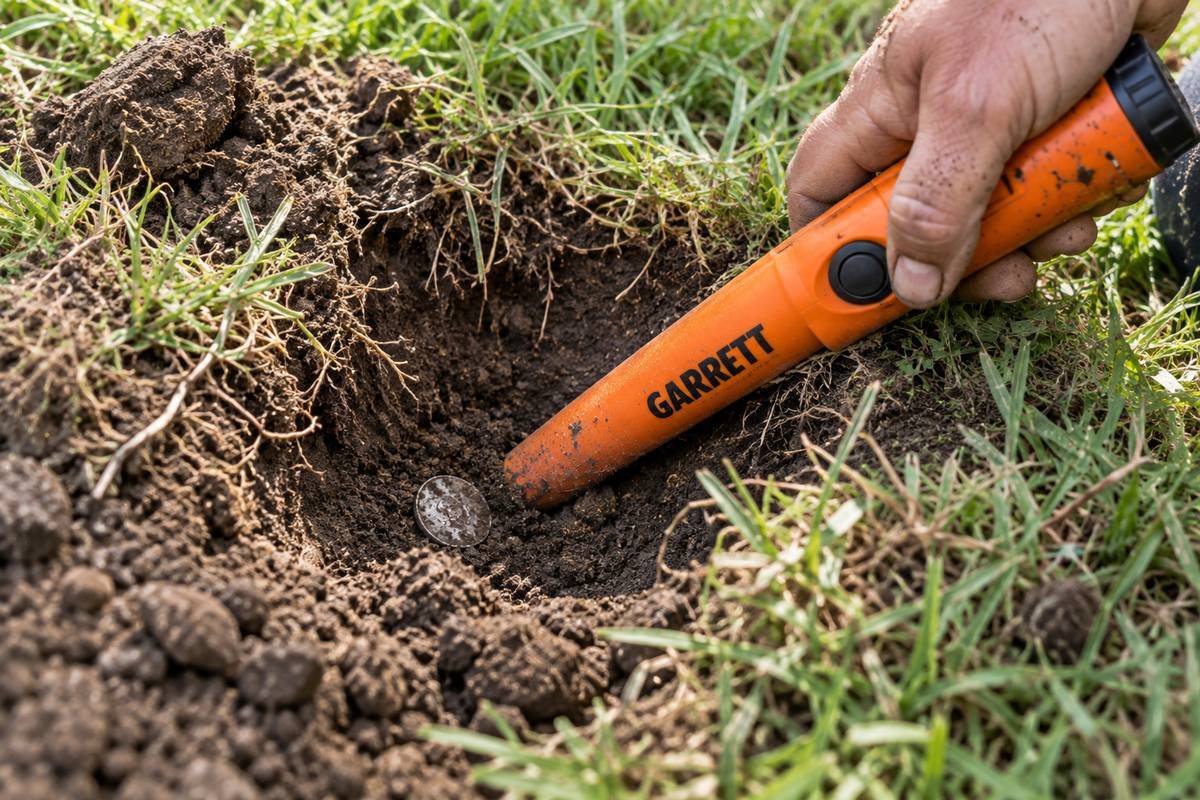
Every pinpointer metal detector on this list will find a coin sitting an inch from the tip. The differences that matter show up in the field: how the unit holds up to a wet dig, how you'll hear or feel it in different conditions, and how quickly you can adjust it once trash starts crowding a hole. If you're still choosing a main detector, our guide to the best metal detector for beginners is a good place to start.
Waterproof rating: IP66 vs. fully submersible
IP66 means a unit can handle rain and a rinse under a tap, but only the tip should go underwater. A fully submersible rating, like the 20 feet on the Pro-Pointer AT, means you can dunk the whole wand in a creek, a tide pool, or a bucket without worrying about it. If you hunt dry parks and yards, IP66 is plenty. If you wade, hunt the beach, or work wet sand, get a fully submersible model.
Audio vs. vibration alerts
An audio alert is faster to react to and easier to judge target strength by, but it's useless if you're already wearing detector headphones. A vibration alert works silently and keeps your hands free to dig at the same time, which helps on a crowded beach or around other hunters. The better units on this list offer both and let you switch between them.
Sensitivity levels and retune speed
Adjustable sensitivity lets you back a pinpointer off when you're working ground full of iron or trash, so it doesn't sound off on everything nearby. A fixed-sensitivity unit like the Pro-Pointer II skips that control, which keeps it simple but means it's a little less precise in cluttered dirt. Fast retune, usually a quick power off and on, saves time once you're digging several targets an hour.
Battery type and runtime
Most pinpointers run on a single 9V or a couple of AAA batteries, and runtime is rarely the deciding factor since even heavy use stretches a battery across several outings. Rechargeable models save money over a season but leave you stuck if you forget to charge one before a trip, so many serious detectorists still carry a spare 9V in their bag regardless of which type they own.
VLF vs. pulse induction pinpointers
Nearly every pinpointer on the market, including all 5 picks here, uses VLF (very low frequency) technology, the same basic principle as a full-size VLF detector shrunk into a handheld wand. A small number of dedicated pulse induction pinpointers exist and hold up better in heavily mineralized (full of natural minerals that can confuse a detector) or hot ground, where a VLF pinpointer can chatter or false-signal. For most detectorists working typical parks, yards, and beaches, that tradeoff isn't worth the extra cost and bulk, which is why VLF dominates this category.
One pulse induction pinpointer you'll see recommended for gold is the Fisher F-Pulse. It has 3 sensitivity levels, vibrate-only or vibrate-and-beep alerts, and it's submersible to 6 feet. After 5 minutes without a button press, it goes into a lost mode and chirps so you can find it. If you prospect in hot, mineralized ground, it's worth a look. For parks, yards, and beaches, a VLF pick from the list below is the better buy.
Our 5 top picks for 2026
1. Garrett Pro-Pointer AT: best overall
The Pro-Pointer AT is the pinpointer most detectorists end up owning. It's submersible to 20 feet, made in the USA, and comes in bright orange so it doesn't disappear in loose dirt or sand. Three sensitivity levels and quick-button adjustment let you tune it down fast in trash-filled ground.
From our own digs: Hunting coins and rings in sand and dirt with a Garrett ACE 300, we use a pinpointer like this one, and it was right on point. We didn't have to overwork the pointer to locate the target in the sand or dirt.

Garrett Pro-Pointer AT
- Waterproof
- 20 ft submersible
- Sensitivity
- 3 adjustable levels
Why we like it: three sensitivity levels, a bright orange body that's hard to lose and a 20 ft waterproof rating cover almost every kind of hunt.
2. Minelab PRO-FIND 40: best advanced features
The PRO-FIND 40 is Minelab's newest pinpointer and the one to get if you already read tones on your main detector. Its Ferrous Tone ID plays a different tone for iron than for other metals, so you can start judging a target before it's out of the hole. Minelab rates it waterproof to 10 feet and says updated circuitry gives it about 10% more depth than the PRO-FIND 35. It has 5 sensitivity levels, vibration feedback, and a built-in LED flashlight, and it runs about 20 hours on a 9V battery.
If you find the older PRO-FIND 35 for less, it has the same tone ID, waterproof rating, and flashlight, with slightly less depth.

Minelab PRO-FIND 40
- Waterproof
- 10 ft
- Extras
- Ferrous Tone ID, 5 sensitivity levels, LED flashlight, vibration
Why we like it: iron gets its own tone, so you can skip a lot of rusty nails before you dig them all the way out.
3. Garrett Pro-Pointer II: best fixed-sensitivity pick
The Pro-Pointer II is Garrett's older, simpler model. It's rated IP66 rather than fully submersible, so only the tip should go underwater, though it handles rain and a rinse under the tap fine. Sensitivity isn't adjustable, which keeps things simple for a detectorist who mostly hunts dry parks and yards and doesn't want another setting to manage.

Garrett Pro-Pointer II
- Waterproof
- IP66, tip only
- Extras
- LED flashlight, lost-pinpointer alarm, 3-year warranty
Why we like it: the lost-pinpointer alarm helps keep it from getting left behind in tall grass, and the fixed sensitivity means one less setting to change during a hunt.
4. Minelab PRO-FIND 15: best simple budget pick
The PRO-FIND 15 strips away the tone ID and extra modes of its bigger sibling and keeps a simple audio alert, waterproofing and a holster, all for a lower price. Minelab rates it waterproof to 5 feet, which covers creeks and wet sand but not deep wading. It's a sensible step up from a budget wand without paying for features a newer detectorist won't use yet.

Minelab PRO-FIND 15
- Waterproof
- 5 ft
- Extras
- holster included
Why we like it: waterproofing to 5 feet at this price, and the simpler feature set means less to learn for someone still getting used to their main detector.
5. SUNPOW OTMD12: best ultra-budget pick
The OTMD12 costs far less than a Garrett or Minelab and won't match them for build quality, but it's waterproof, covers 360 degrees around the tip, and offers two alert modes. It's a reasonable way to see whether you'll use a dedicated pinpointer before spending more on a name brand.

SUNPOW OTMD12
- Waterproof
- yes
- Extras
- 2 alert modes, 360-degree detection
Why we like it: it's a low-risk way to add pinpointing to your kit, and it shows you whether a pinpointer fits how you hunt.
Which pinpointer works with your detector
Any pinpointer works with any metal detector. It's a separate tool with its own battery and its own alert, so you don't need to match brands. Matching only matters if you hunt with wireless headphones and want to hear the pinpointer in the same headphones as your detector. A few brands make wireless versions for that.
- Garrett: the Pro-Pointer AT Z-Lynk is a wireless version of our top pick. It syncs with the Z-Lynk wireless headphones used with the AT MAX and APEX, so its alerts come through the same headphones.
- XP: the MI-6 links to the DEUS, DEUS II, ORX and ICON detectors. You can change its sensitivity from the detector's remote, and the detector can help you find a lost MI-6 even when it's switched off. XP rates it waterproof to 6 meters, about 20 feet.
- Nokta: the AccuPOINT sends audio over Bluetooth to Nokta's headphones or other low-latency Bluetooth headphones. It's rated IP68 and waterproof to 10 feet, has separate tones for iron and other metals, and charges over USB-C instead of taking a 9V.
- Minelab: the PRO-FIND 40 doesn't link to a detector or headphones. It works on its own like the rest of our picks.
If you don't use wireless headphones, skip the wireless versions and choose on waterproof rating and alert type instead.
Extra gear that pairs well with a pinpointer
- Belt holster: most models ship with one, but check before buying if you want hands-free carry.
- Hand digger or trowel: a pinpointer narrows the spot, but you still need a tool to open the hole.
- Finds pouch: keeps recovered items secure while you keep both hands working.
- Spare 9V battery: so a dead battery doesn't end a hunt early.
- Tip protector: a small rubber cap that guards the sensing tip between trips.
How to use a pinpointer
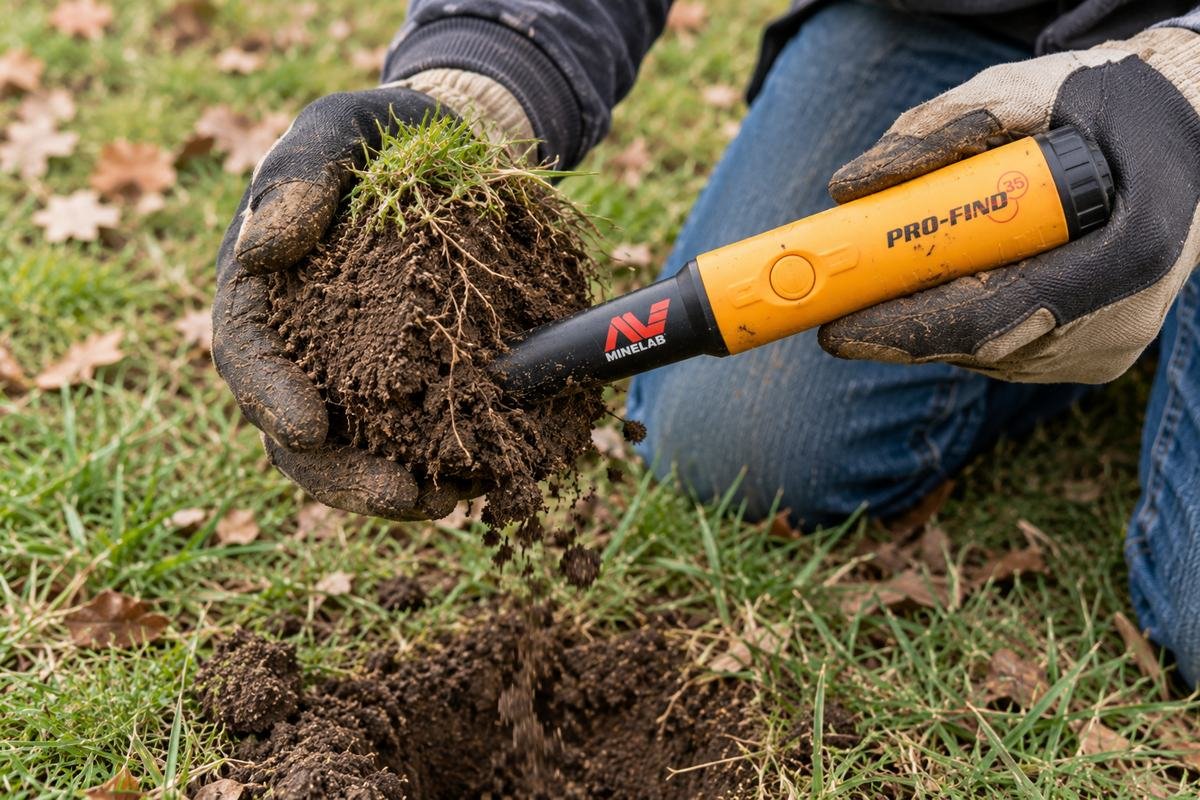
Getting the most out of a pinpointer is mostly about technique, not which model you buy.
- Get a general signal from your main detector first. Narrow the area down to roughly a foot before you start digging, rather than digging blind.
- Dig a small plug and check it with the pinpointer, not your hands. Sweep the pinpointer slowly over the hole and the removed dirt in overlapping passes.
- Check the plug and the hole separately. A target can be in either one, so scan the hole itself, then the pile of dirt beside it.
- Retune between digs. Most pinpointers auto-retune with a quick button press when they start chattering from ground mineralization. Get in the habit of doing this before every new signal.
- Use the tip, not the side, for the tightest read. The very tip of the probe gives the most precise location. A strong signal from the tip usually means the target is within an inch of where it is pointing.
Common pinpointer mistakes
- Scanning with a ring on or a steel digger near the tip. The pinpointer can't tell your tool from the target. Keep metal tools and jewelry away from the tip while you scan.
- Not retuning in wet or mineralized ground. If it sounds off on bare dirt, point the tip away from the hole, retune, and scan again.
- Losing it. A pinpointer is easy to set down in the grass and walk away from. Use the holster or a lanyard, pick a bright color, and turn on the lost alarm if yours has one.
- Prying with the tip. The tip is for sensing, not for levering out rocks. Use your digger for that.
- Dunking a unit that isn't rated for it. Check the rating before you take it into a creek. A weather-resistant model like the Pro-Pointer II isn't meant to go all the way under.
Care and storage
A pinpointer needs very little care, but a few habits keep it working for years.
- Rinse it in fresh water after a beach or saltwater hunt, then let it dry before storing it.
- Check the battery cap and seal before taking a waterproof model underwater. A loose cap or grit on the seal can let water in.
- Take the battery out if it'll sit unused for a few weeks, so a leaking battery can't corrode the contacts.
- Keep a tip protector on it in your bag.
Buying a used pinpointer
Pinpointers are simple tools, so a used one can be a good deal. Before you buy, open the battery cap and look for corrosion, check the seal, and test it on a coin to make sure it alerts and retunes. Our guide to buying used metal detectors covers what else to check.
FAQ
Do I need a pinpointer?
You can detect without one, but a pinpointer cuts recovery time down significantly, especially in ground full of trash or rock where a signal can shift once you start digging. Most detectorists consider it the first accessory worth buying after the detector itself.
Can I use a pinpointer underwater?
Only if it's rated for full submersion. A fully waterproof model like the Pro-Pointer AT or a PRO-FIND unit can go into a creek or the surf. An IP66 model like the Pro-Pointer II should only have its tip submerged, not the whole housing.
Does sensitivity matter if I'm a beginner?
Not much at first. A fixed-sensitivity model is simpler to learn on. Adjustable sensitivity becomes more useful once you're hunting iron-heavy sites and need to tune out clutter that would otherwise trigger the pinpointer constantly.
What's the difference between a pinpointer metal detector and my main detector?
Your main detector sweeps a wide area and tells you a target is somewhere nearby. A pinpointer is a short-range handheld wand you use after you've started digging to narrow that signal down to an exact spot in the hole.
What's the difference between VLF and pulse induction pinpointers?
Nearly every pinpointer on the market, including all 5 picks above, is VLF and works the same way a VLF detector does on a smaller scale. Pulse induction pinpointers are rarer and hold up better in hot, mineralized ground, but most detectorists never need one outside serious gold prospecting.
How do I use a pinpointer once I start digging?
Dig a small plug, then sweep the pinpointer slowly over both the hole and the loose dirt pile rather than just one or the other. Use the tip for the most precise read, and retune the pinpointer between digs if it starts chattering from ground mineralization.
Do pinpointers work with any metal detector?
Yes. A pinpointer runs on its own battery and gives its own alert, so any brand works with any detector. Brand matching only matters for wireless models that send alerts to your detector's headphones.
Why does my pinpointer keep beeping?
It usually needs a retune. Wet or mineralized ground, a metal tool nearby, or a weak battery can all set it off. Point the tip away from the ground, retune, and scan again. If it still chatters, try a fresh battery.
Summary
For most detectorists, the Garrett Pro-Pointer AT is worth the extra cost over a budget wand, since it's fully waterproof and built to last years of regular digging. If you want tone ID and don't mind a smaller user base, the Minelab PRO-FIND 40 is right behind it. And if you're not sure you'll stick with the hobby yet, the SUNPOW OTMD12 lets you try pinpointing for very little money.